


When a spacecraft re-enters the atmosphere or a rocket nozzle roars through a burn, the materials at the sharp end are glowing at temperatures that would melt most metals. Engineers designing for those conditions need to know a deceptively simple quantity: how much heat does the surface actually radiate away? That property, emissivity, determines whether a heat shield cools itself efficiently or quietly cooks from within. Measuring it is hard enough in open air; measuring it under the high-vacuum conditions of space, at temperatures above a thousand degrees, has long been a stubborn gap in thermal metrology. A team of Chinese researchers now reports a system that closes that gap by making the sample itself do the heating.
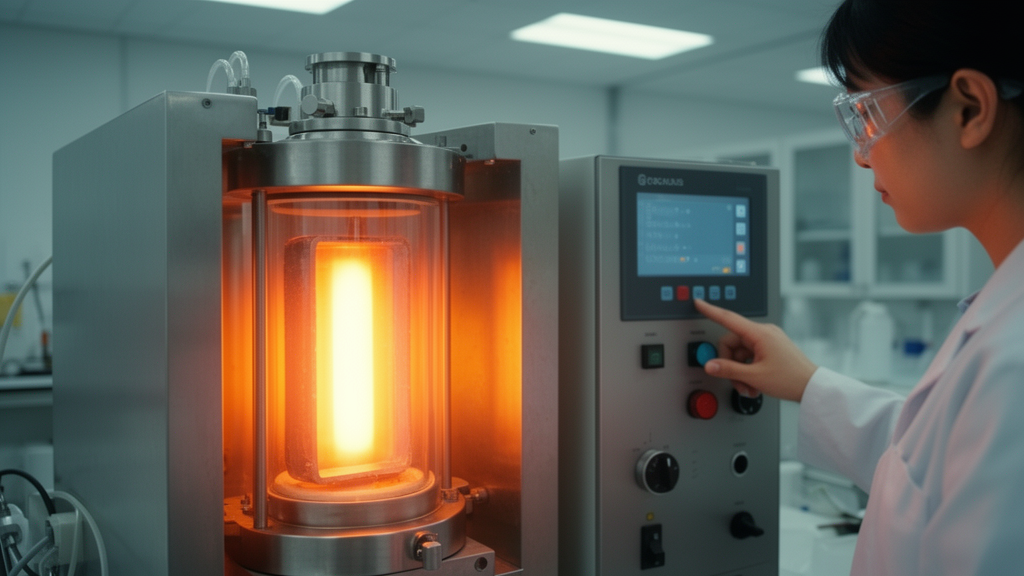
The new instrument, described in Frontiers in Thermal Engineering, is a vacuum-compatible infrared radiation measurement system built around direct electric heating. Instead of surrounding a specimen with an external furnace, the researchers clamp both ends of an electrically conductive sample between hollow, water-cooled brass electrodes and drive a large current through it. The sample becomes its own Joule-heating element, eliminating the heat-transfer delays, background radiation, and structural complexity introduced by separate heaters. The device can take conductive refractory materials from 500 degrees Celsius to more than 3,000 degrees Celsius with a temperature control accuracy of plus or minus 5 degrees, all while an infrared spectrometer watches the glowing surface in real time through an optical window.
The team, led by Dongyang An of Beijing Xinghang Mechanical-Electrical Equipment Co., Ltd. in collaboration with researchers at the Harbin Institute of Technology, first weighed two competing heating concepts. In the conductive thermoelectric arrangement, a tubular graphite heater creates a uniform isothermal zone in which the sample sits, heated both by conduction and radiation. That design heats evenly, but its longer thermal path and more elaborate structure make optical access awkward. The directly clamped configuration wins on simplicity and speed: the sample is the heater, the response is nearly instantaneous, and the surface is directly visible to the measurement optics. That rapid response matters, because aerospace components rarely sit at a steady temperature; they endure thermal cycling, and a device that can heat and cool quickly can mimic those conditions in the laboratory.
Measuring emissivity is where the design gets clever. The gold standard reference in radiometry is a blackbody, an idealized surface that emits the maximum possible radiation at every wavelength. Real materials always emit less, and the ratio of their emission to that of a perfect blackbody at the same temperature is the emissivity. Rather than pairing each specimen with a separate, externally heated reference blackbody, the researchers build the reference into the sample itself. Each specimen starts as a flat metal sheet about 50 by 25 by 2 millimeters, into which a small notch is laser-cut. The sheet is then roll-formed into a cylinder and laser-welded along its seam, so that the notch becomes a small aperture opening into a hollow cavity.
That cavity, thanks to multiple internal reflections of radiation within its walls, behaves very nearly like a blackbody at the same temperature as the surrounding material. Because the sample is only about 2 millimeters thick, the temperature difference between its front and back surfaces is negligible. A Fourier Transform Infrared spectrometer then measures the spectral radiance of both the outer surface and the cavity through the same optical window, under identical thermal and vacuum conditions. Emissivity at each wavelength is simply the ratio of the two radiances. Because the method relies on comparing two simultaneous measurements rather than on absolute radiance values, many calibration errors and background corrections largely cancel out, and the approach follows the well-established radiance-comparison principle used by high-temperature metrology laboratories.
The vacuum environment is handled by a two-stage pumping train. A mechanical backing pump first reduces the chamber pressure, then a molecular pump takes over to reach approximately 10 to the minus 3 pascals without baking the chamber, and down to 10 to the minus 5 pascals with baking. The oil-free arrangement avoids contaminating sensitive specimens. Pressure is monitored across the whole range by a dual-gauge setup: a resistance gauge from atmospheric pressure down to 10 to the minus 1 pascal, and an ionization gauge from there down to 10 to the minus 8 pascals. An optical fiber pyrometer tracks the sample temperature while the FTIR instrument records spectra, and a control cabinet automates heating, pumping, and data acquisition, with both manual and fully automated operation available.
To validate the system, the researchers measured the spectral emissivity of three classic refractory metals: molybdenum, tungsten, and tantalum. These metals, mainstays of rocket nozzles, heat shields, vacuum furnaces, and propulsion hardware, combine extreme melting points with the electrical conductivity that the direct Joule-heating scheme requires. Tests were run at 800, 1,000, and 1,200 degrees Celsius on unpolished, as-fabricated specimens, deliberately reflecting realistic service conditions. Each measurement was repeated three times, with the standard deviation of the emissivity values staying below 2 percent across the spectral range, and the system was cross-checked by comparing the measured emissivity of oxidized molybdenum against published literature values with good agreement.
The results reveal rich, non-gray behavior. All three metals show emissivity that falls relatively steeply in the short-wavelength infrared between roughly 2 and 5 micrometers, then varies more gradually beyond about 6 micrometers. Emissivity also rises with temperature across most of the measured range. At a wavelength of 10 micrometers, molybdenum’s emissivity climbs from 0.191 at 800 degrees to 0.247 at 1,200 degrees; tungsten rises from 0.094 to 0.142; and tantalum from 0.152 to 0.228. In the long-wavelength atmospheric window of 8 to 14 micrometers, molybdenum generally emits the most, tungsten the least, and tantalum falls in between, with the differences growing more pronounced as temperature increases. For engineers modeling radiative heat loss from a glowing nozzle or a thermal protection panel, these distinctions translate directly into different predicted surface temperatures and lifetimes.
The team was careful to quantify how much the numbers can be trusted. At 10 micrometers, they combined random error sources, such as the stability of surface and cavity temperature readings and of the spectral measurement, with systematic contributions including background radiation reflected from the sample surface, spectral noise, the effective emissivity of the cavity reference, and detector nonlinearity. The combined standard uncertainty came out at about 0.0097 to 0.0099, and with a coverage factor of two the expanded uncertainty is roughly 0.019 to 0.020, meaning radiative measurements good to better than 2 percent. Notably, the largest single contributor at all three temperatures was the effective emissivity of the blackbody cavity itself, with reflected background radiation significant at lower temperatures and surface temperature measurement growing more important as heat rises. Local sharp peaks in some spectra were traced to the measurement chain, including residual atmospheric absorption and window transmission effects, rather than to the materials, and were excluded from the temperature-dependence analysis.
The authors are candid that this initial study validates the platform rather than delivering a complete emissivity database: three unpolished metals, three temperature levels, and one representative uncertainty wavelength. Future work will extend the measurements to higher temperatures, additional refractory materials and silicide coatings, varied surface finishes, and comparisons with certified reference data. Even so, the integration of direct Joule heating, a sample-integrated blackbody reference, and in-situ FTIR spectroscopy within a single vacuum chamber offers something the field has lacked: a fast, clean, broadband way to characterize how the hottest materials in aerospace, laser processing, and optics actually shed their heat in the environments where they must survive.
Subject of Research: Vacuum-compatible infrared emissivity measurement of high-temperature refractory materials using direct electric heating and FTIR spectroscopy
Article Title: Vacuum-compatible infrared emissivity characterization of high-temperature materials using direct electric heating
Article References: An, D., Cheng, S., Liu, Z., Cheng, S., Chen, J., Tang, Z., Dai, J., & Xiao, P. (2026). Vacuum-compatible infrared emissivity characterization of high-temperature materials using direct electric heating. Frontiers in Thermal Engineering, 6, Article 1922432. https://doi.org/10.3389/fther.2026.1922432
Image Credits: AI Generated
DOI: 10.3389/fther.2026.1922432
Keywords: emissivity, refractory metals, vacuum furnace, direct electric heating, FTIR spectroscopy, blackbody reference, thermal protection, aerospace materials, molybdenum, tungsten, tantalum, radiometry
Cite Scienmag News
Denise Maddox. (October 16, 2026). New Vacuum Furnace Turns Metal Samples Into Their Own Heaters to Measure Emissivity Past 3,000 Degrees. Scienmag. https://scienmag.com/new-vacuum-furnace-turns-metal-samples-into-their-own-heaters-to-measure-emissivity-past-3000-degrees/
Denise Maddox. "New Vacuum Furnace Turns Metal Samples Into Their Own Heaters to Measure Emissivity Past 3,000 Degrees." Scienmag, 16 October 2026, https://scienmag.com/new-vacuum-furnace-turns-metal-samples-into-their-own-heaters-to-measure-emissivity-past-3000-degrees/. Accessed 16 October 2026.
Denise Maddox. "New Vacuum Furnace Turns Metal Samples Into Their Own Heaters to Measure Emissivity Past 3,000 Degrees." Scienmag. October 16, 2026. https://scienmag.com/new-vacuum-furnace-turns-metal-samples-into-their-own-heaters-to-measure-emissivity-past-3000-degrees/


