


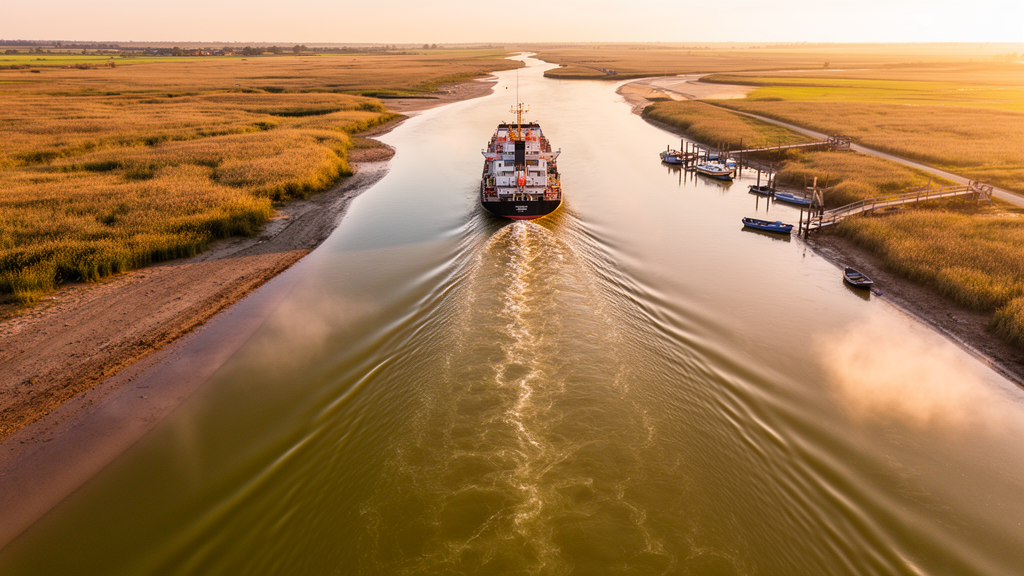
Every day, thousands of cargo vessels glide through canals, estuaries, and tidal rivers, carrying the bulk of global trade with remarkable efficiency. Between 1990 and 2021, the volume of goods transported by sea more than doubled, rising from roughly 4 to nearly 11 billion tonnes. Waterborne transport remains several times more energy efficient than road or rail, making it a cornerstone of decarbonisation strategies worldwide. Yet beneath the calm wake trailing a ship lies a quieter and less visible disturbance: a slow, powerful depression of the water surface known as drawdown. A new review published in Estuarine Management and Technologies synthesises decades of research on this phenomenon, revealing how ship-induced drawdown in shallow and confined waterways drives sediment resuspension, shoreline erosion, habitat degradation, and even risks to human safety.
Drawdown is part of the primary wave system that every moving vessel generates. As a ship advances, it redistributes water from bow to stern, creating a return current that flows opposite to the direction of travel. According to Bernoulli’s principle, the accelerated flow along the hull sides lowers the local pressure, while stagnation points near the bow and stern raise the water level. The result is a bowl-shaped depression of the free surface along both sides of the ship, flanked by raised water at the front and back. In deep, open water this effect dissipates harmlessly. In shallow, confined channels, however, lateral boundaries prevent wave energy from spreading outward, concentrating it instead and allowing drawdown waves to travel remarkable distances from the vessel itself.
The physics of this confinement can be quantified. Researchers characterise it using the blockage ratio, defined as the cross-sectional area of the vessel divided by that of the channel, together with the depth Froude number, which compares vessel speed with shallow-water wave speed. These two parameters classify navigation into subcritical, transcritical, and supercritical regimes. In the transcritical regime, hydrodynamic instabilities arise because water cannot pass steadily through the narrow gaps between hull and channel walls. Although ships operating in the supercritical regime may experience reduced resistance and improved fuel efficiency, most cargo and container vessels cannot sustain such operation because the nonlinear rise in resistance demands impractical amounts of power. The practical consequence is that most large vessels operate in conditions where drawdown effects are amplified rather than avoided.
The environmental consequences begin at the bed. Sediment resuspension occurs when the bed shear stress induced by drawdown currents exceeds the critical shear stress required to set particles in motion, a threshold describable by the classical Shields equation with critical values for non-cohesive sediments typically ranging from 0.02 to 0.08 depending on grain size, particle exposure, and channel geometry. Critical shear stresses reported for inland waterways span from 0.001 to 2 pascals, yet field measurements in China’s Grand Canal recorded ship-induced bed shear stresses of approximately 4 to over 8 pascals, far exceeding the mobilisation threshold. In Hillsborough Bay, Florida, sediment resuspension from long-period primary ship waves proved greater in magnitude than that caused by wind waves. In Sweden’s Göta Älv River, maximum turbidity levels were controlled primarily by drawdown magnitude and could be predicted from parameterised bed shear stress, while shorter secondary waves played a comparatively minor role.
Sustained turbidity has direct biological consequences. Aquatic plants such as charophytes and widgeon grass depend on clear water and are acutely sensitive to light reduction caused by suspended sediment. Ship-generated waves differ fundamentally from wind waves in their capacity to sharply enhance local current velocities and impose abrupt hydraulic loadings, giving them a distinctive capacity to disturb nearshore ecosystems. Beyond shading out vegetation, repeated disturbance of the bed triggers nutrient release and biochemical change: porewater pumping driven by passing ships can elevate ammonia levels in the water column, potentially promoting eutrophication and degrading seagrass habitats. Evidence from sediment cores along the Zhejiang coast shows that biogenic element ratios used as proxies for biological productivity declined under intensive shipping, suggesting reduced phytoplankton primary productivity in heavily trafficked waters.
Physical damage to plants and animals compounds these chemical effects. On the River Nile, ship waves have been reported to wash out floating plants, uproot lightly anchored species, and tear more firmly rooted vegetation through drag forces. Young fish are especially vulnerable. Research on shovelnose sturgeon showed that drawdown can strand juveniles on dry bank slopes, where return currents wash them ashore before the water level recedes. Systematic experiments demonstrated that a vessel travelling at just 12 kilometres per hour can generate near-bed shear stresses of up to 1 pascal via waves alone, enough to detach as much as 45 percent of littoral benthic invertebrates, with cascading effects on predator-prey interactions and food web structure. Recent field monitoring near a gravel bar upstream of Vienna compared near-bed turbulence during natural flow and ship passages over nearly a year of measurements, adding quantitative weight to concerns about benthic habitat disturbance.
The geomorphological record provides perhaps the starkest evidence of drawdown’s power. In the Port of Marghera, Italy, drawdown generated by large vessels reaches amplitudes of up to 2.45 metres, mobilising enormous sediment volumes and driving coastline retreat of up to 4 metres per year. Geographic Information System analysis along the Malamocco-Marghera channel documents cumulative shoreline retreat of 133 metres between 1974 and 2015, with individual years showing average retreat rates exceeding 7 metres. In the Savannah River, Georgia, long-term shoreline retreat along the main shipping channel reaches approximately 1.39 metres per year. Conditions are even more severe in Vietnam’s Cho Gao Canal, where traffic exceeding 1,500 vessels per day has produced 2 to 3 metres of bank loss along both sides, with the worst sections collapsing at roughly 4 metres annually.
Human safety is also at stake. Surveys of lakes in Ontario found that swimmers are frequently destabilised by waves from passing vessels. In a tragic case reported in the Port of Rotterdam, a steep wave generated by a passing container vessel swept anglers from the shoreline into the water, with fatal results. Rapid water level depressions followed by surges create precisely the conditions that catch recreational users unprepared, making drawdown a public safety concern alongside its environmental role.
Mitigation strategies exist, but each carries trade-offs. Speed and traffic regulations are the most direct tools, since primary wave magnitude correlates strongly with vessel speed and blockage ratio, yet slower transits raise freight costs and reduce the efficiency that makes shipping attractive in the first place. Hardened infrastructure such as groins and breakwaters can protect shorelines, though field measurements show these structures themselves suffer damage from ship-wave loads. Vertical dissipative revetments reduced primary wave heights by roughly 20 to 25 percent in one study, but the altered wave fluctuations they create may compromise navigation safety. Nature-based alternatives are increasingly attractive: a hybrid shoreline protection combining a stone sill with vegetation effectively damped both primary and secondary ship waves over two and a half years of monitoring, and mangrove rehabilitation in Thailand reduced erosion along exposed shorelines, though plant survival depended strongly on local wave exposure and appropriate species selection.
With inland shipping projected to grow significantly worldwide, the review’s authors argue that speed restrictions alone cannot solve the problem. They call for standardised monitoring frameworks, long-term field measurements combined with high-resolution hydro-ecological modelling, and threshold-based regulations anchored in physical indicators such as drawdown magnitude and bed shear stress. They also highlight two provocative frontiers: the interaction between ship-induced disturbances and climate change, which may determine ecosystem resilience under future conditions, and the speculative possibility of harvesting energy from ship-generated hydrodynamics, converting an environmental liability into a supplementary renewable resource. What is certain is that the humble drawdown wave, long overshadowed by visible wake spray, deserves a central place in the management of the world’s increasingly busy shallow waterways.
Subject of Research: Environmental impacts of ship-induced drawdown waves in shallow and confined waterways
Article Title: Environmental consequences of ship-induced drawdown in shallow waterways
Article References: Kang, N., Terziev, M., & Incecik, A. (2026). Environmental consequences of ship-induced drawdown in shallow waterways. Estuarine Management and Technologies, 3, 123-134. https://doi.org/10.3897/emt.3.188082
Image Credits: AI Generated
DOI: 10.3897/emt.3.188082
Keywords: ship-induced drawdown, sediment resuspension, shoreline erosion, inland waterways, ship-generated waves, turbidity, aquatic ecosystems, bank stability, mitigation strategies, hydrodynamics, estuary management, navigation
Cite Scienmag News
Denise Maddox. (October 15, 2026). The Hidden Wave: How Passing Ships Are Quietly Reshaping Shallow Waterways. Scienmag. https://scienmag.com/the-hidden-wave-how-passing-ships-are-quietly-reshaping-shallow-waterways/
Denise Maddox. "The Hidden Wave: How Passing Ships Are Quietly Reshaping Shallow Waterways." Scienmag, 15 October 2026, https://scienmag.com/the-hidden-wave-how-passing-ships-are-quietly-reshaping-shallow-waterways/. Accessed 15 October 2026.
Denise Maddox. "The Hidden Wave: How Passing Ships Are Quietly Reshaping Shallow Waterways." Scienmag. October 15, 2026. https://scienmag.com/the-hidden-wave-how-passing-ships-are-quietly-reshaping-shallow-waterways/


