


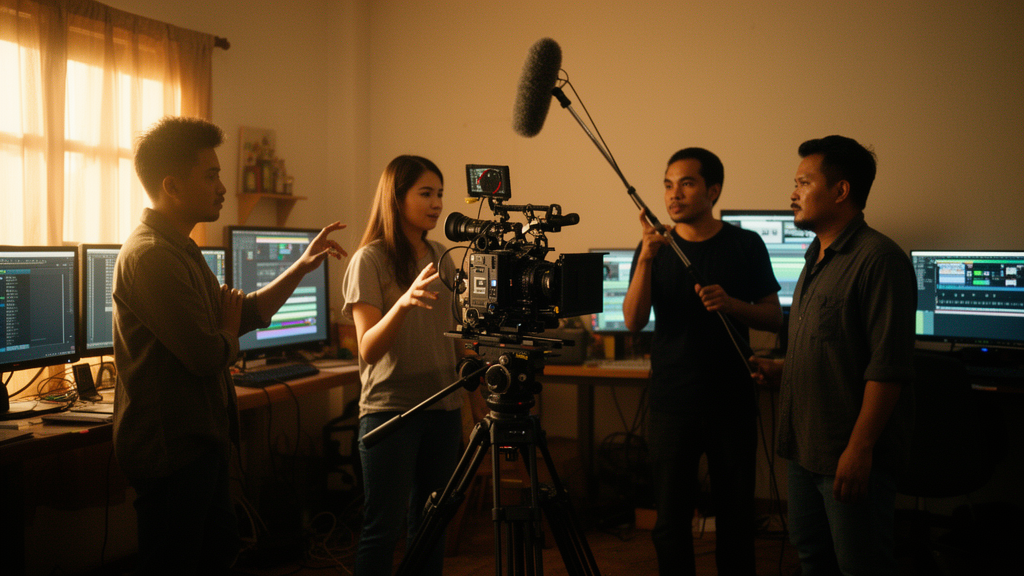
When a Thai horror film or a Thai-Singaporean television drama lands on a global streaming service, who actually controls what the story says? A new study from Thailand argues that the answer is far more layered than the familiar narrative of platform dominance suggests. Published in Frontiers in Sociology, the research introduces a framework called the Access-Representation Nexus, which shows that screen producers in Thailand, the Philippines, and Australia routinely trade away economic, territorial, and contractual rights while deliberately protecting the culturally significant parts of their work: narrative voice, final decision-making authority, and the meanings at the heart of the story.
The study, conducted by Apinya Anphanlam of Mahasarakham University, rests on eighteen months of fieldwork. The researcher interviewed ten experienced industry informants drawn from independent producers and directors, commercial studio executives, cross-border legal specialists, post-production supervisors, and government media-policy actors across three countries. Each participant had at least eight to ten years of professional experience and direct involvement in international production, co-production, transnational financing, or engagement with global subscription streaming services. Participants were anonymized with codes from KI-01 to KI-10, and recruitment continued until the thirty-fourth and final analytical code had been established by the eighth interview, with subsequent interviews only consolidating the framework rather than adding new themes.
Methodologically, the study combined the interviews with a comparative analysis of two cross-border productions: TWIN, a Thailand-Singapore commercial television co-production, and The Medium, a Thailand-South Korea feature film collaboration. The interview protocol was built around four modules covering platform and field re-intermediation, access architecture, representation control, and negotiation strategies. Because many participants were bound by commercial non-disclosure agreements, the researcher used critical-incident and scenario-based questioning to elicit accounts of the financial, contractual, and creative trade-offs made during pitching, financing, production, localization, and final editing, without requesting confidential contractual documents.
The analytical framework draws on critical political economy, Pierre Bourdieu’s field theory, and Homi Bhabha’s concept of the Third Space. It separates two dimensions that are often conflated. Access architecture refers to the financial, legal, institutional, territorial, and distribution arrangements through which a production obtains resources and pathways to markets, including financing terms, intellectual-property allocation, exclusivity, territorial licensing, and public incentives. Representation control refers to the differentiated forms of authority through which producers retain, share, or concede control over narrative voice, casting, adaptation, localization, and culturally significant meanings. The central insight is that these two dimensions are analytically distinct but interdependent: gaining access may require concessions in some domains of authority, while cultural knowledge and professional legitimacy can strengthen a producer’s hand in others.
Across the interviews, a recurrent negotiate-adapt dynamic emerged, built on three interlocking practices. The first is rights architecture as a site of negotiated control. A senior official at the Thai studio GDH described a foundational negotiating priority in stark terms: if a project originates from GDH, the company cannot relinquish ownership of the intellectual property and the Thai distribution rights. In TWIN, rights were segmented by region, with the Thai partner retaining the Thai market, Singaporean partners handling Singapore and Chinese-speaking territories, and profits from the rest of the world divided after expenses. Independent producers described alternative arrangements in which intellectual-property participation was linked to investment shares while final creative or editing control remained with the creative team, demonstrating that economic ownership and creative authority can be separated rather than inherently linked.
The second practice is what the researcher terms manufactured cultural proximity: the deliberate cultivation and mobilization of existing cultural and relational affinities as productive capital. Producers described researching cultural similarities during scriptwriting, drawing on regional genre knowledge, and leveraging long-standing professional relationships. A GDH participant observed, as a market assessment rather than audience research, that Indonesia is especially receptive to horror rooted in cultural or spiritual themes, while Vietnam is a significant market for comedy and romantic comedy. Several participants framed hyperlocal storytelling as a source of distinction rather than an obstacle, with the TWIN showrunner articulating a hyperlocal-to-global logic and noting international platforms’ interest in locally unique material that diverges from conventional American or Korean productions. The study is careful to note that these resources were perceived by participants to be consequential; demonstrating their causal effect on bargaining outcomes would require access to contracts or partner-side interviews.
The third practice is selective narrative adaptation under transnational legibility. Participants consistently distinguished between elements they considered open to modification, such as casting, protagonist characteristics, production style, and market positioning, and elements they regarded as culturally or creatively immutable, including narrative voice, culturally significant meanings, and final decision-making power. One Philippine producer reported preferring to seek alternative financing rather than fundamentally alter the cultural essence of a local story to satisfy a potential financial partner, a boundary case that illustrates the possible economic cost of upholding representational principles. Adaptation, in this account, is not capitulation; what matters analytically is who authorizes the change, which elements are altered, and which domains of authority remain protected.
The two comparative cases illustrate contrasting configurations of the nexus. In The Medium, collaboration with a South Korean partner, initiated by the Korean side, expanded regional production and distribution opportunities while the Thai team led script development, incorporated the partner’s feedback, and took principal responsibility for production, with strong Thai intellectual-property ownership and domestic distribution rights treated as strategic resources rather than inevitable concessions. In TWIN, the showrunner reported settling creative authority early, before production, retaining final say over major screenplay, casting, and production decisions even as the protagonist was modified, casting was internationally coordinated, and themes were shaped to travel across markets. In both configurations, transnational interdependence coexisted with locally retained creative authority, suggesting that economic dependence does not automatically translate into a loss of representational control.
Perhaps the study’s most consequential finding concerns what it does not attribute to platforms. The governance mechanisms identified, including rights allocation, territorial licensing, financing conditions, distribution arrangements, and creative-authority settlements, are not specific to digital platforms. They predate streaming and operate equally through broadcasters, studios, financiers, co-production treaties, and public funding institutions. Platformization is therefore understood as a structural context that may intensify or reconfigure existing production-governance relationships, for instance by expanding acquisition pathways and altering the strategic value of territorial rights, rather than as the origin of those mechanisms. This distinction matters because platform influence cannot be inferred automatically from the mere presence of financing agreements or licensing negotiations.
The study also acknowledges its limits. Ten informants cannot represent the diversity of Asia-Pacific production systems, and major centers such as South Korea, Japan, China, and India were not directly sampled. Reliance on retrospective professional accounts, constrained by confidentiality, means that platform-internal processes, proprietary algorithms, and audience reception remain outside the evidentiary reach of the design. Still, the framework makes testable propositions: that access conditions and representational authority are co-negotiated within shared governance arrangements; that this produces a gradient of positions from service arrangements to full ownership configurations; and that the instruments protecting creative authority, such as pre-agreed final cut or funding-source selection, can vary independently of economic ownership. Within these bounded terms, the picture that emerges is neither heroic autonomy nor passive subordination. Cultural agency, the study concludes, is relational, negotiated, and structurally conditioned, and the governance of global screen culture turns on precisely which aspects of cultural expression remain protected as stories cross borders.
Subject of Research: How Asia-Pacific screen producers negotiate market access and cultural representation in transnational platform-era production governance
Article Title: Negotiating cultural voice in the platform era: the access–representation nexus in Asia-Pacific screen production
Article References: Anphanlam, A. (2026). Negotiating cultural voice in the platform era: the access–representation nexus in Asia-Pacific screen production. Frontiers in Sociology, 11, Article 1987870. https://doi.org/10.3389/fsoc.2026.1987870
Image Credits: AI Generated
DOI: 10.3389/fsoc.2026.1987870
Keywords: platformization, transnational co-production, cultural representation, Asia-Pacific screen production, streaming platforms, producer agency, access-representation nexus, intellectual property, territorial licensing, SVoD, cultural proximity, production governance
Cite Scienmag News
Courtney Benton. (October 15, 2026). Streaming Deals Don’t Have to Silence Local Voices, Asia-Pacific Producers Show. Scienmag. https://scienmag.com/streaming-deals-dont-have-to-silence-local-voices-asia-pacific-producers-show/
Courtney Benton. "Streaming Deals Don’t Have to Silence Local Voices, Asia-Pacific Producers Show." Scienmag, 15 October 2026, https://scienmag.com/streaming-deals-dont-have-to-silence-local-voices-asia-pacific-producers-show/. Accessed 15 October 2026.
Courtney Benton. "Streaming Deals Don’t Have to Silence Local Voices, Asia-Pacific Producers Show." Scienmag. October 15, 2026. https://scienmag.com/streaming-deals-dont-have-to-silence-local-voices-asia-pacific-producers-show/


