


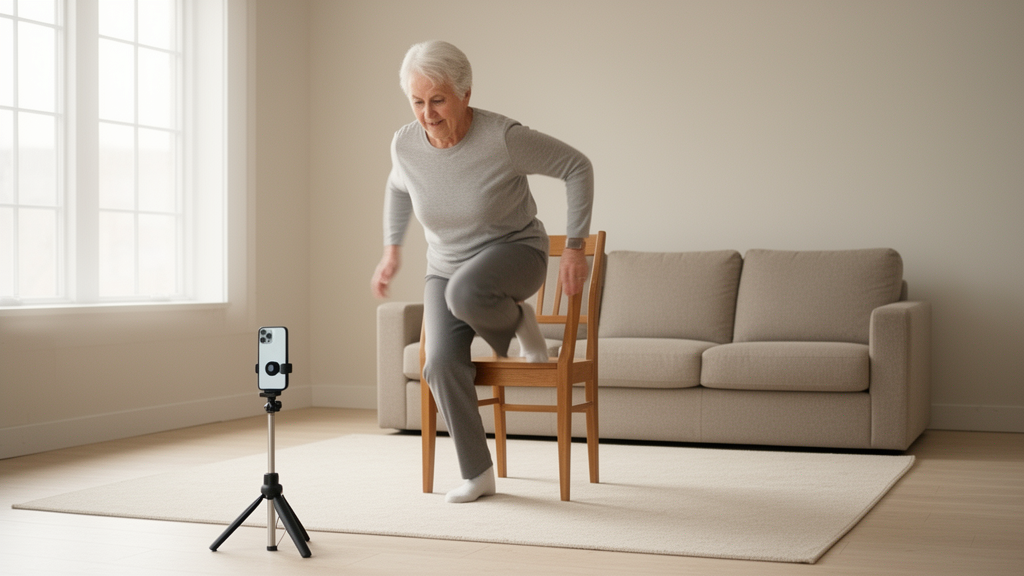
The humble chair stand has long been one of medicine’s most deceptively simple tests. Ask an older adult to rise from a chair and sit back down five times as quickly as possible, and a stopwatch captures a single number that clinicians use to judge lower-limb function. But that number hides an entire biomechanical story: how the hips and knees bend, how quickly the body rises and lowers, and whether the person is progressively slowing down as repetitions accumulate. A new study from researchers at The Hong Kong Polytechnic University, published in Frontiers in Aging, shows that a trio of ordinary smartphones running an open-source motion capture platform can now read that story in remarkable detail, potentially bringing laboratory-grade movement analysis out of the lab and into community clinics.
The platform, called OpenCap, fuses synchronized smartphone videos with musculoskeletal modeling to estimate three-dimensional human movement without any of the reflective markers that traditional systems require. Conventional three-dimensional motion capture, the long-standing reference standard, demands an array of specialized cameras, dozens of markers glued to the skin, trained operators, and dedicated space. Those requirements have kept sophisticated gait and movement analysis confined to research laboratories, even as clinicians increasingly recognize that a single completion time for the five-times sit-to-stand (5STS) test conceals important differences between patients who may arrive at the same total time through very different movement strategies.
Led by Jialiang Xu and Qitao Tan, with Ming Zhang as senior collaborator, the research team recruited twenty-four older Asian women aged 65 and older. Half were classified as healthy and half as sarcopenic, meaning they had the age-associated loss of skeletal muscle mass and function that affects an estimated 10 to 40 percent of older populations and contributes to frailty, falls, and disability. Classification followed the 2025 consensus criteria of the Asian Working Group for Sarcopenia, requiring both low handgrip strength measured with a handheld dynamometer and low height-adjusted appendicular muscle mass measured by bioelectrical impedance. The cohort deliberately focused on women to maintain homogeneity within this sex-specific classification framework, a constraint that shapes how broadly the findings can be generalized.
Each participant performed the 5STS task on a standardized 43-centimeter armless chair with arms crossed over the chest, completing four recorded trials of five consecutive sit-stand-sit repetitions. While an eight-camera Vicon system tracked thirty-nine reflective markers at 250 hertz, three iPhone 14 devices mounted on tripods recorded 720-pixel video at 60 frames per second from frontal, oblique, and lateral viewpoints. The OpenCap pipeline processed the videos using the HRNet pose-estimation algorithm, generating subject-specific musculoskeletal models and extracting hip, knee, and ankle flexion-extension angles. To ensure a fair comparison, the researchers fed both systems through the same anatomical model geometry and the same 6 hertz low-pass filter before analyzing the waveforms.
The agreement results were striking. For knee flexion and extension, OpenCap tracked the laboratory system with a root mean square error of just 1.84 degrees and an intraclass correlation coefficient of 0.998, a level of near-perfect absolute agreement. Hip flexion and extension also showed high agreement, at 0.970, though with larger absolute errors of 5.42 degrees. The ankle proved the weak link: despite small angular errors, its agreement was more variable, which the authors attribute partly to the limited ankle excursion the task demands. Notably, agreement was calculated from participant-level mean waveforms, and the authors caution that these estimates should not be extrapolated to single trials or repetitions.
The validation came with important technical caveats that the authors openly discuss. Because the two recording systems lacked a shared hardware trigger, they were aligned using cross-correlation of the knee waveform, which happened to be the same joint later used to judge agreement, potentially favoring the knee result. Eight of the ninety-six recorded trials were also excluded due to OpenCap synchronization failures that made pose tracking impossible, a reminder that real-world failure rates matter for any technology proposed for clinical screening. Still, the overall message was that for the two joints that dominate the chair-stand movement, the smartphone system reproduced laboratory kinematics with impressive fidelity.
The second half of the study asked whether this rich kinematic data could actually distinguish sarcopenic from healthy women beyond what a stopwatch shows. Using statistical parametric mapping, a technique that tests for differences across entire movement trajectories while controlling the family-wise error rate, the researchers found that the sarcopenic group showed reduced hip flexion near both the beginning and end of the sit-stand-sit cycle, along with brief localized reductions in knee flexion. Angular velocity waveforms, however, did not differ significantly between groups, possibly because the longer movement durations in the sarcopenic group spread the same angular displacement over more time.
The temporal measures told an even clearer story. Sarcopenic participants took significantly longer to complete the full five stands, and the analysis of individual movement phases revealed that both the ascent, the effortful rise requiring lower-limb extensor force generation, and the descent, which demands eccentric control and postural stability, were prolonged. Perhaps most intriguingly, the sarcopenic group showed greater progressive slowing across the five repetitions, quantified as a steeper repetition-duration slope, while their repetition-to-repetition variability was no different from the healthy group. That combination suggests a systematic decline in pace, consistent with reduced functional reserve or fatigability, rather than mere temporal irregularity, though the authors emphasize that mechanisms such as reduced eccentric strength or fear of falling remain untested hypotheses in this study.
The clinical implications are tantalizing but carefully bounded. The authors note that individuals with similar total completion times could differ substantially in rising duration, lowering duration, progressive slowing, or joint-movement strategy, and phase- and repetition-specific analysis could pinpoint where functional limitations actually occur within the task. Yet this study did not test whether these derived measures improve diagnosis, prognosis, or treatment selection beyond conventional timing, and the OpenCap-derived temporal measures were not validated against an independent external reference. Before routine use, researchers will need evidence on repeatability, clinically meaningful thresholds, processing time, and acceptability in community and primary-care settings.
The study’s limitations also frame its scope. The sample was small, restricted to older Asian women with a relatively lean anthropometric profile, and the between-group analyses were unadjusted for potential confounders such as physical activity, medication use, and pain. The cross-sectional design cannot support causal inference, and no direct measures of muscle activation, joint kinetics, or physiological cost were collected. Even so, the work marks a meaningful step toward democratizing biomechanical assessment. If three smartphones and open-source software can capture how aging muscles struggle with something as fundamental as rising from a chair, the door opens to large-scale screening in communities where reflective markers and eight-camera laboratories will never reach.
Subject of Research: Smartphone-based markerless motion capture validation and sarcopenia assessment using the five-times sit-to-stand test in older Asian women
Article Title: OpenCap-based five-times sit-to-stand analysis in older Asian women with and without sarcopenia
Article References: Xu, J., Cai, H., Wang, Y., Hu, Z., Zhang, M., & Tan, Q. (2026). OpenCap-based five-times sit-to-stand analysis in older Asian women with and without sarcopenia. Frontiers in Aging, 7, Article 1960201. https://doi.org/10.3389/fragi.2026.1960201
Image Credits: AI Generated
DOI: 10.3389/fragi.2026.1960201
Keywords: OpenCap, sarcopenia, five-times sit-to-stand, markerless motion capture, biomechanics, older adults, kinematics, smartphone cameras, musculoskeletal modeling, statistical parametric mapping, AWGS 2025, aging
Cite Scienmag News
Beatrice Stafford. (October 15, 2026). Smartphone Cameras Match Lab Systems in Reading How Aging Muscles Fail the Chair-Stand Test. Scienmag. https://scienmag.com/smartphone-cameras-match-lab-systems-in-reading-how-aging-muscles-fail-the-chair-stand-test/
Beatrice Stafford. "Smartphone Cameras Match Lab Systems in Reading How Aging Muscles Fail the Chair-Stand Test." Scienmag, 15 October 2026, https://scienmag.com/smartphone-cameras-match-lab-systems-in-reading-how-aging-muscles-fail-the-chair-stand-test/. Accessed 15 October 2026.
Beatrice Stafford. "Smartphone Cameras Match Lab Systems in Reading How Aging Muscles Fail the Chair-Stand Test." Scienmag. October 15, 2026. https://scienmag.com/smartphone-cameras-match-lab-systems-in-reading-how-aging-muscles-fail-the-chair-stand-test/


