


…
Trichomes have long been celebrated as the plant kingdom’s first line of defense against insects and mites, but their role in fending off other plants has remained almost entirely unexamined. The new findings from the University of León team add an unusual chapter to this story by showing that the humble hairs on a tomato stem can determine whether a parasitic dodder seedling lives or dies. This is significant because parasitic plants represent one of the most economically damaging groups of agricultural pests worldwide, and resistance strategies against them have traditionally focused on chemical signals, germination stimulants, and post-attachment immune responses rather than on the physical architecture of the host surface.
The distinction between pre-attachment and post-attachment resistance is central to interpreting the study’s results. Pre-attachment mechanisms operate before the parasite has established any vascular connection with the host, meaning that a failure at this stage prevents infestation altogether. The observation that only about one in five Cuscuta campestris seedlings managed to form haustoria on tomato stems points to a remarkably effective barrier operating at this earliest phase. By comparison, dodder seedlings attaching to many susceptible hosts establish connections with far greater frequency, which underscores how unusual the tomato stem surface must be from the parasite’s perspective.
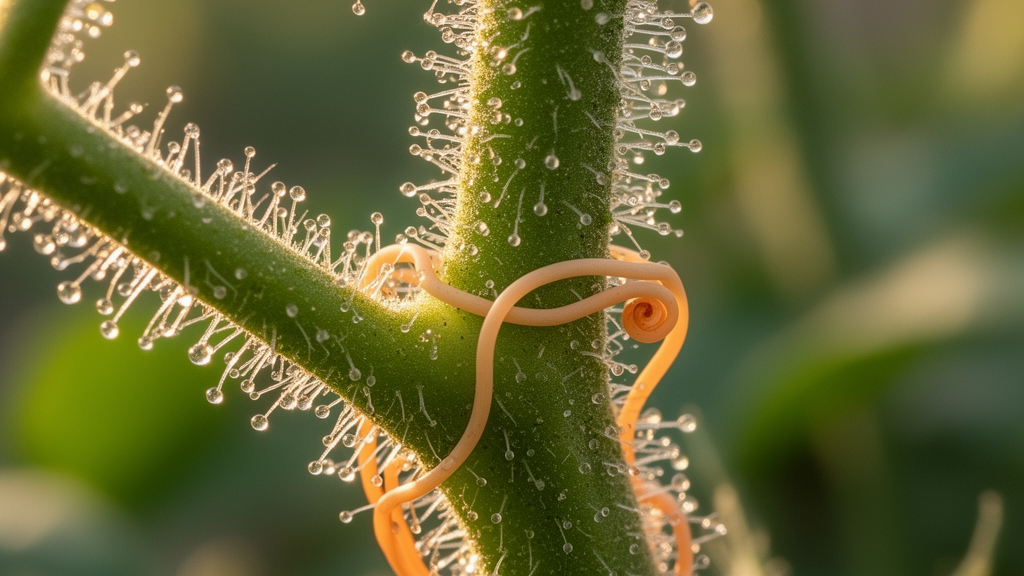
The physical explanation proposed by the researchers is elegant in its simplicity. Dodder seedlings coil around a host stem and press specialized organs called haustoria against the host epidermis in an attempt to penetrate and eventually tap into the vascular tissue. For this pressure to be effective, the parasite must achieve close, stable contact with the epidermal surface. Long, non-glandular trichomes of types I and II act like a dense bristling forest that keeps the coiling parasite at arm’s length, so to speak, preventing the haustorial tips from seating firmly against the epidermis. Without firm contact, the mechanical stimulus and chemical cues that normally trigger haustorium differentiation are insufficient, and the seedling exhausts its limited reserves.
This exhaustion is a critical point. A germinated dodder seed contains only a small store of nutrients and must reach a host and establish a functional connection within days, or it dies. Any delay imposed by a physical barrier translates directly into reduced survival. The approximately eighty percent failure rate observed on tomato stems therefore represents not merely an inconvenience for the parasite but a lethal bottleneck in its life cycle. From an evolutionary standpoint, this suggests that trichome density on stems could be a trait under selection in natural populations where dodder pressure is significant, and conversely a trait that may have been inadvertently altered during tomato domestication and breeding.
The finding that the same long trichomes also impede secondary parasitism extends the significance of the results. Secondary parasitism, in which lateral branches from an already infested neighboring plant launch new attacks, is often the more destructive mode of spread in agricultural settings because a single established dodder plant can generate many aggressive stems simultaneously. If the trichome barrier bends under the pressure of a dodder stem but still prevents haustorial penetration, it provides protection not just against initial colonization but against the epidemic spread of the parasite through a crop or plant community. This dual function at both stages of parasitism strengthens the case that trichomes are a genuine resistance mechanism rather than an incidental observation.
Equally noteworthy is the behavior of the type VI glandular trichomes during infestation. These short, four-lobed structures are among the best-studied defensive features of tomato, known for storing acylsugars, terpenes, and phenolic compounds in an intercellular cavity that ruptures readily upon contact. The study’s observation that glandular heads near the parasite turned brown, showed strong autofluorescence, and sometimes ruptured is consistent with a controlled release of defensive chemistry at precisely the location where the parasite is attempting to establish itself. Autofluorescence in plant tissues is commonly associated with phenolic compounds and cell wall fortification, so the signal suggests both chemical discharge and localized defensive activation.
The second type VI response is perhaps even more intriguing. As the host constructed an epidermal and subepidermal defensive barrier beneath the site of attempted penetration, additional type VI trichomes darkened, lost turgor, and adopted a flattened four-lobed appearance. This coordinated change implies that glandular trichomes are not passive bystanders but active participants in a spatially organized defense program. The flattening and turgor loss may represent a programmed collapse that deposits stored metabolites onto the emerging barrier tissue, or it may reflect redirection of resources from secretion to structural support. Either interpretation positions type VI trichomes as sensors and effectors in the plant’s response to parasitic attack.
It is worth placing these observations in the broader context of trichome biology in the Solanaceae. Within the genus Solanum, trichome density and type vary enormously among species, and even among cultivated tomato varieties. Wild relatives of tomato, such as Solanum habrochaites and Solanum pennellii, are famous for their dense glandular covering and the potent insect-repellent chemistry it produces. Breeders have occasionally introgressed trichome-related traits from wild germplasm into cultivated lines for pest resistance. The present results suggest that stem trichome characteristics, which are usually evaluated with insects in mind, could also be relevant selection criteria for dodder resistance, opening a new avenue for breeding programs in tomato and potentially other crops.
The mechanism proposed here also invites comparison with well-documented trichome effects against other plant adversaries. Against small herbivorous insects, trichomes function partly by preventing the pest from achieving firm footing and close contact with the epidermis, the same principle that appears to defeat dodder attachment. Against fungal pathogens, glandular trichomes release antimicrobial compounds upon rupture. The dodder interaction thus sits at the intersection of these two classical functions, combining a mechanical exclusion role with a chemical warfare role. This convergence suggests that trichomes may have been recruited repeatedly in plant evolution as general-purpose barriers against anything that attempts to breach the epidermis, whether animal, fungal, or plant.
From the parasite’s perspective, the findings illuminate the challenges that Cuscuta faces when encountering a well-defended host. Dodder haustorium formation is known to be influenced by host-derived chemical signals, and parasites can discriminate among potential hosts based on volatile and contact cues. A host whose surface is obscured by trichomes presents a fundamentally different sensory and mechanical environment. The parasite may perceive fewer contact signals, may be unable to apply sufficient pressure, and may be exposed to repellent or toxic metabolites simultaneously. This layered obstruction helps explain why host range in Cuscuta species is broad but not universal, and why some host combinations consistently fail.
The experimental design deserves attention for its ecological realism. By using mung bean plants pre-parasitized by dodder as a source of secondary infection, the researchers reproduced the natural mode of dodder spread through plant communities, rather than relying solely on artificial placement of seedlings. This two-stage system, combining primary infestation assays with neighbor-based secondary transmission, provides a more faithful model of how resistance traits would perform in the field. The replication across three independent biological experiments with varying plant numbers also strengthens confidence that the observed attachment failure rates are robust rather than artifacts of a single cohort.
Practical implications follow naturally from these results. If stem trichome density and morphology can be measured and selected for, tomato breeders could screen germplasm for lines with enhanced pre-attachment resistance to dodder. Such resistance would be valuable precisely because it acts before any vascular connection forms, preventing yield loss rather than merely limiting it. Moreover, a physical barrier is less likely to be overcome by parasite adaptation than some single-gene resistances, since the parasite would need to evolve both the mechanical force and the chemical tolerance to penetrate a dense trichome layer. Combining trichome-based resistance with known post-attachment defenses could produce durable, multi-layered protection.
There are also broader ecological questions raised by the work. In natural ecosystems, trichome density varies with environmental conditions such as light, water availability, and herbivore history. Plants growing under stress often produce denser or taller trichomes, which means that the same trait that helps against drought and insects might incidentally influence susceptibility to parasitic plants. Conversely, agricultural selection for smooth, easily handled fruit and foliage may have reduced trichome cover in some cultivated lines, potentially increasing vulnerability to dodder. Understanding these trade-offs could inform both crop improvement and the study of plant-plant interactions in wild communities.
The study also highlights a gap in the scientific literature that the authors correctly identify. Reviews of trichome function rarely mention parasitic plants, and reviews of plant resistance to parasitic plants rarely mention trichomes. This mutual blind spot has likely persisted because parasitic plant research has historically focused on root parasites such as Striga and Orobanche, where host interactions occur underground and trichomes are irrelevant. Stem parasites like Cuscuta, which must contact the aerial epidermis directly, are the natural context in which trichome defenses would be expected, and this study demonstrates that expectation convincingly.
Future research directions suggested by these findings include identifying the specific metabolites released by type VI trichomes during dodder attack, quantifying whether the released compounds are toxic to the parasite or merely deterrent, and testing whether trichome density correlates with resistance across diverse tomato genotypes. Genetic analysis of natural variation in stem trichome traits could reveal loci that breeders could manipulate. Additionally, examining whether other Cuscuta species or other stem parasites face similar barriers on different host species would establish how general this defense mechanism is across plant-parasite systems.
In sum, the work reframes an ordinary feature of the plant surface as an active and multifunctional defense organ. The long trichomes of tomato stems deny dodder seedlings the contact they need, and the glandular trichomes respond dynamically when infestation is attempted, contributing both chemistry and structural material to the host’s defense. That such a familiar structure, visible to any observer of a tomato plant, could play a decisive role against one of agriculture’s most unusual pests is a reminder that major discoveries in plant science sometimes hide in plain sight, waiting for someone to look closely at the interface between two organisms that rarely meet in the literature.
Subject of Research: …
Article Title: An overlooked function of trichomes in defense against parasitic plants
Article References: Frey, C., López-López, L., Martínez-Toral, A., & Acebes, J. L. (2026). An overlooked function of trichomes in defense against parasitic plants. Frontiers in Plant Physiology, 4, Article 1894074. https://doi.org/10.3389/fphgy.2026.1894074
Image Credits: AI Generated
DOI: 10.3389/fphgy.2026.1894074
Keywords: trichomes, tomato, Cuscuta campestris, dodder, plant defense, parasitic plants, pre-attachment resistance, glandular trichomes, haustoria, plant physiology, host-parasite interaction, Solanum lycopersicum
Cite Scienmag News
Drew Townsend. (October 15, 2026). Tomato Hairs Fight Back: Tiny Trichomes Thwart Parasitic Dodder. Scienmag. https://scienmag.com/tomato-hairs-fight-back-tiny-trichomes-thwart-parasitic-dodder/
Drew Townsend. "Tomato Hairs Fight Back: Tiny Trichomes Thwart Parasitic Dodder." Scienmag, 15 October 2026, https://scienmag.com/tomato-hairs-fight-back-tiny-trichomes-thwart-parasitic-dodder/. Accessed 15 October 2026.
Drew Townsend. "Tomato Hairs Fight Back: Tiny Trichomes Thwart Parasitic Dodder." Scienmag. October 15, 2026. https://scienmag.com/tomato-hairs-fight-back-tiny-trichomes-thwart-parasitic-dodder/


