


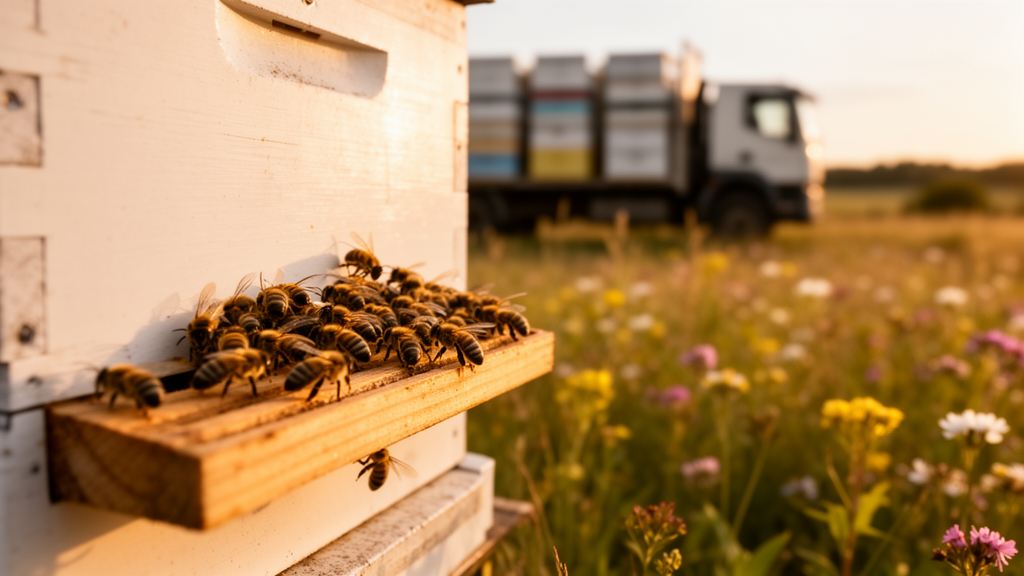
When beekeepers load their hives onto trucks and drive them to mountain pastures each summer, they are betting that new forage will translate into more honey. But what happens inside the bees themselves during these journeys has remained largely a mystery. Now, a two-year field study from southern Italy offers one of the most detailed looks yet at how the gut bacteria of honey bees respond to seasonal change and to short-distance migratory beekeeping, and the answer is surprising: the calendar matters far more than the truck.
Researchers at the University of Molise tracked six colonies of Italian honey bees, Apis mellifera ligustica, one of the world’s most widely kept and productive subspecies, across two consecutive years in the Campania region. Three colonies stayed put at Castelpoto, a lowland site at 280 meters above sea level, while three others were transferred each summer to Piano Melaino on Mount Taburno, roughly 10.5 kilometers away but more than a kilometer higher in altitude. All six colonies began the experiment in the same apiary and were headed by sister queens from a single genetic line, a design choice that helped standardize the genetic background across the two groups, though sister queens are not genetically identical.
The two sites offered strikingly different floral landscapes. During summer, the lowland Castelpoto site was dominated by plants such as Helminthotheca, Trifolium, and Beta, while the mountain site at Taburno supported a richer array of pollen-producing species including Echium, Trifolium, Castanea, and Rubus. To keep nutrition comparable, all colonies received standardized supplementation: a winter dose of 2.5 kilograms of candied sugar paste and weekly spring feeding with 50 percent sucrose syrup for four consecutive weeks.
Sampling was intensive. Every week during each season, fifteen returning forager bees were collected at the hive entrance of each colony. The hindguts, comprising the ileum and rectum, were aseptically dissected from each bee and pooled into seasonal sampling units, one for each of the four seasons per colony per year. Over the two-year study, this produced 48 seasonal sampling units, with three independent colonies serving as biological replicates for each combination of management system, season, and year. DNA was extracted and the V1–V3 hypervariable region of the bacterial 16S rRNA gene was amplified and sequenced on an Illumina MiSeq platform using paired-end chemistry.
The sequencing revealed a taxonomically rich community spanning 25 phyla, 43 classes, 91 orders, 159 families, and 242 genera. But the story was dominated by two familiar characters. Gilliamella and Snodgrassella, both core members of the honey bee gut microbiome, consistently made up the bulk of the bacterial community in every colony, every season, and every year. Their relative abundances, however, swung dramatically with the seasons. Gilliamella surged in autumn, reaching 70.1 percent in stationary colonies and 66.3 percent in migratory colonies during the autumn of 2023. Snodgrassella peaked in spring and winter, hitting 52.7 percent in migratory colonies in spring 2022 and 51.3 percent in stationary colonies in spring 2023. The two genera displayed essentially mirror-image seasonal patterns, with one rising as the other fell.
Beyond the two dominants, other genera showed their own seasonal rhythms. Bartonella spiked to 28.0 percent in migratory colonies during the summer of 2022, while Fructobacillus increased sharply in migratory colonies during autumn 2023. Frischella appeared at lower levels and fluctuated across seasons and years. Interestingly, Bifidobacterium, often considered an important gut symbiont of honey bees, was detected at very low relative abundance throughout the study. The researchers caution that this could reflect methodological biases inherent in partial 16S rRNA gene amplification rather than true ecological absence, and they urge careful interpretation of this finding.
To test whether season or management system better explained the variation in gut bacterial communities, the team applied rigorous multivariate statistics. Alpha diversity, measured by Shannon and Inverse Simpson indices calculated from harmonized genus-level relative abundance profiles, showed significant seasonal variation in both years. In 2022, season significantly affected Shannon diversity with a p-value of 0.0001 and Inverse Simpson diversity with a p-value of 0.0002, while management system showed no significant effect. The pattern repeated in 2023 with seasonal p-values of 0.0019 and 0.0014 for the two indices, and non-significant management effects. A confirmatory analysis using operational taxonomic units directly for the complete 2023 dataset independently supported these findings.
Beta diversity told the same story. Using Bray–Curtis dissimilarities and Principal Coordinates Analysis, the researchers found that the first two PCoA axes accounted for 74.75 percent of the variation in 2022 and 63.75 percent in 2023. PERMANOVA revealed that season explained 41.0 percent of the variation in bacterial community composition in 2022 and 46.5 percent in 2023, both highly significant. Management system, by contrast, explained only 3.9 percent in 2022 and 4.2 percent in 2023, neither statistically significant. PERMDISP tests confirmed that these results were not driven by differences in multivariate dispersion among groups. In short, the seasonal clock, not the relocation, was the predominant force shaping gut bacterial community structure.
Colony performance added another layer of complexity. In 2022, migratory colonies produced significantly more honey than their stationary counterparts, averaging 20.83 kilograms versus 12.20 kilograms per colony, a difference that was statistically significant. No significant differences were detected for hive-stored honey, hive-stored pollen, or colony population in that year. But in 2023, the productive advantage vanished. None of the investigated performance parameters differed significantly between the two management systems, although migratory colonies showed numerically higher values for stored pollen, colony population, and annual honey production. With only three colonies per group, the researchers emphasize that these numerical differences should be interpreted cautiously.
The disconnect between microbiota dynamics and colony productivity is perhaps the most important takeaway. Although temporal variation in gut bacterial communities occurred alongside differences in honey production between years, the study does not establish any causal or functional relationship between the two. The persistence of dominant taxa like Gilliamella and Snodgrassella across seasons indicates compositional continuity, but the researchers are careful to note that this does not by itself demonstrate functional stability, microbial resilience, or the absence of dysbiosis. Direct functional analyses of the microbiome, along with larger numbers of independent colonies and apiaries and detailed characterization of dietary and environmental factors, will be needed to clarify whether and how migratory beekeeping affects honey bee gut microbiota and colony performance in the longer term.
Subject of Research: Seasonal dynamics of gut microbiota and colony performance in honey bees under stationary versus migratory beekeeping
Article Title: Seasonal gut microbiota dynamics and colony performance under stationary and short-distance migratory beekeeping in Apis mellifera ligustica
Article References: Iorizzo, M., Albanese, G., Tedino, C., Succi, M., Di Donato, L. M., de Nigris, A., Di Criscio, D., Ganassi, S., Ambrosone, L., & De Cristofaro, A. (2026). Seasonal gut microbiota dynamics and colony performance under stationary and short-distance migratory beekeeping in Apis mellifera ligustica. Frontiers in Insect Science, 6, Article 1890935. https://doi.org/10.3389/finsc.2026.1890935
Image Credits: AI Generated
DOI: 10.3389/finsc.2026.1890935
Keywords: honey bee, gut microbiota, Apis mellifera ligustica, migratory beekeeping, 16S rRNA sequencing, Gilliamella, Snodgrassella, seasonality, colony performance, honey production, microbial ecology, beekeeping management
Cite Scienmag News
Morgan Morrow. (October 15, 2026). Season Beats Migration: Italian Honey Bee Gut Microbiota Follows the Calendar, Not the Truck. Scienmag. https://scienmag.com/season-beats-migration-italian-honey-bee-gut-microbiota-follows-the-calendar-not-the-truck/
Morgan Morrow. "Season Beats Migration: Italian Honey Bee Gut Microbiota Follows the Calendar, Not the Truck." Scienmag, 15 October 2026, https://scienmag.com/season-beats-migration-italian-honey-bee-gut-microbiota-follows-the-calendar-not-the-truck/. Accessed 15 October 2026.
Morgan Morrow. "Season Beats Migration: Italian Honey Bee Gut Microbiota Follows the Calendar, Not the Truck." Scienmag. October 15, 2026. https://scienmag.com/season-beats-migration-italian-honey-bee-gut-microbiota-follows-the-calendar-not-the-truck/


