


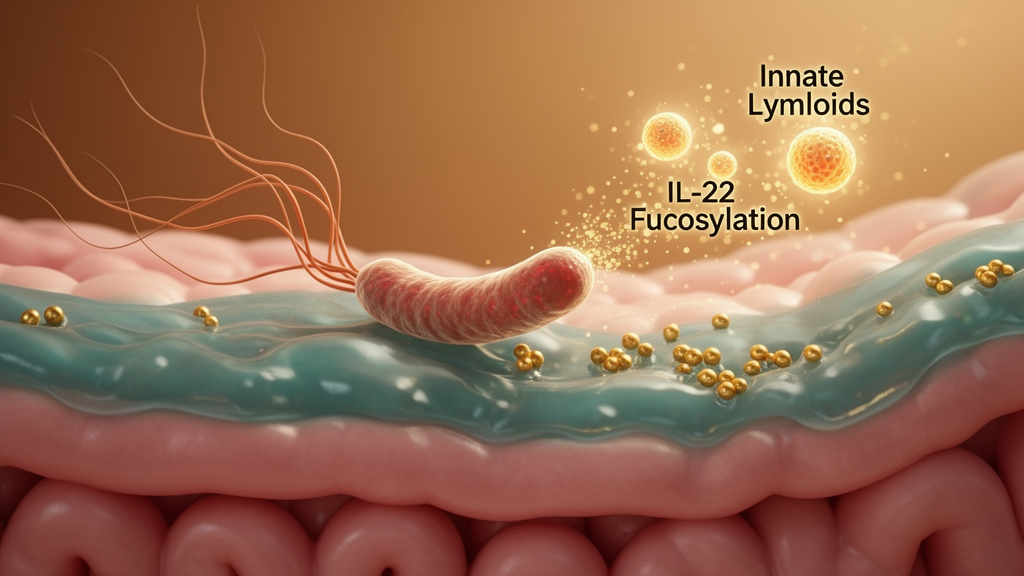
A single commensal bacterium found in the human gut may hold the key to repairing one of the most devastating consequences of ulcerative colitis: the collapse of the mucus barrier that normally shields the intestinal wall from the caustic contents of the colon. In a study published in Genome Biology, researchers from Tianjin Medical University General Hospital and Nankai University School of Medicine report that a Lachnospiraceae bacterium designated 3–1-57, and specifically its flagellin protein, can restore the chemical decoration of the gut’s principal mucus protein and thereby rebuild mucosal defenses in colitis. The work, led by corresponding authors Bangmao Wang, Xiaomin Su, Hailong Cao, and Tianyu Liu, with Lingfeng Li, Jiaying Jiang, and Yihan Huang as co-first authors, traces a complete signaling chain from a bacterial surface protein to the sugar modifications that give intestinal mucus its protective character.
The central discovery concerns fucosylation, the attachment of fucose sugars to mucin 2, or MUC2, the gel-forming glycoprotein that constitutes the bulk of the colonic mucus layer. Fucose residues added to MUC2 are not cosmetic. They alter the mucus matrix in ways that support its integrity and its interactions with the microbial community. In colitis, this fucosylation is lost, and the mucus barrier weakens, leaving the epithelial surface exposed. The new study shows that the flagellin of L. 3–1-57, the protein that forms the propeller-like appendage of the bacterium, can reverse this deficit through a defined immunological cascade.
The clinical foundation of the work rests on two cohorts of human participants. Compared with healthy controls and with patients whose ulcerative colitis was in remission, patients with active disease showed reduced abundance of L. 3–1-57 in their gut microbiota. The depletion was not random. The lower the abundance of the bacterium, the more severe the disease, an inverse correlation that held across the study population. This pattern suggests that L. 3–1-57 is not merely a passive bystander in colitis but a component of the microbial community whose presence tracks with mucosal health.
To test whether the relationship is causal, the team turned to mouse models of chemically induced colitis. Oral administration of live L. 3–1-57 attenuated intestinal inflammation and mucus barrier dysfunction. Purified flagellin from the bacterium, delivered without the living organism, achieved the same protection. The contrast with a well-known gut pathobiont was stark: flagellin from Escherichia coli exacerbated disease rather than relieving it. This strain-specific divergence is one of the most technically significant aspects of the study, because flagellins from different bacteria are structurally similar yet immunologically distinct, and the field has lacked a clear account of which commensal flagellins promote homeostasis rather than inflammation.
The mechanistic chain begins at Toll-like receptor 5, or TLR5, the innate immune receptor that recognizes bacterial flagellin. Using binding assays, the researchers demonstrated that L. 3–1-57 flagellin binds TLR5 with high affinity. Upon this engagement, dendritic cells, the antigen-presenting sentinels of the mucosal immune system, are activated to produce interleukin-23. Interleukin-23 in turn expands the population of group 3 innate lymphoid cells, or ILC3s, that produce interleukin-22. Interleukin-22 is a cytokine with well-documented effects on epithelial cells, and in this context it drives the expression of fucosyltransferase 2, the enzyme that catalyzes the α-1,2-linked fucosylation of MUC2. The restored fucosylation rebuilds the mucus matrix and closes the protective loop.
The team then dismantled the pathway piece by piece to confirm that each element is indispensable. Genetic ablation of Tlr5 in mice abolished the protective effect of the flagellin. Pharmacological inhibition of α-1,2-fucosylation eliminated the benefit even when the immune cascade was intact. Neutralization of interleukin-22 likewise erased the protection. These loss-of-function experiments establish that the TLR5–IL-23–IL-22 axis and the fucosylation it drives are not merely correlated with recovery but are required for it, a standard of mechanistic proof that many microbiome studies do not reach.
A further technical point addresses a common concern about flagellin-based therapies. Analysis of the gut microbiota by 16S rRNA amplicon sequencing showed that orally administered L. 3–1-57 flagellin did not induce broad restructuring of the microbial community. The protection, in other words, is not mediated by wholesale alteration of the microbiome but by a targeted immune and glycosylation pathway. Detection of His-tagged flagellin in colonic mucus confirmed that the protein reaches its site of action after oral delivery, and flow cytometric analysis documented the activation of dendritic cells in the colonic lamina propria and mesenteric lymph nodes.
The translational implications are threefold. First, the authors nominate L. 3–1-57 as a candidate next-generation probiotic, a living organism whose administration could restore a depleted protective community member. Second, the flagellin itself is proposed as a postbiotic therapy, a purified microbial product that delivers the benefit without the need for live bacteria, an approach that may offer more predictable dosing and safety. Third, the fecal depletion of L. 3–1-57 is suggested as a noninvasive auxiliary diagnostic biomarker, a measurable microbial signal that could complement clinical assessment of disease activity.
The study also contributes to a broader reevaluation of flagellin, a molecule long viewed with suspicion because of its role in inflammatory signaling. The new work demonstrates that flagellin is not a monolithic inflammatory trigger but a family of strain-specific immunomodulators whose effects depend on the producing organism. Flagellins from commensal bacteria are among the most potent modulators of intestinal immunity, yet their homeostatic functions have remained poorly defined. By identifying a commensal flagellin that promotes mucosal repair through a defined receptor-to-glycosylation pathway, the study provides a framework for distinguishing protective from harmful flagellins and for exploiting the protective ones therapeutically.
The work was supported by the National Natural Science Foundation of China and related funding programs, and was approved by the Ethics Committee of Tianjin Medical University General Hospital and the Tianjin Medical University Animal Care and Use Committee. The article is open access under a Creative Commons license, and the authors declare no competing interests. As with all preclinical microbiome research, the findings in mouse models and human associations will require further validation before clinical application, but the study establishes a complete mechanistic account of how a single commensal bacterium, acting through its flagellin and a defined immune axis, can rebuild the chemical architecture of the mucus barrier that colitis destroys.
,
Subject of Research: Commensal Lachnospiraceae bacterium mitigates colitis-induced mucin fucosylation deficits through ILC3/IL-22 axis
Article Title: Commensal Lachnospiraceae bacterium mitigates colitis-induced mucin fucosylation deficits through ILC3/IL-22 axis
Article References: Commensal Lachnospiraceae bacterium mitigates colitis-induced mucin fucosylation deficits through ILC3/IL-22 axis. (n.d.). https://doi.org/10.1186/s13059-026-04304-7
Image Credits: AI Generated
DOI: 10.1186/s13059-026-04304-7
Keywords: Commensal, Lachnospiraceae, bacterium, mitigates, colitis-induced, mucin, fucosylation, deficits, ILC3, IL-22, axis, scientific research
Cite Scienmag News
Morgan Morrow. (October 15, 2026). Gut bacterium’s flagellin restores colitis-damaged mucus via ILC3/IL-22 fucosylation axis. Scienmag. https://scienmag.com/gut-bacteriums-flagellin-restores-colitis-damaged-mucus-via-ilc3-il-22-fucosylation-axis/
Morgan Morrow. "Gut bacterium’s flagellin restores colitis-damaged mucus via ILC3/IL-22 fucosylation axis." Scienmag, 15 October 2026, https://scienmag.com/gut-bacteriums-flagellin-restores-colitis-damaged-mucus-via-ilc3-il-22-fucosylation-axis/. Accessed 15 October 2026.
Morgan Morrow. "Gut bacterium’s flagellin restores colitis-damaged mucus via ILC3/IL-22 fucosylation axis." Scienmag. October 15, 2026. https://scienmag.com/gut-bacteriums-flagellin-restores-colitis-damaged-mucus-via-ilc3-il-22-fucosylation-axis/


