



Credit: Kessler Foundation
East Hanover, NJ – April 5, 2024 – March job numbers showed minimal changes for people with disabilities, according to today’s National Trends in Disability Employment (nTIDE) semi-monthly update issued by Kessler Foundation and the University of New Hampshire’s Institute on Disability (UNH-IOD). Despite small declines in the employment-to-population ratio over the past four months, employment remains at historically high levels for people with disabilities. The small gain in their labor force participation rate is a positive sign that people with disabilities are still engaging in the labor market by looking for work.
Month-to-Month nTIDE Numbers (comparing February 2024 to March 2024)
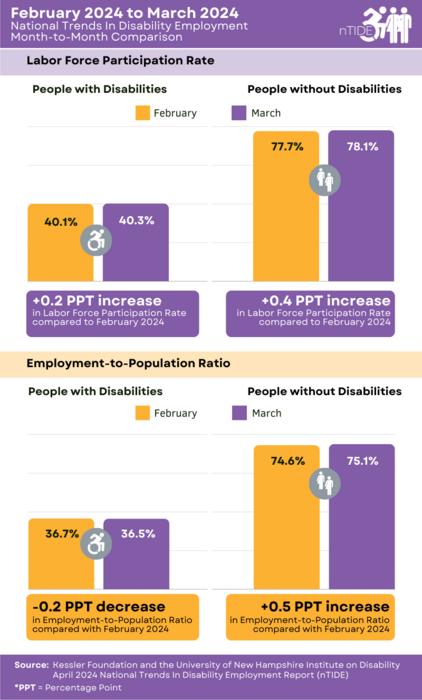
Based on data from the U.S. Bureau of Labor Statistics (BLS) Jobs Report released today, the employment-to-population ratio for people with disabilities (ages 16-64) decreased from 36.7 percent in February 2024 to 36.5 percent in March 2024 (down 0.5 percent or 0.2 percentage points). For people without disabilities (ages 16-64), the employment-to-population ratio increased from 74.6 percent in February 2024 to 75.1 percent in March 2024 (up 0.7 percent or 0.5 percentage points). The employment-to-population ratio, a key indicator, reflects the percentage of people who are working relative to the total population (the number of people working divided by the number of people in the total population multiplied by 100).
“The employment-to-population ratio for people with disabilities declined for the fourth consecutive month, curtailing the gains seen over the last two years,” remarked John O’Neill, PhD, director of the Center for Employment and Disability Research at Kessler Foundation. “There are concerns that this pattern may be more than just seasonal fluctuation and/or sample variation. Nevertheless, the overall trend for the employment-to-population ratio remains above historic highs,” he added.
In March, the labor force participation rate for people with disabilities (ages 16-64) increased from 40.1 percent in February 2024 to 40.3 percent in March 2024 (up 0.5 percent or 0.2 percentage points). For people without disabilities (ages 16-64), the labor force participation rate increased from 77.7 percent in February 2024 to 78.1 percent in March 2024 (up 0.5 percent or 0.4 percentage points). The labor force participation rate reflects the percentage of people who are in the labor force (working, on temporary layoff (on furlough), or actively looking for work in the last four weeks) relative to the total population (the number of people in the labor force divided by the number of people in the total population multiplied by 100).
“While the percentage of employed people with disabilities declined slightly over the last four months, labor force participation is leveling off rather than declining,” said Megan Henly, PhD, research assistant professor at UNH-IOD. “People with disabilities are still engaged in the labor force at a similar rate to last month,” she noted, “and we may soon see this translate into improvement in employment rates for people with disabilities.”
Year-to-Year nTIDE Numbers (comparing March 2023 to March 2024)
The employment-to-population ratio for people with disabilities (ages 16-64) decreased from 36.6 percent in March 2023 to 36.5 percent in March 2024 (down 0.3 percent or 0.1 percentage points). For people without disabilities (ages 16-64), the employment-to-population ratio increased from 74.9 percent in March 2023 to 75.1 percent in March 2024 (up 0.3 percent or 0.2 percentage points).
The labor force participation rate for people with disabilities (ages 16-64) increased from 40.2 percent in March 2023 to 40.3 percent in March 2024 (up 0.2 percent or 0.1 percentage points). For people without disabilities (ages 16-64), the labor force participation rate also increased from 77.6 percent in March 2023 to 78.1 percent in March 2024 (up 0.6 percent or 0.5 percentage points).
In March, among workers ages 16-64, the 6,173,000 workers with disabilities represented 4.1 percent of the total 150,192,000 workers in the U.S.
Ask Questions about Disability and Employment
Each nTIDE release is followed by an nTIDE Lunch & Learn online webinar. This live broadcast, hosted via Zoom Webinar, offers attendees Q&A on the latest nTIDE findings, provides news, updates from the field, and features invited panelists who discuss current disability-related findings and events.
On April 5, 2024, at 12:00 pm – 1:00 pm Eastern, guest presenters Carolyn LeBrane Tilton and Alexander Andreson from Disability Rights Louisiana, join Drs. O’Neill and Henly, and Liz Weintraub of AUCD. Join our free Lunch & Learn live or visit the nTIDE archives at: ResearchonDisability.org/nTIDE.
Also, register now for our mid-month Deeper Dive into employment trends at nTIDE Deeper Dive – 04/19/2024.
NOTE: The statistics in the nTIDE are based on BLS numbers but are not identical. They are customized by UNH to combine the statistics for men and women of working age (16- 64). nTIDE is funded by the National Institute on Disability, Independent Living and Rehabilitation Research (NIDILRR; 90RTGE0005) and Kessler Foundation.
About the Institute on Disability at the University of New Hampshire
The Institute on Disability (IOD) at the University of New Hampshire (UNH) was established in 1987 to provide a university-based focus for the improvement of knowledge, policies, and practices related to the lives of persons with disabilities and their families. For information on the NIDILRR-funded Research and Training Center on Disability Statistics, visit ResearchOnDisability.org.
About Kessler Foundation
Kessler Foundation, a major nonprofit organization in the field of disability, is a global leader in rehabilitation research. Our scientists seek to improve cognition, mobility, and long-term outcomes, including employment, for adults and children with neurological and developmental disabilities of the brain and spinal cord including traumatic brain injury, spinal cord injury, stroke, multiple sclerosis, and autism. Kessler Foundation also leads the nation in funding innovative programs that expand opportunities for employment for people with disabilities. For more information, visit KesslerFoundation.org.
Press Contacts at Kessler Foundation:
Deborah Hauss, DHauss@kesslerfoundation.org
Carolann Murphy, CMurphy@KesslerFoundation.org
Stay Connected with Kessler Foundation
Twitter | Facebook | YouTube | Instagram | SoundCloud
Graphics:
Title [ORANGE CHART]: nTIDE Month-to-Month Comparison of Labor Market Indicators for People with and without Disabilities
Caption: This graphic compares the labor market indicators for February 2024 and March 2024, showing a slight increase in the labor force participation rate and a slight decrease in the employment-to-population ratio for people with disabilities. Both indicators increased slightly for people without disabilities.
Title [GREEN/BLUE chart]: nTIDE Year-to-Year Comparison of Labor Market Indicators for People with and without Disabilities
Caption: This graphic compares the labor market indicators for March 2023 and March 2024, showing increases in the employment-to-population ratio and labor force participation rate for people without disabilities. For people with disabilities, the employment-to-population ratio declined slightly and the labor force participation rate increased.
Cite Scienmag News
Courtney Benton. (April 5, 2024). nTIDE March 2024 Jobs Report: Despite recent declines, people with disabilities remain engaged in the labor market. Scienmag. https://scienmag.com/ntide-march-2024-jobs-report-despite-recent-declines-people-with-disabilities-remain-engaged-in-the-labor-market/
Courtney Benton. "nTIDE March 2024 Jobs Report: Despite recent declines, people with disabilities remain engaged in the labor market." Scienmag, 5 April 2024, https://scienmag.com/ntide-march-2024-jobs-report-despite-recent-declines-people-with-disabilities-remain-engaged-in-the-labor-market/. Accessed 4 September 2026.
Courtney Benton. "nTIDE March 2024 Jobs Report: Despite recent declines, people with disabilities remain engaged in the labor market." Scienmag. April 5, 2024. https://scienmag.com/ntide-march-2024-jobs-report-despite-recent-declines-people-with-disabilities-remain-engaged-in-the-labor-market/

