


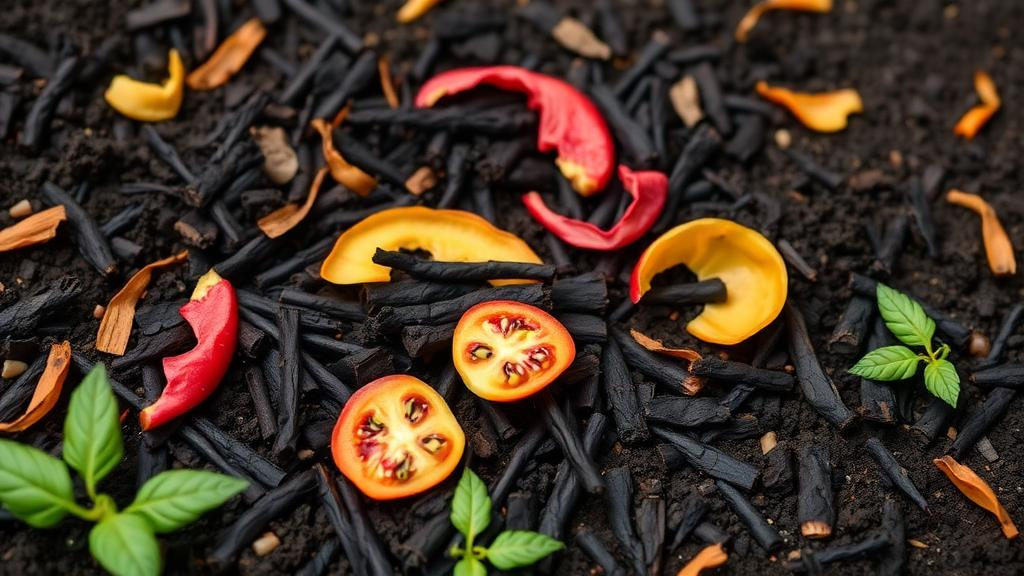
Three of Italy’s most abundant food-processing leftovers—winery vinasse, olive pomace, and tomato peels—are usually treated as a disposal problem. A new greenhouse study published in Frontiers in Soil Science argues they should be treated as a resource. Researchers at the University of Parma, working with partners in Italy and China, converted all three residues into biochar, a porous, carbon-rich material made by heating biomass in oxygen-starved conditions, and then measured what happened when the charred waste was mixed into the soil of two staple crops: industrial tomato and durum wheat.
The results were striking enough to grab attention well beyond the soil-science community. Vinasse biochar—the charred residue of distillation by-products from wine production—turned out to be the nutritional powerhouse of the group. It carried the highest concentrations of nitrogen (12,000 mg/kg), potassium (11,700 mg/kg), and phosphorus (4,200 mg/kg) of any amendment tested. When applied at 0.5 percent by weight to wheat soil, it nearly doubled fresh root weight (+97 percent), lifted dry root weight by 57 percent, and boosted stem fresh and dry weight by roughly 41 and 44 percent. In tomato, the same treatment expanded canopy cover by 125 percent, a proxy for photosynthetic capacity and overall plant vigor.
What makes the finding more than a simple growth-chart curiosity is the molecular evidence behind it. Using quantitative reverse-transcription PCR on leaf tissue collected at two time points during each crop’s life cycle, the team tracked 25 genes in tomato and 18 in wheat. Vinasse biochar consistently switched on genes involved in nitrogen transport and assimilation, cell-wall biogenesis, hormone signaling, and stress response. In tomato, the nitrate transporter gene NRT2 stayed upregulated across the entire experiment, while in wheat the nitrate reductase gene NR was activated early and then dialed down as the plant matured—suggesting the crop shifted to alternative nitrogen-acquisition pathways once the biochar’s initial pulse had been absorbed.
The researchers also observed a classic growth–defense trade-off playing out at the genetic level. Jasmonate is a plant hormone that triggers defense responses against pests and pathogens, but activating it costs energy that would otherwise go into growth. The JAZ gene family represses jasmonate-triggered transcription. In both tomato and wheat treated with vinasse biochar, JAZ was upregulated late in the life cycle, effectively telling the plant to suppress defense signaling and channel resources into biomass instead. This mirrors earlier findings in Arabidopsis and San Marzano tomato, and helps explain why biochar-amended plants grew faster without showing signs of stress.
Beneath the leaves, the story continued in the soil. The team measured three enzyme activities that serve as proxies for key nutrient-cycling functions: arylamidase (nitrogen mineralization), β-glucosidase (cellulose degradation), and acid and alkaline phosphatase (phosphorus release). Vinasse biochar at 0.5 percent raised β-glucosidase activity by 29 percent in wheat and 20 percent in tomato relative to untreated controls. Tomato peel biochar at the same dose boosted phosphatase activity by 27 percent in tomato, while olive pomace biochar lifted it by 45 percent in wheat. Arylamidase activity, nearly undetectable before planting, surged in tomato soils amended with any of the three biochars—reaching up to eleven times control levels with vinasse biochar at 0.25 percent.
Not every biochar behaved the same way, and the differences matter. Olive pomace biochar, despite being rich in carbon and nutrients like calcium and magnesium, actually suppressed β-glucosidase activity in both crops—likely because its porous structure adsorbed the enzyme’s substrate, making less of it available for breakdown. This adsorption effect has been reported before in biochar-soil interactions and underscores a central lesson of the study: biochar is not a one-size-fits-all amendment. Its chemical makeup depends heavily on the starting biomass and the pyrolysis conditions, which in this experiment ranged from 850 to 915 °C in a slow-pyrolysis, fixed-bed downdraft gasifier.
The researchers also produced composts from the same three residues and ran a head-to-head comparison. Composts delivered more immediately available nitrogen—vinasse compost contained 35,360 mg/kg total nitrogen versus 12,008 mg/kg in the corresponding biochar—and higher cation exchange capacity. But biochars won decisively on carbon sequestration. Roughly 70 to 85 percent of the carbon in biochar is locked into stable, sp²-hybridized polycyclic aromatic structures that resist microbial breakdown for 500 to 1,000 years. Compost carbon, by contrast, is mostly aliphatic and sp³-hybridized, meaning microbes consume it within months to a few years. When the team modeled carbon storage at an application rate of 3 tonnes per hectare, biochars outperformed their compost counterparts by wide margins—olive pomace compost sequestered 78 percent less carbon than the wood-based reference biochar, and vinasse compost 46 percent less.
That carbon advantage translates directly into money. Using a carbon credit price of €30 per tonne of CO₂ equivalent—a figure drawn from European voluntary carbon markets—the researchers estimated that farmers applying these biochars could earn between €50 and €230 per hectare in additional revenue. Production costs remain a hurdle: biochar currently costs around €500 per tonne to produce, versus €25 to €86 per tonne for compost. However, because biochar is applied at much lower rates (roughly 10 to 20 tonnes per hectare versus 10 to 40 for compost), transport and spreading costs partially offset the gap, and carbon credit income could tip the balance further in biochar’s favor.
Safety was not overlooked. The team ran standard phytotoxicity germination tests with barley and lettuce at concentrations up to 5 grams per plate and found no adverse effects for any of the three biochars or composts. Heavy metal and polycyclic aromatic hydrocarbon levels in all products fell below the limits set by EU Regulation 1009/2019 for fertilizing products. The biochars also showed high BET surface areas (501–554 m²/g), indicating the kind of porous architecture that shelters beneficial rhizosphere microbes from competitors and predators—another mechanism by which biochar can quietly improve nutrient availability over time.
The study’s real contribution may be its integrated approach. Rather than examining agronomy, molecular biology, soil enzymology, and economics in isolation, the researchers folded all four into a single experimental framework, using the same three residues and the same two test crops throughout. This allowed them to draw a mechanistic line from biochar chemistry through soil function to gene expression and, ultimately, to plant biomass and farm economics. The authors caution that greenhouse pot experiments, however well controlled, cannot fully reproduce field conditions, and that future trials at field scale—tracking nutrient release, yield, and long-term carbon retention—will be needed to confirm these effects under real agricultural conditions. But if the greenhouse results hold, the humble leftovers of Italy’s wine, olive, and tomato industries could become a cornerstone of a more circular, more climate-friendly agriculture.
Subject of Research: Biochar from agri-food waste residues improves plant growth, soil enzyme activity, and carbon sequestration in tomato and wheat
Article Title: Valorization of agri-food wastes: impacts of vinasse, olive pomace, and tomato peel biochars on plant physiology, soil health and sustainability
Article References: Valorization of agri-food wastes: impacts of vinasse, olive pomace, and tomato peel biochars on plant physiology, soil health and sustainability. (n.d.). https://doi.org/10.3389/fsoil.2026.1927359
Image Credits: AI Generated
DOI: 10.3389/fsoil.2026.1927359
Keywords: biochar, vinasse, olive pomace, tomato peel, soil health, carbon sequestration, circular economy, sustainable agriculture, plant gene expression, soil enzymes, compost, agri-food waste
Cite Scienmag News
Alan Morgan. (October 15, 2026). Waste to Wealth: Biochar From Vinasse, Olive Pomace, and Tomato Peels Supercharges Crops and Soil. Scienmag. https://scienmag.com/waste-to-wealth-biochar-from-vinasse-olive-pomace-and-tomato-peels-supercharges-crops-and-soil/
Alan Morgan. "Waste to Wealth: Biochar From Vinasse, Olive Pomace, and Tomato Peels Supercharges Crops and Soil." Scienmag, 15 October 2026, https://scienmag.com/waste-to-wealth-biochar-from-vinasse-olive-pomace-and-tomato-peels-supercharges-crops-and-soil/. Accessed 15 October 2026.
Alan Morgan. "Waste to Wealth: Biochar From Vinasse, Olive Pomace, and Tomato Peels Supercharges Crops and Soil." Scienmag. October 15, 2026. https://scienmag.com/waste-to-wealth-biochar-from-vinasse-olive-pomace-and-tomato-peels-supercharges-crops-and-soil/


