


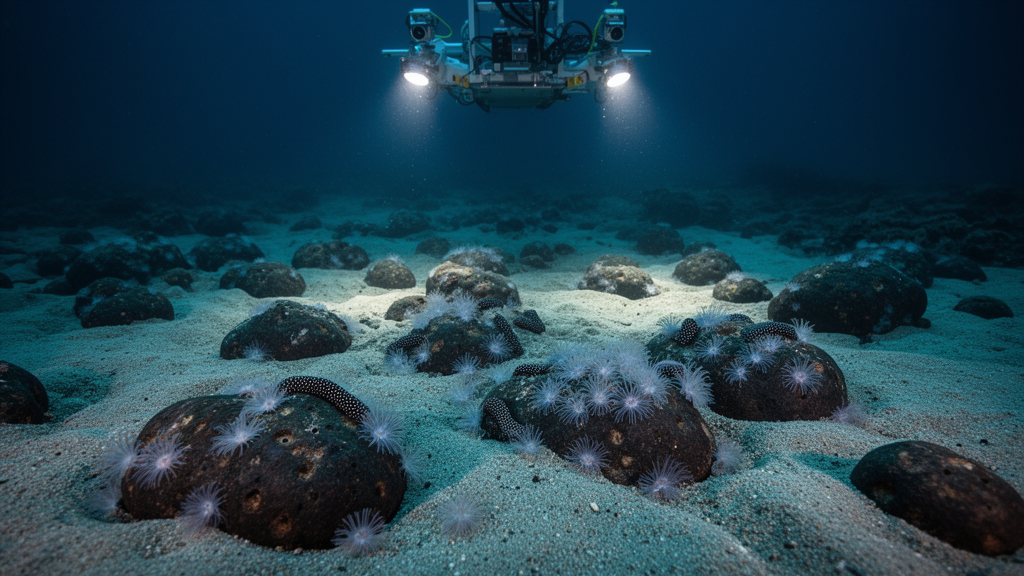
Four kilometers beneath the surface of the Northwest Pacific, the abyssal seafloor looks like a barren plain scattered with dark, potato-sized stones. Those stones, polymetallic nodules rich in nickel, copper, cobalt and manganese, have long been assumed to be straightforward benefactors of deep-sea life, offering the only hard surfaces for attachment across vast soft-sediment plains. A new study, published in Communications Earth & Environment, upends that simple assumption. Drawing on one of the largest image datasets ever assembled from a nodule-rich abyssal basin in the Northwest Pacific, researchers found that megafaunal communities do not simply grow richer as nodule cover increases. Instead, animal density follows a striking U-shaped curve, and the very character of the community transforms from one dominated by mobile grazers to one ruled by sessile filter-feeders as the stones pile up.
The team, led by Leyi Fang, Dongsheng Zhang, Chengcheng Shen and Chunsheng Wang of the Second Institute of Oceanography in Hangzhou, together with colleagues at Shanghai Jiao Tong University, Zhejiang Ocean University and Beijing Pioneer Hi-Tech Development Corporation, deployed seafloor imaging across a broad gradient of nodule cover in a Northwest Pacific nodule province. From the thousands of photographs, the researchers annotated a total of 169 morphospecies belonging to 14 phyla. Holothurians, the elongated sea cucumbers that plow through abyssal sediment, and sponges, the stationary pumpers of deep water, emerged as the dominant taxa, together anchoring the community structure of this remote ecosystem.
The surprise came when the researchers quantitatively assessed how megafaunal density responded to nodule cover. Rather than a monotonic rise, density declined from low to intermediate nodule cover, remained relatively stable across intermediate levels, and then increased sharply at high cover. The U-shaped response suggests that the relationship between nodules and abyssal animals is far more nuanced than the widely held assumption that more hard substrata automatically mean more biodiversity. At low cover, the seafloor community is dominated by mobile deposit-feeders, animals such as holothurians that ingest sediment and extract organic particles from it. At high cover, the balance flips decisively toward sessile filter-feeders, sponges and other attached organisms that strain suspended particles from the water column.
Technically, the transition is driven primarily by changes in the relative density of dominant taxa rather than by species turnover. In ecological terms, the same cast of characters persists across the nodule gradient, but their relative abundances shift dramatically, producing a pronounced change in community composition. This distinction matters for how scientists model and predict the impacts of deep-sea mining. If nodule removal primarily alters the balance of dominant species rather than eliminating rare ones outright, the ecological consequences of mining may manifest first as functional shifts in how the ecosystem processes carbon and nutrients, rather than as immediate extinctions.
The study also placed the Northwest Pacific nodule province in a global context by comparing it with the Clarion-Clipperton Zone, the vast fracture zone in the eastern Pacific that has become the epicenter of deep-sea mining interest. The comparison revealed that the Northwest Pacific supports lower megafaunal density and a distinct assemblage composition, yet achieves comparable diversity. The researchers attribute these large-scale differences to two oceanographic variables: the flux of particulate organic carbon, the rain of organic particles from the surface that feeds abyssal life, and carbonate saturation, which governs whether animals can build and maintain calcium carbonate structures. Both variables exert continental-scale influence on abyssal biogeography, meaning that nodule provinces cannot be managed as interchangeable units.
Polymetallic nodules form over millions of years as metal oxides precipitate around nuclei on the seafloor, growing at rates of millimeters per million years. Because they provide the only hard substrata across abyssal plains, they are widely assumed to enhance biodiversity, and this assumption has shaped environmental baselines for mining contracts. Yet, as the authors note, understanding of how nodule cover shapes megafaunal communities has remained limited, largely restricted to conditions of low nodule cover. By sampling across a broad gradient, the new study fills a critical gap, revealing that the ecological role of nodules changes qualitatively as cover increases, not just quantitatively.
The implications for deep-sea mining are direct. The International Seabed Authority has yet to finalize mining regulations, and environmental management of nodule provinces has often relied on region-wide assumptions drawn from the better-studied Clarion-Clipperton Zone. The new findings underscore the need for region-specific management, since the Northwest Pacific responds differently to nodule cover and hosts a distinct community composition. Mining scenarios that remove nodules from high-cover areas would disproportionately affect sessile filter-feeders, organisms that cannot relocate once their substratum is gone. Conversely, areas of low cover dominated by mobile deposit-feeders may respond to mining disturbance through different mechanisms, such as sediment plume effects on feeding and movement.
The research was conducted aboard the research vessel Dayangyihao, with cruises organized and supported by Beijing Pioneer Hi-Tech Development Corporation. Species annotation benefited from consultation with specialists in deep-sea taxonomy, and the statistical framework was refined through iterative analysis. The work was financially supported by the National Key Research and Development Program of China, the Scientific Research Fund of the Second Institute of Oceanography under the State Key Laboratory of Submarine Geoscience, and the UN Ocean Decade Programme Digital DEPTH, reflecting the growing international investment in abyssal ecosystem science ahead of anticipated mining decisions.
As demand for battery metals intensifies and the prospect of commercial nodule extraction moves closer, studies like this one provide the ecological evidence base that regulators and mining companies will need. The U-shaped density response and the mobile-to-sessile community transition reveal that nodule cover is not a simple biodiversity dial but a structural driver that reshapes how abyssal ecosystems function. Protecting the full range of nodule cover conditions, from sparse to dense, may therefore be essential to preserving the ecological integrity of the Northwest Pacific abyss, one of the least explored and most consequential frontiers in ocean science.
Subject of Research: Deep-sea megafaunal ecology and polymetallic nodule cover in the Northwest Pacific abyss
Article Title: Pronounced megafaunal community transition driven by polymetallic nodule cover in the Northwest Pacific abyss
Article References: Fang, L., Zhang, D., Shen, C., Pang, Y., Lin, S., Yan, R., Li, R., Li, H., & Wang, C. (2026). Pronounced megafaunal community transition driven by polymetallic nodule cover in the Northwest Pacific abyss. Communications Earth & Environment. https://doi.org/10.1038/s43247-026-04042-5
Image Credits: AI Generated
DOI: 10.1038/s43247-026-04042-5
Keywords: deep-sea mining, polymetallic nodules, abyssal plain, megafauna, Northwest Pacific, benthic ecology, Clarion-Clipperton Zone, holothurians, sponges, marine biodiversity, Pronounced, megafaunal
Cite Scienmag News
Violet Maxwell. (October 15, 2026). Nodules Reshape Abyssal Life in Surprising Ways, Deep-Sea Survey Reveals. Scienmag. https://scienmag.com/nodules-reshape-abyssal-life-in-surprising-ways-deep-sea-survey-reveals/
Violet Maxwell. "Nodules Reshape Abyssal Life in Surprising Ways, Deep-Sea Survey Reveals." Scienmag, 15 October 2026, https://scienmag.com/nodules-reshape-abyssal-life-in-surprising-ways-deep-sea-survey-reveals/. Accessed 15 October 2026.
Violet Maxwell. "Nodules Reshape Abyssal Life in Surprising Ways, Deep-Sea Survey Reveals." Scienmag. October 15, 2026. https://scienmag.com/nodules-reshape-abyssal-life-in-surprising-ways-deep-sea-survey-reveals/


