


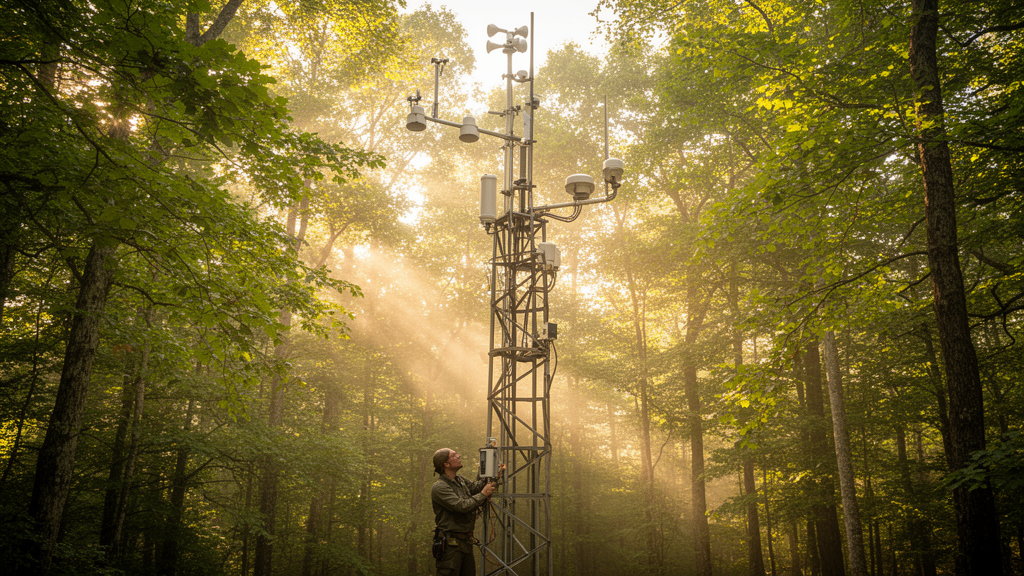
Forests are the planet’s silent water pumps. Every day, trees pull billions of liters of water from the soil and exhale it into the atmosphere through a process called evapotranspiration, a phenomenon that links the water cycle, the energy balance, and the carbon economy of every woody ecosystem on Earth. But as climate change intensifies heatwaves and droughts, scientists have struggled to measure this crucial flux accurately, especially under the very extremes that threaten forests most. Now, a team of Chinese researchers has unveiled an innovative solution: a hybrid artificial intelligence framework that merges classical physics with machine learning to estimate forest water use with unprecedented reliability, even when conditions turn brutal.
The research, published in Frontiers in Forests and Global Change, tackles a problem that has long frustrated climate scientists. Existing global evapotranspiration products, such as GLEAM and GLDAS, disagree substantially over forested terrain. Over China’s forests, the study found, these two widely used datasets differ by about 16 percent in their spatial means, with an average pixel-wise disagreement of 25 percent. In some subtropical and southwestern forest regions, the discrepancy exceeded 50 percent. Such uncertainty is not a trivial academic quibble; it undermines everything from drought early-warning systems to water-allocation planning for plantations.
The core challenge is that purely data-driven models, while impressively accurate within the range of their training data, tend to lose their predictive power precisely under the hot, dry, high-vapor-pressure-deficit conditions that increasingly threaten woody plants worldwide. These are the very conditions that matter most for understanding forest vulnerability to climate change. Machine-learning models trained on historical observations simply have not seen enough examples of extreme stress to extrapolate reliably, a limitation that has become glaringly apparent as compound heat and drought events trigger hydraulic failure and tree mortality across biomes once considered safe.
The new framework, developed by Jianzhe Ma, Qingshan Xu, and colleagues at institutions including the Chinese Academy of Sciences and the Chinese Academy of Forestry, takes a fundamentally different approach. Rather than relying solely on data or solely on physics, the model runs three parallel branches simultaneously. The first is a classical Penman-Monteith physical branch, in which a machine-learning model predicts surface resistance, the physiological control that trees exert on water loss through their stomata. The second is a purely data-driven branch that predicts latent heat flux directly from thirteen environmental predictors. The third branch learns a sample-level adaptive weight that fuses the two, shifting reliance toward whichever branch is locally more trustworthy.
To train and validate this hybrid model, the researchers assembled an impressive dataset: 17,515 daily eddy-covariance observations from twelve woody-plant flux sites spanning China’s remarkable climate gradient, from tropical seasonal rainforest in Xishuangbanna to boreal larch forest near the Russian border, and from rubber plantations on Hainan Island to alpine shrubland on the Qinghai-Tibet Plateau. They supplemented tower observations with reanalysis meteorology from ERA5-Land, satellite vegetation indices from MODIS, and a spaceborne canopy-height product that captures forest structure from orbit.
Under standard random cross-validation, the adaptive fusion and the data-driven branch performed comparably, each explaining 83 percent of the observed variance in daily latent heat flux. The physical branch alone was weaker, at 40 percent, reflecting the difficulty of capturing all the biotic and structural complexity of real forests with a single equation. But the true test came when the researchers deliberately trained the models only on mild-condition samples and then asked them to predict evapotranspiration under unseen climate extremes: heatwaves, droughts, and episodes of high atmospheric demand.
The results were striking. Under drought conditions, the data-driven branch’s explanatory power collapsed to just 24 percent of observed variance, while the adaptive fusion retained 61 percent. Under heat extremes, the fusion achieved 64 percent versus 60 percent for the data-driven model alone. Under high vapor pressure deficit, the fusion reached 74 percent versus 69 percent. Most remarkably, across the pooled all-extreme set of 2,067 days, the adaptive model explained 88 percent of the variance, outperforming both individual branches. The learned adaptive weight shifted measurably toward the physical branch under water- and energy-limited conditions, with mean values of 0.53 under drought and 0.47 under heat, confirming that the model intelligently leans on physics when data-driven inference becomes unreliable.
The interpretability analysis revealed that net radiation is the single most important control on woody-plant evapotranspiration, followed by canopy greenness indices such as MSAVI and NDVI, atmospheric humidity, and canopy height. Soil moisture emerged as a dominant control only under water-limited conditions, consistent with the well-known transition from energy-limited to water-limited evaporative regimes. Canopy height, retrieved from space, proved important because it governs aerodynamic conductance and the coupling between the forest canopy and the atmosphere, a structural influence that simpler models often miss.
The spatial patterns the model revealed tell a compelling ecological story. Multi-year mean evapotranspiration declined from 2.9 millimeters per day in tropical rubber plantations to just 0.9 millimeters per day in boreal larch forest, a threefold difference that mirrors the gradient in available energy, temperature, and growing-season length. All climate zones showed a pronounced summer maximum, with the largest seasonal amplitude in warm-temperate and tropical forests and the smallest in the cold-temperate zone. These patterns establish a quantitative baseline for the water use of China’s principal woody-plant biomes.
Perhaps most importantly for practical applications, the analysis identified which woody-plant communities are most exposed to model-challenging extremes. Boreal larch forest experienced drought conditions on 35 percent of observation days, while dry-hot savanna woodland and rubber plantation faced heat and high-vapor-pressure-deficit extremes on up to 21 and 30 percent of days, respectively. In contrast, tropical seasonal rainforest and subtropical evergreen broadleaf forest were comparatively buffered, with fewer than 1 percent of days classified as extreme. Because these are precisely the conditions under which purely data-driven models lose skill, the findings pinpoint where physics-constrained estimation is most urgently needed.
The framework is not yet an operational monitoring tool, and the researchers are careful to frame it as a promising foundation rather than a finished product. The twelve flux sites, though climatically diverse, cannot capture the full structural and taxonomic diversity of China’s forests. The model operates at the ecosystem scale without incorporating leaf-level physiological measurements such as sap flow or water potential. And the gridded inter-comparison relied on existing products because generating a spatially continuous national realization of the new model was beyond the current study’s scope. Nevertheless, the combination of interpretability, physical consistency, and demonstrated robustness under extremes positions this approach as a compelling template for the next generation of forest water-use monitoring systems.
As climate change accelerates and compound extremes become the norm rather than the exception, the ability to track how forests use water, reliably and transparently, will become ever more critical. This study demonstrates that the answer lies not in abandoning physics for artificial intelligence, nor in ignoring the power of data-driven learning, but in teaching the two to work together, with a learned weight that knows when to trust each one. In an era of unprecedented environmental stress, that kind of adaptive wisdom may prove to be exactly what forest science needs.
Subject of Research: An interpretable, physics-constrained model for woody-plant evapotranspiration under heat and drought extremes in China
Article Title: An interpretable, physics-constrained model for woody-plant evapotranspiration under heat and drought extremes in China
Article References: Ma, J., Xu, Q., Yu, M., Lin, X., Zhang, S., Zhou, F., Wang, H., & Yuan, W. (2026). An interpretable, physics-constrained model for woody-plant evapotranspiration under heat and drought extremes in China. Frontiers in Forests and Global Change, 9, Article 1987392. https://doi.org/10.3389/ffgc.2026.1987392
Image Credits: AI Generated
DOI: 10.3389/ffgc.2026.1987392
Keywords: interpretable, physics-constrained, model, woody-plant, evapotranspiration, under, heat, drought, extremes, China, scientific research
Cite Scienmag News
Katie Riggs. (October 15, 2026). Physics Meets AI: A Smarter Way to Track How Thirsty Forests Really Are. Scienmag. https://scienmag.com/physics-meets-ai-a-smarter-way-to-track-how-thirsty-forests-really-are/
Katie Riggs. "Physics Meets AI: A Smarter Way to Track How Thirsty Forests Really Are." Scienmag, 15 October 2026, https://scienmag.com/physics-meets-ai-a-smarter-way-to-track-how-thirsty-forests-really-are/. Accessed 15 October 2026.
Katie Riggs. "Physics Meets AI: A Smarter Way to Track How Thirsty Forests Really Are." Scienmag. October 15, 2026. https://scienmag.com/physics-meets-ai-a-smarter-way-to-track-how-thirsty-forests-really-are/


