


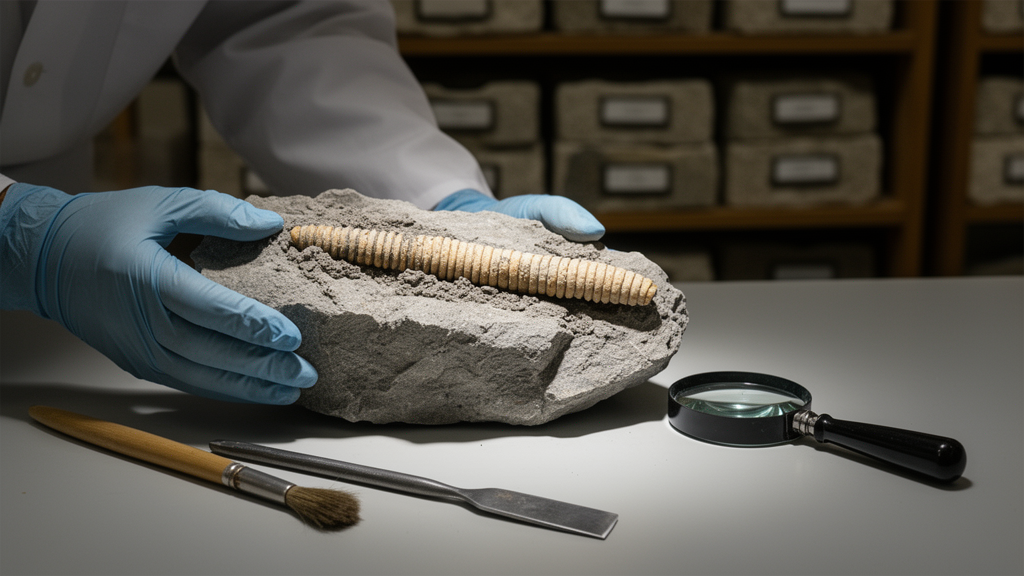
A tiny calcareous tube glued to the shell of a 40-million-year-old sea snail has just rewritten part of the evolutionary timeline of one of the ocean’s most successful groups of worms. Paleontologists studying fossils from the Cowlitz Formation in Lewis County, Washington State, have identified a brand-new species of the serpulid tubeworm genus Hydroides, named Hydroides engi. The discovery, published in the journal Zitteliana, marks the first confirmed Eocene record of a genus that today thrives in warm shallow seas around the world, and it offers a rare glimpse into the deep history of a group whose fossil record has long been frustratingly incomplete.
Serpulid tubeworms are marine segmented worms belonging to the polychaetes, a hugely diverse class of annelids. What makes them special is their architecture: they secrete their own calcareous tubes, which they cement permanently onto hard surfaces such as rocks, shells, and even ship hulls. From these protective tubes they extend feathery feeding crowns into the water column. The group has existed since the Permian period, more than 250 million years ago, and their sturdy mineralized tubes fossilize well. Yet identifying fossil serpulids to genus and species is notoriously difficult, because the features that modern taxonomists rely on most, particularly the elaborate chitinous operculum that seals the tube opening, almost never survive the fossilization process.
Hydroides is the largest recognized genus of living serpulids, with dozens of described species found predominantly in tropical to subtropical shallow waters worldwide. Its two-tiered operculum, crowned with chitinized spines, is a signature feature of the living animals. But because these soft and chitinous structures decay, paleontologists must depend entirely on tube morphology to recognize the genus in the fossil record, a task complicated by the fact that serpulid tubes vary enormously within a single species and can look strikingly similar across unrelated lineages, a phenomenon known as homeomorphy. This is precisely why the new Washington State material matters so much.
The fossils were collected as loose specimens, or float, from exposures of the Cowlitz Formation at a classic site known as the Big Bend locality along the Cowlitz River, east of the town of Vader. The exposure, only about 20 meters thick, represents marine deposition at water depths of up to 200 meters in a warm to tropical environment during the late middle Eocene, roughly 40 to 43 million years ago. All of the studied specimens are housed in the collection of the Burke Museum of Natural History and Culture at the University of Washington in Seattle, and most were collected decades ago, before access to the site became restricted to boat arrivals.
The new species was formally established on the basis of a holotype tube attached to the gastropod Ranella washingtoniana, along with paratypes and referred specimens encrusting shells of the predatory snail Murex sopenahensis. The tubes are thin and subtly subquadrangular in cross section during early growth, with clearly visible growth lines and delicate, flange-like peristomes. As the tube matures, its outer surface develops a flattened upper side bordered by low but distinct crests, marked by a faint central longitudinal thread. In the final growth stage, preserved in one paratype, the tube becomes more rounded and rugose, its surface covered with dense corrugations and small vesicles. The lumen, the internal channel through which the worm once lived, remains circular and smooth throughout.
One of the most intriguing aspects of Hydroides engi is how its growth responded to the shape of its host. The holotype, attached to a large Ranella shell, grew mostly straight until it reached the snail’s aperture and was forced to double back on itself. Specimens attached to smaller Murex shells had far less room and responded by twisting and coiling repeatedly, cementing the tube to itself in many places and forming a tangled pile in which the flattened upper surface points in multiple directions. The largest preserved tube measures an estimated 13.6 millimeters in length, with a greatest diameter of 5.1 millimeters, dimensions that help distinguish the new species from its smaller Miocene relatives in Egypt and from the Paleocene Hydroides? quadrata of Denmark, which reaches only 1.6 millimeters across.
The discovery dramatically reshapes what scientists know about the genus’s deep past. Before this study, the Paleogene fossil record of Hydroides amounted to a handful of questionable or poorly documented occurrences: a possible Danian species from cold-water coral reefs at Faxe in Denmark, unfigured tubes from Paleocene cores drilled on the Emperor Seamounts in the western Pacific, and an unconfirmed suggestion that an Italian Eocene species originally described as Serpula athesiana might belong to Hydroides. Meanwhile, a Paleocene species from New Jersey, Hydroides primitiva, described in 1948 from nothing more than the coiled internal filling of a tube, has now been declared a nomen dubium, a dubious name lacking the diagnostic characters needed to justify its identification as an annelid at all. The genus only becomes well represented in the fossil record from the Miocene onward, with numerous occurrences across Europe, North Africa, and the Central Paratethys.
Because confirmed pre-Miocene records of Hydroides are so scarce, each new one carries real weight for reconstructing the genus’s biogeographic history. Previous researchers have proposed, based on opercular morphology and molecular divergence estimates, that Hydroides originated either in the Indo-West-Pacific or in the ancient western Tethys Sea. The presence of a confirmed Eocene species in the northeastern Pacific, the first Cenozoic record of the genus from western North America, indirectly supports the hypothesis that Hydroides began dispersing during the Paleocene and Eocene, with its main radiation occurring later, during the Miocene. In other words, the genus’s apparent modern focus of diversity may reflect a later chapter of a much longer story that began tens of millions of years earlier and spread across multiple ocean basins.
The Cowlitz fossils also preserve an ecological story. The tubes of Hydroides engi are epibionts, organisms that live attached to the surfaces of other organisms, and the shells they colonized were almost certainly occupied by hermit crabs at the time. Several lines of evidence point to this conclusion. The worm tubes never overgrew the shell apertures, indicating the shells were inhabited while the worms grew. Only a few of the moderately abundant Murex sopenahensis shells at the locality bear encrusters, while the rest are clean and unworn, exactly the pattern expected if the encrusted shells had passed through the lives of hermit crab occupants. Several living Hydroides species are documented associates of hermit crabs, sometimes on Murex shells, and the Oligocene Hydroides record from North Carolina also appears to represent a hermit crab association. Although no direct hermit crab fossils have been found in the Cowlitz Formation, the worm tubes stand as indirect testimony of their presence.
The study also documents a previously unrecorded member of the Cowlitz ecosystem: a vermetid gastropod, a shell-building snail that mimics worm tubes, found attached to the apical fragment of a Turritella shell. The Cowlitz Formation as a whole hosts a diverse shallow-marine invertebrate fauna of more than 200 species, dominated by bivalves and gastropods but also including scaphopods, nautiloids, foraminiferans, crustaceans, and corals, with ostracods remaining the only major group still awaiting formal study. The researchers suggest that more fossils of Hydroides may be sitting unrecognized in museum drawers, particularly in regions such as western North America where fossil annelids have received comparatively little attention. For now, Hydroides engi, named in honor of Ronald C. Eng, the Burke Museum’s longtime invertebrate paleontology collection manager, stands as both a taxonomic milestone and a reminder that even the humblest museum specimens can hold the keys to rewriting evolutionary history.
Subject of Research: A new Eocene fossil serpulid tubeworm species, Hydroides engi, from the Cowlitz Formation of Washington State, USA
Article Title: A new Eocene species of Hydroides ( Polychaeta , Serpulidae ) from the Cowlitz Formation, Lewis County, Washington State, USA
Article References: Goedert, J. L., Rich, M. A., & Kočí, T. (2026). A new Eocene species of Hydroides (Polychaeta, Serpulidae) from the Cowlitz Formation, Lewis County, Washington State, USA. Zitteliana, 100, 81-91. https://doi.org/10.3897/zitteliana.100.191011
Image Credits: AI Generated
DOI: 10.3897/zitteliana.100.191011
Keywords: Hydroides engi, Serpulidae, polychaete, Eocene, Cowlitz Formation, Washington State, fossil tubeworm, paleontology, epibiont, hermit crab, Burke Museum, biogeography
Cite Scienmag News
Gavin Prescott. (October 15, 2026). Fossil Tubeworm from Washington State Rewrites the Story of a Widespread Marine Genus. Scienmag. https://scienmag.com/fossil-tubeworm-from-washington-state-rewrites-the-story-of-a-widespread-marine-genus/
Gavin Prescott. "Fossil Tubeworm from Washington State Rewrites the Story of a Widespread Marine Genus." Scienmag, 15 October 2026, https://scienmag.com/fossil-tubeworm-from-washington-state-rewrites-the-story-of-a-widespread-marine-genus/. Accessed 15 October 2026.
Gavin Prescott. "Fossil Tubeworm from Washington State Rewrites the Story of a Widespread Marine Genus." Scienmag. October 15, 2026. https://scienmag.com/fossil-tubeworm-from-washington-state-rewrites-the-story-of-a-widespread-marine-genus/


