


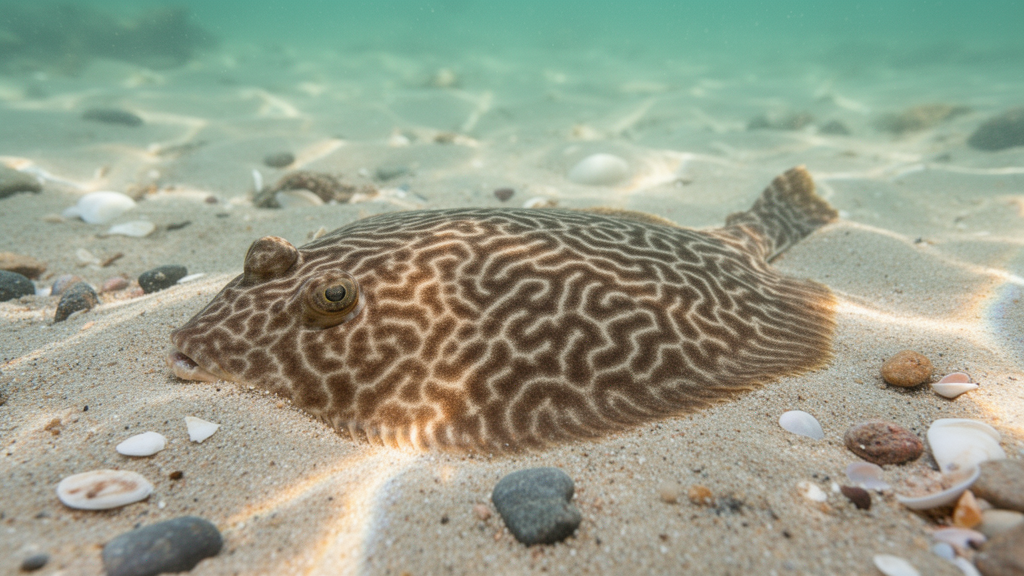
Marine biologists have described a striking new species of flatfish from Chinese waters, one whose ocular side is decorated with an intricate flaxen-white pattern of interlocking stripes that resembles a maze. The fish, formally named Soleichthys labyrinthus and given the English common name mesh sole, was unveiled in the journal ZooKeys based on a holotype and 24 paratypes trawled from the northern South China Sea and the East China Sea. Its discovery lifts the number of recognized species in the sole genus Soleichthys to eleven and adds a surprising new branch to a group of fishes that has long confounded taxonomists with its look-alike species and chameleon-like abilities.
The genus Soleichthys, established by Pieter Bleeker in 1860, belongs to the family Soleidae, the true soles — flattened, bottom-dwelling fishes in the order Pleuronectiformes. What sets these soles apart from other soleids is an extraordinary anatomical feature: an extremely elongated, tubular anterior nostril on the eyed side of the head. When directed backward, this nostril can reach the lower orbit of the eye or even extend beyond its midpoint. Certain species in the genus can also shift their body coloration in response to environmental cues, making them masters of camouflage on sandy and muddy seafloors. That flexibility, combined with genuinely similar body plans across species, has repeatedly muddled morphology-based identification, and the genus has been shuffled, synonymized, and resurrected several times since the nineteenth century.
The road to the new species began at a fish market in Xiamen, Fujian Province, in early 2026. During routine fish sampling along the northern coast of the South China Sea, researchers collected several soles that they could immediately assign to Soleichthys thanks to well-developed pectoral fins on both sides of the body and the signature elongated anterior nostrils. But one feature stopped them short: a unique flaxen-white, labyrinth-shaped color pattern on the eyed side that matched no known species. Nor did it match an undescribed Soleichthys specimen that had been recorded decades earlier from waters off Taiwan, suggesting that this fish had been slipping through nets, and through taxonomic attention, for a very long time.
In total, 25 specimens entered the study. Twenty-three were purchased at the Xiamen fish market between March and April 2026; local fishermen reported that the animals had been taken by bottom trawling in the northern South China Sea. Two additional specimens came from bottom-trawl surveys in the East China Sea, one collected in September 2025 and one in December 2022 — the latter a quiet hint that the species has been sitting in museum and institute collections for years, unrecognized. The specimens are now catalogued in the fish collections of the East China Sea Fisheries Research Institute, the Institute of Zoology of the Chinese Academy of Sciences, the South China Sea Institute of Oceanology, and the Shanghai Natural History Museum.
Quantifying the new species required meticulous counting and measuring. The team followed standard protocols for meristic counts and morphometric measurements, taking all values to the nearest 0.1 millimeter with vernier calipers on the ocular side. Fine traits, including scale structure and the branching patterns of fin rays, were examined under a stereomicroscope, and lateral-line scales were counted the same way. Vertebral counts were obtained from radiographs of the holotype and ten paratypes. The results paint a consistent picture: the holotype, a 134-millimeter female-sized adult in standard length, carries 80 dorsal-fin rays, 65 anal-fin rays, five pelvic-fin rays on each side, and 85 lateral-line scales, with a vertebral formula of 9 plus 36, totaling 45 vertebrae.
Across the type series, the species shows 78 to 86 dorsal-fin rays and 65 to 73 anal-fin rays, 84 to 96 lateral-line scales, and 43 to 45 total vertebrae — counts that immediately separate it from most close relatives. S. dori, S. heterorhinos, S. nigrostriolatus, and S. multifasciatus, for example, all have 87 or more dorsal-fin rays. The new species has five pelvic-fin rays per side, versus four in S. tubiferus and S. multifasciatus. Even the pectoral fin offers diagnostic clues: the two or three uppermost rays of the eyed-side fin are nearly equal in length, whereas in S. oculofasciatus and S. siammakuti the first ray is distinctly longer than the second. And while the basal third of the uppermost three or four pectoral rays is covered in ctenoid scales, the eyed-side pectoral fin is completely naked in S. maculosus and S. siammakuti and scaled to mid-ray length in S. microcephalus.
Coloration, however, is the mesh sole’s headline act. The eyed side is tawny brown, darker along the midline of the body, and overlaid with narrow flaxen-white stripes that join into an unmistakable reticulated, labyrinth-like network — the feature that inspired both the scientific epithet labyrinthus, Latin for labyrinth-shaped, and the Chinese name Miwang Changbita, meaning mesh long-nose sole. Crucially, the species lacks the complete transverse bands that decorate most of its congeners, as well as the narrow black vermiculate stripes of S. nigrostriolatus. Two prominent white blotches sit along the lateral line, one anterior and one posterior, and a series of four — occasionally five — small pale blotches runs longitudinally along the bases of both the dorsal and anal fins, the first anal blotch usually opposite the second dorsal one. The caudal fin is striking as well: a broad black transverse band followed posteriorly by a broad white marginal band about half as wide as the black one. On the blind side, the body is pale while the dorsal and anal fins are dark brown to black with white ray tips and bases.
Morphology alone rarely settles the status of a new flatfish, so the team turned to DNA barcoding. They generated mitochondrial cytochrome c oxidase subunit I (COI) sequences for three specimens of the new species and combined them with 13 database sequences representing five related species, using the banded sole Zebrias quagga as an outgroup. A maximum-likelihood analysis run in IQ-TREE, with nodal support assessed through 1,000 bootstrap replicates, placed the three S. labyrinthus specimens in a strongly supported monophyletic clade — bootstrap support of 97 — that is sister to all other sampled Soleichthys species. In other words, the maze-patterned sole is not just a variant of something already known; it occupies its own distinct evolutionary lineage within the genus.
The genetic distances reinforce that conclusion. Kimura 2-parameter distances calculated from the COI sequences show essentially no divergence among the new species’ own specimens, with intraspecific values of 0.000 to 0.004 across the genus — with one notable exception. Meanwhile, the distances between S. labyrinthus and its congeners are deep: 0.182 relative to S. heterorhinos, rising to 0.227 relative to S. maculosus, values typical of well-separated species rather than populations of a single one. Intriguingly, the analysis also flagged a problem with the existing data: the two database sequences identified as S. heterorhinos did not form a monophyletic group and showed a surprisingly high intraspecific distance of 0.182, a red flag suggesting that at least some records filed under that name may conceal further hidden diversity — a question the authors say requires further verification.
Beyond adding an eleventh species, the study delivers a fully updated identification key covering all recognized members of Soleichthys, built from original species descriptions, published literature, and fresh comparisons with non-type specimens of S. heterorhinos. The key routes users to S. labyrinthus by the combination of a white-caudal-margined eye, the absence of transverse bands, a relatively wide white tail band, and the pair of white lateral-line spots. Given that the genus has already proven to be a labyrinth of look-alikes — and that one of its own names may itself be a composite of multiple species — the mesh sole may prove to be less an ending than a beginning. The waters of the South China Sea, it appears, still hold flatfish secrets waiting to be read from the patterns on their backs.
Subject of Research: Taxonomic description and genetic identification of a new species of sole fish from Chinese seas
Article Title: A new species of sole ( Pleuronectiformes , Soleidae ), Soleichthys labyrinthus , from the China Sea
Article References: A new species of sole ( Pleuronectiformes , Soleidae ), Soleichthys labyrinthus , from the China Sea. (n.d.). https://doi.org/10.3897/zookeys.1294.197188
Image Credits: AI Generated
DOI: 10.3897/zookeys.1294.197188
Keywords: Soleichthys labyrinthus, flatfish, taxonomy, new species, Soleidae, South China Sea, COI barcoding, phylogenetics, East China Sea, marine biodiversity, ZooKeys, species
Cite Scienmag News
Drew Townsend. (October 15, 2026). Labyrinth-Patterned Flatfish Discovered in the South China Sea Is a Brand-New Species. Scienmag. https://scienmag.com/labyrinth-patterned-flatfish-discovered-in-the-south-china-sea-is-a-brand-new-species/
Drew Townsend. "Labyrinth-Patterned Flatfish Discovered in the South China Sea Is a Brand-New Species." Scienmag, 15 October 2026, https://scienmag.com/labyrinth-patterned-flatfish-discovered-in-the-south-china-sea-is-a-brand-new-species/. Accessed 15 October 2026.
Drew Townsend. "Labyrinth-Patterned Flatfish Discovered in the South China Sea Is a Brand-New Species." Scienmag. October 15, 2026. https://scienmag.com/labyrinth-patterned-flatfish-discovered-in-the-south-china-sea-is-a-brand-new-species/


