


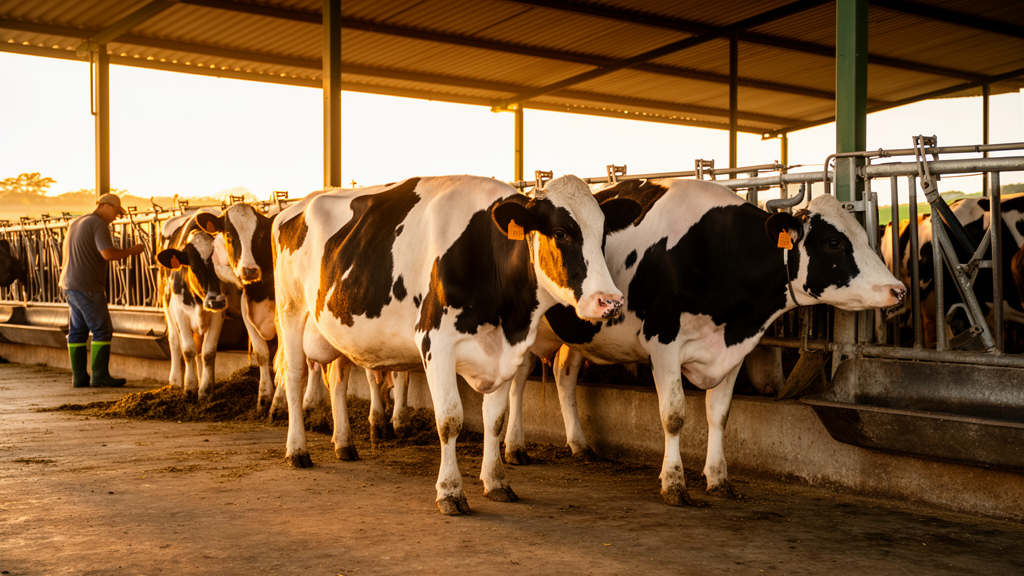
A rigorous on-farm welfare audit of dairy farms in São Paulo State, Brazil, has uncovered an uncomfortable paradox: farms that pass one of the world’s most widely used welfare assessment schemes with a respectable rating can still be home to cows with serious lameness, filthy legs and udders, skin lesions, and calves disbudded with a hot iron and no pain relief. The study, published in Frontiers in Animal Science, examined three pasture-based and three continuously confined dairy farms across three milk-producing regions of São Paulo State, and its central message is a caution to anyone who reads a welfare label as a guarantee of cow comfort.
The research team, based at the Luiz de Queiroz College of Agriculture of the University of São Paulo, revisited archived field records originally collected between December 2013 and February 2014 during master’s research completed in 2015. Each of the six commercial farms was visited once, during the warm and rainy season, and a full assessment took roughly seven hours per farm, combining direct observations of individual animals, inspection of resources such as water troughs and shade, and a structured interview with the person responsible for herd management. The authors are careful to frame the work as a descriptive multi-case study: with only three purposively selected farms per management system and a single seasonal snapshot, the findings describe the assessed farms rather than estimate current prevalence across Brazilian dairying.
The assessments were anchored to the 2009 Welfare Quality Assessment Protocol for Cattle, a framework that organizes dozens of animal-based, resource-based, and management-based measures into four principles: Good Feeding, Good Housing, Good Health, and Appropriate Behavior. Each principle is scored from 0 to 100, and the four scores feed into an overall classification of Excellent, Enhanced, Acceptable, or Not classified. For the pasture-based herds, the team used an adaptation developed by Patrícia Garcia for Brazilian grazing systems, which excluded cubicle-specific measures that make no sense on pasture and added tropical-relevant indicators such as tick infestation, shade availability, and water-trough accessibility. Crucially, the two procedures differ in both content and aggregation rules, so the authors explicitly warn that scores from pasture and confined farms cannot be directly compared.
The overall verdicts looked reasonably encouraging at first glance. Four of the six farms met the historical protocol requirements for an Enhanced classification, and the remaining two were rated Acceptable; none failed. But the aggregate scores concealed deep problems. Good Health was consistently the weakest principle on every single farm, ranging from 30 to 35 points on pasture-based farms and from 22 to 25 on confined farms, well below the scores achieved for feeding and housing. Perhaps the most striking illustration of threshold sensitivity came from one confined farm: with a one-point drop in its Appropriate Behavior score, or a two-point drop in Good Health, its classification would have collapsed from Acceptable to Not classified. A label, in other words, can hang on a knife’s edge.
Lameness was one of the most consequential findings. Moderate locomotion impairment affected between 14 and 28 percent of assessed cows on the three pasture-based farms, with severe impairment ranging from zero to 8 percent. On the confined farms the picture was markedly worse: moderate impairment ranged from 30 to 41 percent, and severe impairment from 18 to 24 percent. The authors stress that these figures are descriptive case observations and cannot be attributed to housing system, since herd size, breed, flooring, bedding, hoof care, and stocking density were not controlled. Still, they note that the pattern is biologically consistent with evidence that pasture access can support locomotion recovery, while also pointing out that well-designed housing can mitigate the same risks. Locomotion, they argue, should be read as a management outcome rather than an automatic consequence of production system.
Skin and limb injuries told a similar story of trouble on both sides of the pasture fence. Severe integument alterations affected 25 to 57 percent of cows on pasture-based farms and 41 to 65 percent on confined farms. On pasture, the recorded problems included lesions and hair loss compatible with prior tick infestation, photosensitization, dermatobiosis, injection-site abscesses, and papillomas. In the confined herds, abrasions and swellings clustered around the hock, knee, flank, and neck, and the assessors’ field notes flagged bedding condition and contact with neck rails or headlocks as plausible local contributors. The authors cite a recent Brazilian study of 335 grazing dairy cows under tropical conditions in which 81.5 percent carried at least one integumentary injury, reinforcing that pasture access does not eliminate injury risk when handling facilities, fences, walking tracks, vegetation, and parasites remain hazards.
Hygiene was the constraint that united every farm in the study. All six exceeded the protocol’s serious-problem threshold for at least one body region, and all three continuously housed farms exceeded it for the lower hind legs, udder, and upper hind legs or flank simultaneously. On two of the pasture farms, more than half of the cows had dirty lower hind legs, and more than half had dirty upper legs or flanks on two of them as well. Dirty cows matter beyond appearances: cow hygiene is associated with somatic cell count and mastitis risk, and the bulk-tank somatic cell counts of all three pasture-based farms exceeded the protocol’s alarm threshold of 600,000 cells per milliliter. The authors caution that in grazing systems, soiling may reflect rainfall, mud, and congregation around shade and water points rather than poor bedding management, so the corrective actions differ by context.
Water and thermal environment added further concerns. On one pasture farm, water was not available in a sufficiently efficient, abundant, and clean manner; another had clean, functional drinkers but only one water source per group; and a confined farm scored poorly for thirst because its drinkers were dirty. Shade provision scored a perfect 100 on one pasture farm but only 20 on another, which lacked sufficient and evenly distributed shade, a subtle but important point, since shade concentrated around feed or water can increase competition and disadvantage subordinate cows. And in a finding the authors describe as consistent and preventable, all six farms practiced hot-iron disbudding without anesthesia or analgesia, despite evidence that local anesthesia reduces acute pain and that combining it with a non-steroidal anti-inflammatory drug provides more sustained relief.
Behavior scores highlighted both the promise and the pitfalls of the assessment method. Pasture-based farms scored between 38 and 67 for Appropriate Behavior and all received the maximum score for expression of other behaviors because cows had year-round pasture access, while all three confined farms received zero on that criterion simply because no pasture was provided. Given that the behavioral tests also differed in duration and location between protocol versions, the authors insist these numbers mix genuine observation with structural features of the procedures. One confined farm’s qualitative behavioral assessment described cows as fearful, frustrated, bored, restless, apathetic, and stressed, a within-farm signal the authors say should prompt repeated assessment rather than causal conclusions about housing.
The practical takeaway from the study is a push for farm-specific action rather than system rivalry: routine animal-based monitoring, lameness prevention, hygienic resting and walking areas, clean and redundant water points, adequate and well-distributed shade, multimodal pain control for disbudding, and worker education. The authors also argue that a dashboard combining the four principle scores with sentinel measures such as lameness, leanness, integument lesions, and somatic cell count may serve farmers better than a single classification label. With data now more than a decade old, the scores cannot be read as today’s conditions or as official classifications under the protocol’s 2023 Version 3, which changed how thirst and injury measures are calculated. What the study delivers instead is a methodological warning with lasting relevance: an Enhanced rating can coexist with substantial suffering, and only measure-level scrutiny reveals where the real welfare work lies.
Subject of Research: Welfare assessment of pasture-based and confined dairy farms in São Paulo State, Brazil
Article Title: Welfare assessment in pasture-based and confined dairy farms in São Paulo State, Brazil: a descriptive multi-case study identifying health and hygiene constraints
Article References: Pinto, A. L. M., Silveira, R. M. F., Nogueira, A. G. D., & Silva, I. J. O. D. (2026). Welfare assessment in pasture-based and confined dairy farms in São Paulo State, Brazil: a descriptive multi-case study identifying health and hygiene constraints. Frontiers in Animal Science, 7, Article 1985819. https://doi.org/10.3389/fanim.2026.1985819
Image Credits: AI Generated
DOI: 10.3389/fanim.2026.1985819
Keywords: dairy cattle, animal welfare, Welfare Quality protocol, lameness, hygiene, pasture-based systems, confined housing, disbudding pain relief, São Paulo State, animal-based measures, Brazil, farm assessment
Cite Scienmag News
William Thompson. (October 15, 2026). Healthy Labels, Hidden Hurts: Brazilian Dairy Cows Score Better Than They Live. Scienmag. https://scienmag.com/healthy-labels-hidden-hurts-brazilian-dairy-cows-score-better-than-they-live/
William Thompson. "Healthy Labels, Hidden Hurts: Brazilian Dairy Cows Score Better Than They Live." Scienmag, 15 October 2026, https://scienmag.com/healthy-labels-hidden-hurts-brazilian-dairy-cows-score-better-than-they-live/. Accessed 15 October 2026.
William Thompson. "Healthy Labels, Hidden Hurts: Brazilian Dairy Cows Score Better Than They Live." Scienmag. October 15, 2026. https://scienmag.com/healthy-labels-hidden-hurts-brazilian-dairy-cows-score-better-than-they-live/


