


Spiders have a way of commanding human attention that is stranger than simple fear would predict. A new eyetracking study from the University of Nebraska-Lincoln, published in Frontiers in Arachnid Science, has charted precisely where people’s eyes go when they are shown photographs of spiders alongside other arthropods, and the results defy a straightforward story of avoidance. When a spider shared the screen with nearly any other creature, from butterflies to centipedes, participants’ gazes drifted toward the non-spider image. Yet when two spiders competed for attention, viewers’ eyes were drawn toward the very features people say they find frightening: prominent fangs, silken webs, clusters of eggs, and a spider caught mid-meal.
The research team, led by psychologist Emma C. Brase together with arachnologist Eileen A. Hebets and colleagues, recruited 118 undergraduate students and recorded their eye movements with a desktop-mounted SR Research EyeLink 1000 system. Participants sat with their chins and foreheads resting against supports, roughly 44 centimeters from the screen, while viewing 130 randomly ordered pairs of photographs for four seconds each. The images, all realistic photographs taken by an arachnologist, deliberately avoided artificial manipulation of brightness, contrast, or salience, so that the responses recorded would reflect as natural a viewing experience as possible. Before the experiment began, participants also completed a validated spider phobia questionnaire and a survey of their attitudes toward spiders.
The methodological core of the study lies in four complementary eyetracking metrics. Total dwell time measured how long participants spent looking at each image across a trial; first run dwell time captured how long they lingered on their initial visit; first fixation time recorded how quickly their gaze landed on an image after the trial began; and run count tallied how many times they returned to an image. In attention research, a shorter first fixation time, a larger run count, and greater dwell time together signal an attentional bias toward a stimulus. Analyzing thirteen distinct image pairings with repeated measures ANOVAs, and validating the results with negative binomial mixed models, the team looked for converging evidence across these measures rather than relying on any single indicator.
The headline finding was unambiguous: spiders lose attentional contests against almost everything else. Participants fixated faster on butterflies than on spiders and showed significantly longer dwell times, longer first run dwell times, and quicker first fixations on non-butterfly insects, non-spider arachnids, and myriapods such as centipedes and millipedes. They also returned more often to the non-spider images. The pattern held even when the competing image was itself an arachnid, or when it possessed traits people typically associate with spider aversion. Myriapods, with far more legs than any spider, still attracted more attention. The authors interpret this as active avoidance: participants likely registered the spider’s presence but deliberately directed their first saccade elsewhere.
This avoidance pattern echoes what researchers have documented with other emotional stimuli. In earlier work on political orientation, both liberals and conservatives oriented first toward negative images, but the responses differed in how long they lingered. Studies of contamination fear have similarly found that disgusting stimuli may be attended to rapidly and then actively avoided. The spider results fit this vigilance-avoidance framework: the eyes seem to detect the aversive stimulus quickly, then steer away from it early in the trial. Notably, the present study did not support the idea of a generalized spider-like cognitive category. Participants appeared to readily distinguish spiders from other arachnids, suggesting that the aversion is tuned specifically to spiders rather than to their entire class.
Scorpions, often assumed to be the original evolutionary trigger of arachnid fear, produced their own distinct pattern. Compared with non-scorpion arachnids, scorpion images received longer first run dwell times for the non-scorpion side, indicating aversion, though the difference did not extend to all metrics. The effect was strongest among participants with low spider phobia, and among female participants, who spent more time viewing non-scorpion arachnids than scorpions. This aligns with prior findings that people with low spider fear are the most distracted by scorpions and snakes, possibly because these animals are prioritized as evolutionarily relevant threats. The paradox is stark: only about 0.5 percent of spider species pose any danger to humans, compared with roughly 23 percent of scorpion species, yet people show strong aversion to both.
When spiders were pitted directly against other spiders, the avoidance gave way to something more intriguing. Except for hairiness, attention was drawn toward images bearing additional spider-relevant cues. Participants dwelled longer on larger-eyed jumping spiders, colorful jumping spiders, spiders on webs, spiders with eggs, spiders with conspicuous fangs, and spiders eating, and they fixated faster on most of these images. The one consistent exception was hair: less hairy spiders received more attention and faster fixations than their hairier counterparts, consistent with earlier work linking hairiness to disgust. Hairy spiders were generally avoided, while spiders in webs, guarding eggs, or feeding, features that could plausibly amplify fear, actually pulled the gaze in.
The authors propose two non-exclusive explanations. The first is simple stimulus richness: when both images contain a spider, the one offering more to look at wins. The second is more psychologically interesting, involving predictability of movement. Prior research has established that fast, jerky, unpredictable movement is a primary driver of spider anxiety. A spider on a web, guarding eggs, or consuming prey is, by the logic of everyday experience, a spider that will stay put. Viewers may implicitly prefer the images in which the animal’s next move is constrained, while a spider standing on open ground implies the possibility of sudden, erratic motion. Consistent with this, participants showed no difference in first fixation time between spiders with and without conspicuous fangs, suggesting that the presence of dangerous features alone does not automatically trigger avoidance.
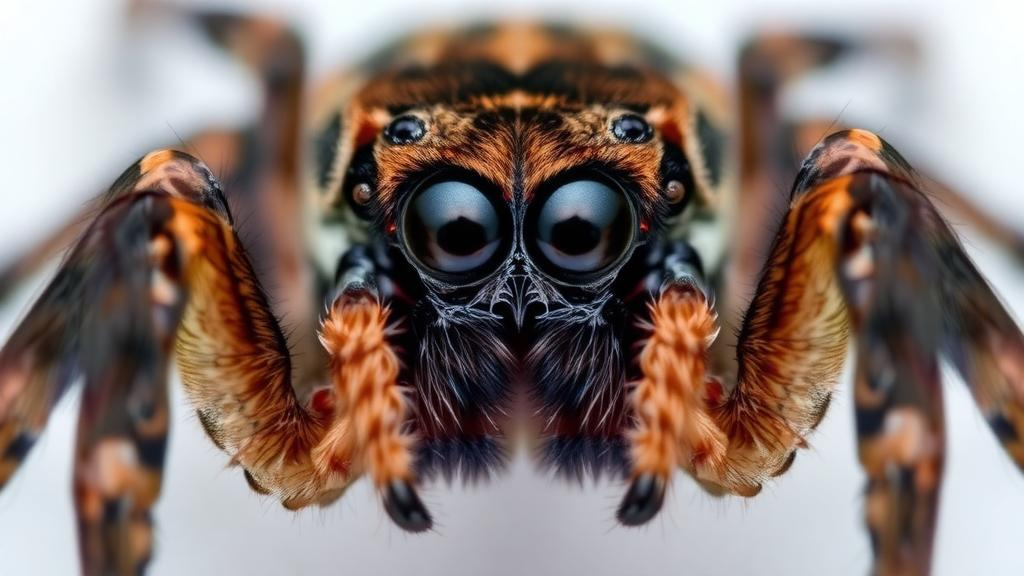
Anthropomorphism offers a third thread. Jumping spiders, whose two enlarged principal eyes resemble a human face more than the multiple eyes of typical spiders, received considerably more and faster attention than smaller-eyed spiders across every measure. Colorful jumping spiders were also returned to more frequently than neutral-colored ones, and this preference was strongest among participants with low spider phobia. Two-eyed insects likewise drew some of the quickest fixations in the study. The researchers suggest that the neoteny barrier, the human fondness for infant-like features such as large, innocent-looking eyes, may explain why these arthropods capture attention despite conflicting emotions of fear and curiosity.
Perhaps the most striking aspect of the findings is what did not matter much. Sex and spider phobia level occasionally moderated the effects, as in the case of female participants dwelling longer on butterflies than on spiders while male participants spent more time viewing spiders, but the strongest and most consistent effects were driven purely by image content. Under free-viewing conditions, low-level perceptual salience appears to dominate. The practical implications reach beyond the laboratory. Identifying the spider traits that attract engagement rather than avoidance could reshape exposure therapy for arachnophobia, inform conservation messaging, and help science communicators reframe spiders from objects of dread into subjects of fascination, one glance at a time.
Subject of Research: Eyetracking analysis of human visual attention and attentional bias toward spider images and spider-specific features
Article Title: Human eyetracking reveals a general avoidance of spider images but a bias toward spider-specific features
Article References: Human eyetracking reveals a general avoidance of spider images but a bias toward spider-specific features. (n.d.). https://doi.org/10.3389/frchs.2025.1717365
Image Credits: AI Generated
DOI: 10.3389/frchs.2025.1717365
Keywords: arachnophobia, eyetracking, visual attention, spiders, attentional bias, anthropomorphism, jumping spiders, scorpions, fear, disgust, free-viewing paradigm, eye movements
Cite Scienmag News
Gavin Prescott. (October 15, 2026). Eyes Turn Away from Spiders but Lock Onto Their Big Eyes, Webs and Fangs. Scienmag. https://scienmag.com/eyes-turn-away-from-spiders-but-lock-onto-their-big-eyes-webs-and-fangs/
Gavin Prescott. "Eyes Turn Away from Spiders but Lock Onto Their Big Eyes, Webs and Fangs." Scienmag, 15 October 2026, https://scienmag.com/eyes-turn-away-from-spiders-but-lock-onto-their-big-eyes-webs-and-fangs/. Accessed 15 October 2026.
Gavin Prescott. "Eyes Turn Away from Spiders but Lock Onto Their Big Eyes, Webs and Fangs." Scienmag. October 15, 2026. https://scienmag.com/eyes-turn-away-from-spiders-but-lock-onto-their-big-eyes-webs-and-fangs/


