


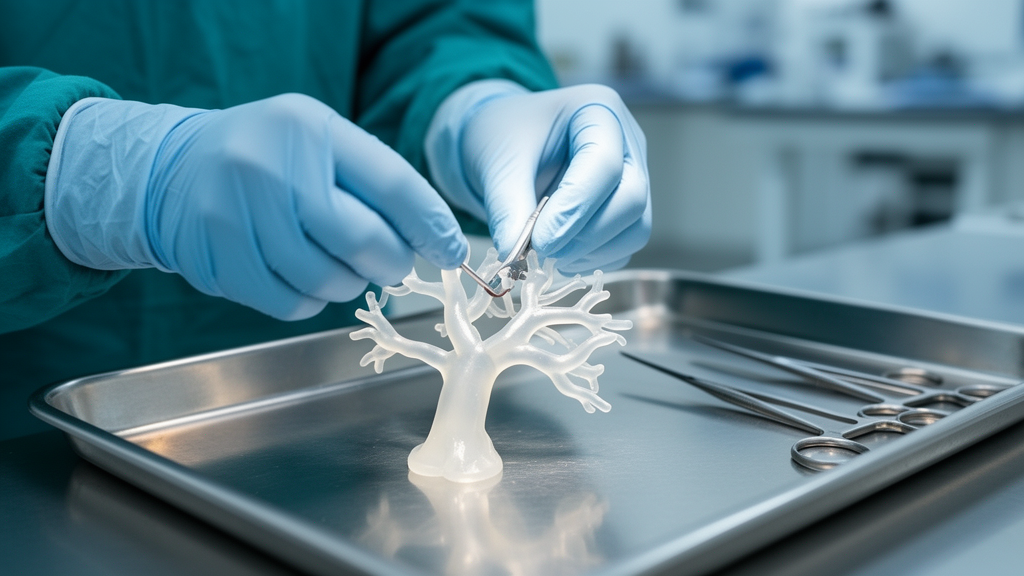
Training a neurosurgeon to thread a microcatheter through blood vessels narrower than two millimeters has always posed a painful dilemma: the procedures that build the necessary skill are precisely the ones where a slip of the hand can injure a patient. Physical vascular models printed in three dimensions offer a way to practice on lifelike replicas of cerebral arteries, but a stubborn engineering problem has limited their usefulness. PolyJet printing, one of the most accurate additive manufacturing technologies available, reliably produces open channels in vessels as thin as the middle meningeal artery, yet the inner surfaces it leaves behind are so rough that catheters catch and drag in a way no real vessel ever would. A team of engineers and physicians in Hamburg has now shown that the fix may be as simple as a coat of spray.
The research, published in Frontiers in Medical Engineering by Eve Sobirey of Hamburg University of Technology and colleagues at the University Medical Center Hamburg-Eppendorf, set out to quantify how different surface coatings change the friction behavior of PolyJet-printed vascular models. The goal was deliberately modest and practical: not to replicate the exact tribology of living brain vessels, for which no quantitative reference values exist, but to bring the unrealistically high catheter advancement forces of printed models down to a range that feels plausible to experienced hands. The work was carried out in the context of the HANNES simulator, a Hamburg-developed training platform that replicates the arterial path from the groin to the head and runs real interventional instruments under pulsatile flow at physiological pressure.
The team’s earlier work had established that PolyJet printing outperforms alternatives such as stereolithography when it comes to keeping tiny vessel lumens open and geometrically faithful. Stereolithography models suffered from unreliable patency in small diameters, while PolyJet models of the middle meningeal artery reproduced complex vascular geometries with open channels. But when interventional physicians handled the PolyJet models, they judged them significantly too rough, and the resulting friction undermined the realism of catheter navigation. Previous attempts at friction-reducing coatings elsewhere had either been applied to larger vessels or evaluated only in silicone models, without objective force measurements or validation by experienced users.
For the new study, the researchers systematically tested eight coating systems drawn from three functional families. Elastic coatings such as Plasti Dip, a solvent-based synthetic rubber, and RT 601, an addition-curing silicone elastomer, work by smoothing the printed layer structure and softening the contact between catheter and wall. Friction-reducing polymer coatings, including Hard Coat Finish and the polyurethane-forming Aquasure, create continuous smooth layers that minimize surface asperities. Silicone oil forms a lubricating boundary film, Teflon spray deposits a solid low-surface-energy sliding layer of PTFE, and the hydrophilic system X-tec HP3066 retains water at the surface to form a hydrated boundary layer that prevents direct solid-on-solid contact. The team also tested three blood-mimicking fluids: tap water, a water-glycerin mixture, and water with a small amount of baby shampoo, whose surfactants lower surface tension and improve wettability.
Measuring friction inside a two-millimeter channel under clinically meaningful conditions required a purpose-built test bench. A cylindrical test specimen, abstracted from the anatomy of the foramen spinosum of the middle meningeal artery, was connected to the HANNES fluid system and continuously flushed with blood-mimicking fluid at 37 degrees Celsius. A guidewire clamped in a universal testing machine was cycled back and forth through a stationary catheter at a constant one millimeter per second, with a force sensor of plus or minus 0.01 newton accuracy recording the forces generated by the interaction of wire, catheter, fluid, and vessel wall. Twenty cycles served to compare coatings, and a separate sixty-cycle series assessed short-term stability under repeated loading.
The results were striking. The uncoated reference specimen showed a median catheter advancement force of 0.18 newtons in water, with force peaks reaching 0.37 newtons. Every one of the eight coatings reduced advancement forces, but by very different amounts. In water, Plasti Dip brought the median down to 0.04 newtons and Teflon spray to 0.05 newtons; in baby shampoo solution, Aquasure achieved the lowest median of all at 0.04 newtons. Surface roughness measurements told a parallel story at first glance: the uncoated surface had an arithmetic mean roughness of 11.5 micrometers, while RT 601 polished it down to a remarkable 0.2 micrometers and Aquasure and Plasti Dip also achieved large reductions. Yet the force data revealed that roughness alone could not explain handling performance, a finding that became the intellectual pivot of the study.
The decisive insight came from analyzing the entire force path rather than single summary numbers. Teflon spray and Plasti Dip produced smooth, uniform force curves with few peaks, whereas Aquasure, despite its equally low median force, showed pronounced local fluctuations that a clinician’s fingertips would perceive as irregularity. Micro-computed tomography added a third dimension to the evaluation: X-tec preserved the largest free lumen diameter, while Teflon spray achieved the most homogeneous coating with the lowest standard deviation. At the other extreme, RT 601 narrowed the channel most severely and deposited uneven material accumulations that appeared as local hotspots in the diameter heat maps. A coating can thus lower friction while silently distorting the very anatomy the model is meant to reproduce.
Short-term stability testing exposed further nuances. Plasti Dip, Hard Coat Finish, and Aquasure were the most stable, with median forces rising by only 0.01 newtons over sixty cycles. Teflon spray, although it started with the lowest force of all at 0.02 newtons, showed an abrupt increase after roughly forty cycles, jumping by 0.03 newtons overall. The authors interpret this sudden change as more likely reflecting localized coating degradation or partial loss than gradual wear, though the mechanism remains unproven and is flagged as a priority for future investigation. In a training context, where a single model may serve many repetitions, such durability questions matter as much as peak performance.
The final arbiter was clinical judgment. Two interventional neuroradiologists with ten and thirteen years of experience evaluated the coated models inside the full HANNES simulator, navigating a Marathon microcatheter and Traxcess guidewire transfemorally through the vascular tree under standardized pulsatile conditions, and rating each model on a five-point Likert scale. The uncoated model scored poorly, with both physicians reporting increased resistance and frequent, noticeable stick-slip effects. Aquasure and Teflon spray received consistently high marks of four to five points across feel, probing, friction, and resistance realism, with stick-slip effects rated rare or barely noticeable. Plasti Dip was let down not by its friction but by occluded distal vessels, and X-tec divided the evaluators over unrealistically high proximal resistance.
The study’s overall verdict is that choosing a coating is an exercise in balancing tribological performance, geometric fidelity, ease of application, and cost. Teflon spray emerged as the best all-round option: applied in seconds with no pretreatment, inexpensive in practice, homogeneous on micro-CT, and endorsed by both clinicians, though its durability beyond about forty cycles needs work. Aquasure achieved the lowest forces and unanimous clinical approval but demands a substantially more complex procedure involving curing agents and careful handling. The authors caution that their results are exploratory, based on single samples per coating and two physician evaluators, and call for larger multicenter validation, testing across different advancement speeds and printed materials, and systematic study of long-term coating behavior. Even so, the message is clear: a targeted coat of the right chemistry can close the gap between a printed plastic tube and the feel of a living artery, bringing risk-free surgical simulation one realistic step closer.
Subject of Research: Surface coatings to reduce catheter friction in PolyJet 3D-printed small vascular models for neurointerventional training
Article Title: Reducing catheter advancement forces in PolyJet printed small vascular models for neurointerventional training through surface coatings
Article References: Sobirey, E., Schmiech, J., Bechstein, M., Flottmann, F., Wagner, M., Fiehler, J., & Krause, D. (2026). Reducing catheter advancement forces in PolyJet printed small vascular models for neurointerventional training through surface coatings. Frontiers in Medical Engineering, 4, Article 1925336. https://doi.org/10.3389/fmede.2026.1925336
Image Credits: AI Generated
DOI: 10.3389/fmede.2026.1925336
Keywords: PolyJet printing, neurointerventional training, vascular models, surface coatings, tribology, catheter forces, 3D printing, middle meningeal artery, micro-CT, Teflon spray, surgical simulation, friction reduction
Cite Scienmag News
Denise Maddox. (October 15, 2026). Teflon Coating Makes 3D-Printed Brain Vessels Feel Real for Surgeons in Training. Scienmag. https://scienmag.com/teflon-coating-makes-3d-printed-brain-vessels-feel-real-for-surgeons-in-training/
Denise Maddox. "Teflon Coating Makes 3D-Printed Brain Vessels Feel Real for Surgeons in Training." Scienmag, 15 October 2026, https://scienmag.com/teflon-coating-makes-3d-printed-brain-vessels-feel-real-for-surgeons-in-training/. Accessed 15 October 2026.
Denise Maddox. "Teflon Coating Makes 3D-Printed Brain Vessels Feel Real for Surgeons in Training." Scienmag. October 15, 2026. https://scienmag.com/teflon-coating-makes-3d-printed-brain-vessels-feel-real-for-surgeons-in-training/


