


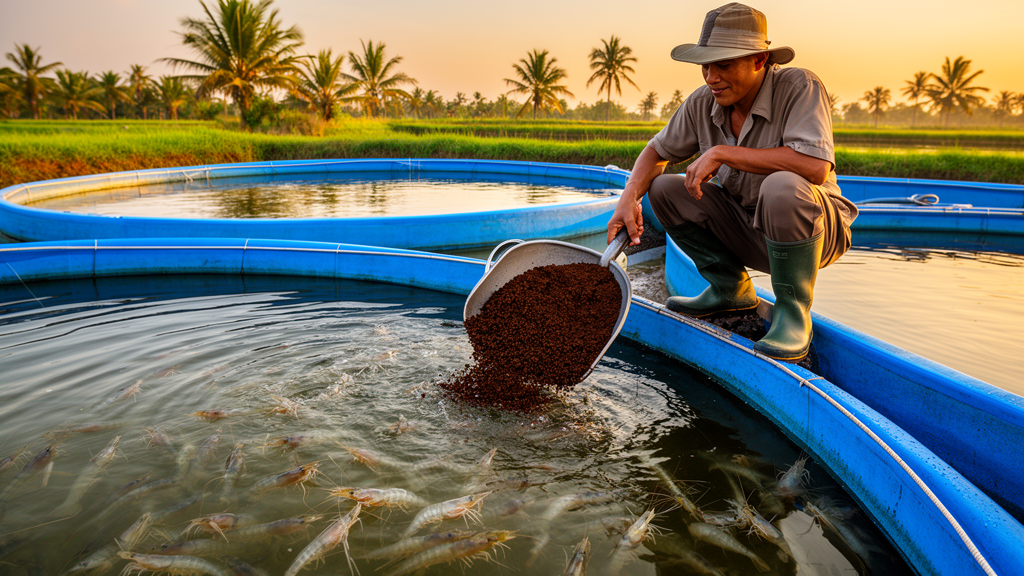
White-leg shrimp, Penaeus vannamei, has become the backbone of the global farmed crustacean industry, and its expansion into unconventional environments is one of the most striking stories in modern aquaculture. Among these new frontiers, inland saline water has attracted particular attention. Vast tracts of land-locked saline groundwater, often unusable for conventional agriculture, can in principle support shrimp farming far from the coast. But rearing P. vannamei in such waters, typically at salinities around 10 parts per thousand, imposes its own metabolic challenges, and farmers have long sought feed formulations that keep the animals growing efficiently while staying healthy under mild osmotic and oxidative stress. A new 60-day feeding trial, published in Frontiers in Aquaculture, suggests that an unexpected ingredient, humic acid derived from leonardite, may be a powerful tool for exactly this purpose.
Humic acids are large, complex organic molecules formed through the microbial and chemical decomposition of plant and animal matter over geological timescales. Leonardite, a soft, oxidized form of lignite coal, is one of the richest natural sources of these compounds. In livestock nutrition, humic substances have a reputation for improving gut health, nutrient absorption and stress tolerance, and aquaculture researchers have increasingly wondered whether the same benefits translate to shrimp. The new study set out to answer a deceptively simple question: does supplementing feeds with leonardite humic acid, abbreviated LHA, change how juvenile shrimp use protein and lipid, and can it blunt the oxidative damage that can accumulate in intensively fed animals?
To find out, the research team designed a rigorous 3 × 3 factorial experiment. Nine experimental diets were formulated, spanning three levels of crude protein (360, 330 and 300 grams per kilogram), three levels of lipid (50, 70 and 90 grams per kilogram) and three levels of LHA supplementation (0, 9 and 12 grams per kilogram). The diets also varied systematically in digestible energy, ranging from roughly 374 to 398 kilocalories per 100 grams, creating a matrix in which the independent and combined effects of nutrient density and humic acid could be disentangled. Each diet was assigned to triplicate groups of shrimp, with 675 juveniles weighing about 5.02 grams at the start of the trial randomly distributed across the tanks.
The outcome was remarkably clear. Shrimp fed the intermediate-protein, intermediate-lipid diet supplemented with the highest dose of humic acid, a formulation labeled P33L7LHA1.2, delivered 330 grams of crude protein and 70 grams of lipid per kilogram along with 12 grams of LHA, outperformed every other group. These animals recorded the highest weight gain, the highest specific growth rate, and the best protein and lipid efficiency ratios, meaning they converted dietary protein and lipid into body tissue more effectively than their peers. At the same time, they showed the lowest feed conversion ratio, the widely used efficiency metric that every shrimp farmer watches closely, alongside the highest whole-body protein content and, notably, the lowest whole-body lipid content and hepatopancreas somatic index, a measure of the relative size of the shrimp’s central metabolic organ.
That combination, faster growth with leaner bodies and a smaller relative hepatopancreas, points to a genuinely improved metabolic state rather than simple overfeeding. In crustaceans, the hepatopancreas performs the functions of a liver and pancreas combined, secreting digestive enzymes, storing energy reserves and orchestrating lipid metabolism. When the organ enlarges, it often reflects a heavy lipid-handling burden. A lower index combined with superior growth suggests the shrimp in the LHA-supplemented groups were processing their feed with less metabolic strain, a finding with direct implications for both productivity and animal welfare in intensive systems.
The digestive enzyme data reinforced this picture. Amylase and lipase activities in the hepatopancreas rose significantly as dietary lipid levels increased, while protease activity followed the opposite trajectory, peaking in the group fed the intermediate protein-lipid ration and falling to its lowest in animals receiving the high-lipid, low-protein diet. Critically, LHA supplementation enhanced the activity of all three digestive enzymes at every dietary level, with the strongest responses observed at the 12 gram per kilogram dose. The researchers also measured two key lipid metabolic enzymes, glucose-6-phosphate dehydrogenase and carnitine palmitoyltransferase-1, both of which reached their maximum activities in the P33L7LHA1.2 group and their minimum in shrimp receiving the low-lipid diet without humic acid. Elevated activity of these enzymes indicates more efficient mobilization and oxidation of fatty acids, consistent with the leaner body composition of the best-performing animals.
Perhaps the most striking results concerned oxidative stress. Shrimp, like all aerobic animals, generate reactive oxygen species during normal metabolism, and high-lipid diets can accelerate their production, damaging cell membranes and taxing the animal’s antioxidant defenses. The trial tracked the activity of superoxide dismutase and catalase, the two frontline antioxidant enzymes, in both the hepatopancreas and the gills. As dietary lipid increased, hepatopancreatic antioxidant enzyme activities declined while branchial activities rose, revealing a tissue-specific redistribution of defensive capacity. LHA supplementation, however, reduced the activities of both enzymes across the board, with the lowest values again recorded in the group receiving the highest humic acid dose alongside the intermediate protein-lipid ration.
At first glance, lower antioxidant enzyme activity might seem undesirable, but the accompanying biochemical markers tell a different story. Shrimp fed 12 grams per kilogram of LHA displayed the lowest levels of malondialdehyde, the standard biomarker of lipid peroxidation and membrane damage, together with the lowest circulating glucose, cholesterol and triglyceride concentrations. Reduced malondialdehyde despite reduced antioxidant enzyme activity implies that the animals were experiencing less oxidative insult in the first place, requiring a less activated defense system. In other words, humic acid appears to have lightened the oxidative load itself rather than merely forcing the antioxidant machinery to work harder, a distinction that matters enormously for long-term health and stress resilience in farmed shrimp.
The metabolic blood markers add a further layer of insight. Lower plasma glucose suggests a calmer stress response, since glucose mobilization is a classic endocrine signature of physiological stress in crustaceans. Reduced cholesterol and triglyceride levels, meanwhile, align with the enhanced lipid-oxidizing enzyme activities and the lower whole-body lipid deposits, painting a coherent metabolic portrait of animals that were absorbing nutrients efficiently, burning lipid effectively and carrying less metabolic baggage. Taken together with the growth and feed efficiency data, the trial makes a strong case that humic acid is not merely a passive feed additive but an active modulator of shrimp physiology.
The practical conclusion of the study is straightforward: among the nine diets tested, the formulation containing 330 grams per kilogram of crude protein, 70 grams per kilogram of lipid and 12 grams per kilogram of leonardite humic acid produced the most favorable growth performance and antioxidant responses in juvenile P. vannamei reared in inland saline water at 10 parts per thousand. For an industry pushing into inland regions and simultaneously hunting for sustainable, non-antibiotic feed additives, the findings arrive at an opportune moment. Leonardite is an abundant, inexpensive natural resource, and if humic acid supplementation can reliably improve feed conversion, reduce fat deposition and dampen oxidative stress at a modest inclusion level, it could become a standard component of shrimp feeds in saline aquaculture systems worldwide. The researchers caution that their results apply to juveniles over a 60-day window, and further work will be needed to confirm the benefits across full production cycles, but the direction of the evidence is unmistakable. A coal-derived organic compound, of all things, may soon help shrimp thrive in water that farmers once considered worthless.
Subject of Research: Effects of dietary leonardite humic acid on growth, lipid metabolism and antioxidant status of juvenile white-leg shrimp in inland saline water
Article Title: Leonardite humic acid enhances growth, lipid utilization and antioxidant status in juvenile Penaeus vannamei
Article References: Leonardite humic acid enhances growth, lipid utilization and antioxidant status in juvenile Penaeus vannamei. (n.d.). https://doi.org/10.3389/faquc.2026.1840408
Image Credits: AI Generated
DOI: 10.3389/faquc.2026.1840408
Keywords: Penaeus vannamei, leonardite humic acid, aquaculture nutrition, inland saline water, lipid metabolism, antioxidant status, feed conversion ratio, hepatopancreas, digestive enzymes, shrimp farming, protein-lipid diets, oxidative stress
Cite Scienmag News
Daisy Hatcher. (October 15, 2026). Humic Acid from Leonardite Boosts Shrimp Growth and Health in Saline Waters. Scienmag. https://scienmag.com/humic-acid-from-leonardite-boosts-shrimp-growth-and-health-in-saline-waters/
Daisy Hatcher. "Humic Acid from Leonardite Boosts Shrimp Growth and Health in Saline Waters." Scienmag, 15 October 2026, https://scienmag.com/humic-acid-from-leonardite-boosts-shrimp-growth-and-health-in-saline-waters/. Accessed 15 October 2026.
Daisy Hatcher. "Humic Acid from Leonardite Boosts Shrimp Growth and Health in Saline Waters." Scienmag. October 15, 2026. https://scienmag.com/humic-acid-from-leonardite-boosts-shrimp-growth-and-health-in-saline-waters/


