

Magnetic resonance imaging has transformed what scientists know about the human brain, but according to a new opinion article, the very design of this powerful technology is systematically excluding the people whose brains scientists most need to study: children with neurodevelopmental disorders. Writing in Frontiers in Neuroergonomics, Nancy Raitano Lee of Drexel University argues that MRI and related clinical neuroimaging tools were built around a medical model of care in which patients adapt to the machine, not the other way around. For individuals with conditions such as autism spectrum disorder, intellectual disability, and Down syndrome, that mismatch can make participation in brain research nearly impossible, and the consequences ripple through the entire field’s understanding of how atypical development unfolds.
Neurodevelopmental disorders are a broad category of conditions affecting cognition, behavior, social functioning, and motor development, with onset during the developmental period. They range from focal difficulties, such as speech sound disorder, to global impairments in intellectual and adaptive functioning, as seen in intellectual disability. Because these conditions first become evident in infancy and early childhood, developmental scientists have long emphasized that research should begin as early in life as possible. Early identification of the neural mechanisms driving atypical development is considered essential for designing effective interventions during the windows when the developing brain is most malleable. Yet the practical demands of neuroimaging often exceed the developmental capabilities of the very individuals at the center of the investigation.
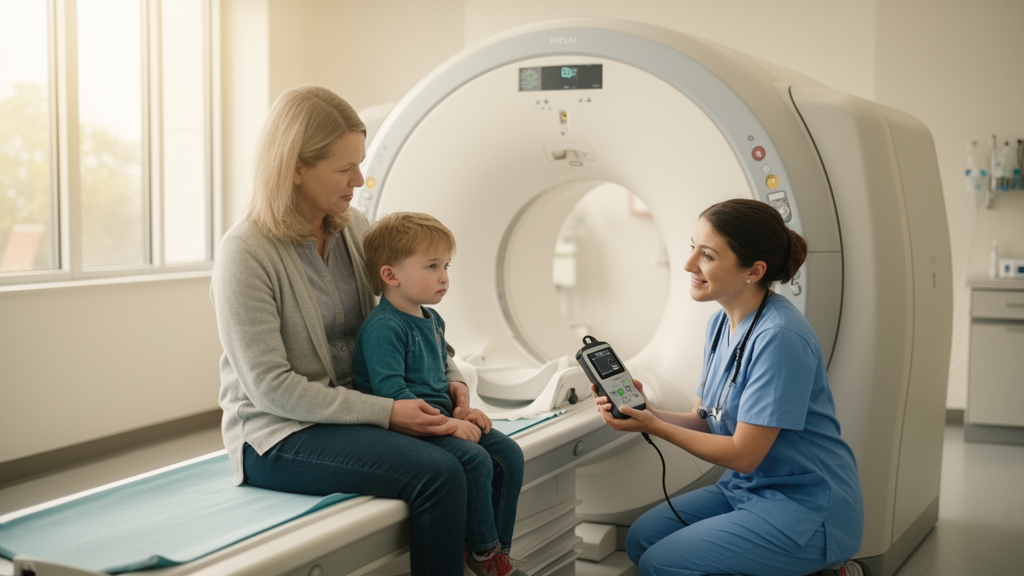
The barriers begin long before a participant ever enters a scanner. Families must travel to a medical or research facility, navigate complex and overstimulating environments, endure long waits, and communicate with care providers, all of which are documented obstacles to healthcare and research participation for people with neurodevelopmental disorders and their families. Once inside, the MRI experience imposes further demands: participants must lie nearly motionless, tolerate an unfamiliar and confined space, and cope with the intense noises and vibrations the machine generates. These are precisely the challenges that are amplified for individuals who experience heightened anxiety, elevated rates of attention-deficit/hyperactivity disorder, and sensory sensitivities that are more common in neurodevelopmental disorders than in neurotypical peers.
The evidence that these barriers skew research participation is striking. Examining the National Database for Autism Research, now housed within the National Institute of Mental Health Data Archive, Lee found that just over 10 percent of participants had verbal and performance IQ scores more than one standard deviation below the population mean, and fewer than 1 percent of participants had any neuroimaging data at all. This stands in sharp contrast to the fact that close to 40 percent of autistic children have intellectual disability, characterized by intellectual ability roughly two or more standard deviations below the population mean. In other words, the autistic individuals least represented in brain imaging studies are those whose profiles are most common and most in need of scientific attention.
Research on Down syndrome, the most common genetic cause of intellectual disability, tells a similar story. Studies have documented a trend toward lower average IQ among participants unable to complete MRI scanning, with those who could not finish scanning averaging an IQ of 49 compared with 58 among those who could. Chronological age was also significantly linked to scanning success, with younger participants less likely to yield usable data, suggesting that developmental level itself determines who is included in the science. The upshot is a self-reinforcing sampling bias: the field’s brain-based theories are increasingly built on data from older, more cognitively able participants, leaving the earliest and most affected stages of development largely unexamined.
The problem becomes dramatically worse when functional MRI enters the picture. During structural MRI acquisition, a participant can watch a movie or even sleep while images are collected. Functional MRI, by contrast, requires participants either to lie awake without external stimulation, as in resting-state functional MRI, or to perform a cognitive task while scanning proceeds. To quantify how these constraints shape the literature, Lee conducted a Web of Science search for studies on Down syndrome and magnetic resonance imaging, identifying 198 published articles, of which 83 described quantitative neuroimaging investigations of infants, children, or adults. Only 14 of those included functional MRI, and just 4 used task-based fMRI. Of all the fMRI studies, none included exclusively child participants, though one included mostly children, while 58 of the 83 studies focused solely on adults.
That gap matters because the brain bases of the complex learning difficulties faced by children with Down syndrome cannot be inferred from studies of adults. If nearly all functional neuroimaging evidence comes from grown participants, scientists have little mechanistic insight into how atypical neural circuits emerge during childhood, when interventions could have the greatest impact. Lee argues that this represents a fundamental obstacle to building developmentally informed theories, and that merely training harder for the scanner is not a sufficient solution. Behavioral training protocols do exist to prepare children for MRI and magnetoencephalography, but they place the burden of adaptation on the participant rather than on the technology.
The alternative Lee champions is to adapt the technology to the participant through portable neurotechnologies, particularly functional near-infrared spectroscopy and electroencephalography. Because these tools can be brought into a family’s home, they eliminate travel and the stress of unfamiliar clinical environments, which are especially difficult for families of autistic individuals. They also remove the core physical demands of MRI: there is no confined bore, no requirement for complete stillness, and no deafening acoustic noise. Perhaps most importantly, portable devices allow the examiner to sit beside or across from the participant and demonstrate tasks in person, using gestures and modeling rather than spoken instructions delivered over an intercom from an adjacent room. That flexibility reduces language demands and eases anxiety, a decisive advantage given the high rates of communication difficulties in neurodevelopmental disorders.
Lee is careful to note that no neuroimaging method suits everyone. Functional near-infrared spectroscopy requires tolerating a snug cap or band on the head, and EEG requires tolerating electrode placement and its associated sensations. Because neurodevelopmental disorders are highly heterogeneous, a one-size-fits-all approach is doomed to leave some groups behind. Among the recommendations offered are embedding neuroimaging within broader behavioral phenotyping studies, advertising clearly to families that completing imaging procedures is not required for participation, and thoroughly characterizing participants who cannot tolerate imaging, including their age, sex, cognitive level, autistic traits, and adaptive and maladaptive behavior. That documentation would reveal to whom findings generalize and, just as importantly, to whom they do not.
The broader promise of this shift is equity. If researchers can transparently demonstrate which children are excluded from conventional neuroimaging and why, they gain a scientific justification for developing alternative technologies fitted to those participants’ needs. Greater access to research participation, Lee argues, ultimately translates into greater access to interventions for all individuals with neurodevelopmental disorders, not only those easiest to scan. In an era when wearable sensors and home-based monitoring are reshaping medicine, the message of this analysis is that brain science should follow the same path: bring the laboratory to the child, rather than demanding that the child conform to the laboratory.
Subject of Research: Barriers to magnetic resonance imaging participation in neurodevelopmental disorders and the potential of portable neurotechnology
Article Title: The challenges of magnetic resonance imaging and the promise of portable neurotechnology for advancing scientific discovery about neurodevelopmental disorders
Article References: The challenges of magnetic resonance imaging and the promise of portable neurotechnology for advancing scientific discovery about neurodevelopmental disorders. (n.d.). https://doi.org/10.3389/fnrgo.2026.1884952
Image Credits: AI Generated
DOI: 10.3389/fnrgo.2026.1884952
Keywords: magnetic resonance imaging, neurodevelopmental disorders, Down syndrome, autism spectrum disorder, functional near-infrared spectroscopy, electroencephalography, intellectual disability, functional MRI, portable neurotechnology, research participation, brain development, clinical neuroergonomics
Cite Scienmag News
Colin Clarke. (October 15, 2026). MRI Barriers Exclude Children With Neurodevelopmental Disorders, Says Scientist Urging Portable Brain Imaging. Scienmag. https://scienmag.com/mri-barriers-exclude-children-with-neurodevelopmental-disorders-says-scientist-urging-portable-brain-imaging/
Colin Clarke. "MRI Barriers Exclude Children With Neurodevelopmental Disorders, Says Scientist Urging Portable Brain Imaging." Scienmag, 15 October 2026, https://scienmag.com/mri-barriers-exclude-children-with-neurodevelopmental-disorders-says-scientist-urging-portable-brain-imaging/. Accessed 15 October 2026.
Colin Clarke. "MRI Barriers Exclude Children With Neurodevelopmental Disorders, Says Scientist Urging Portable Brain Imaging." Scienmag. October 15, 2026. https://scienmag.com/mri-barriers-exclude-children-with-neurodevelopmental-disorders-says-scientist-urging-portable-brain-imaging/


