


Deep beneath the rolling farmland of Northern Switzerland, in a thick band of 175-million-year-old Opalinus Clay, the country plans to entomb its most dangerous radioactive waste for hundreds of thousands of years. A newly published analysis by Xiaoshuo Li of Nagra, Switzerland’s national cooperative for radioactive waste disposal, now offers the most detailed quantitative look yet at whether that plan will actually keep people safe. The verdict is striking: even over timeframes stretching to millions of years, calculated radiation doses to hypothetical future residents remain orders of magnitude below Swiss regulatory limits, confirming an enormous safety margin for the proposed repository at the Nördlich Lägern site.
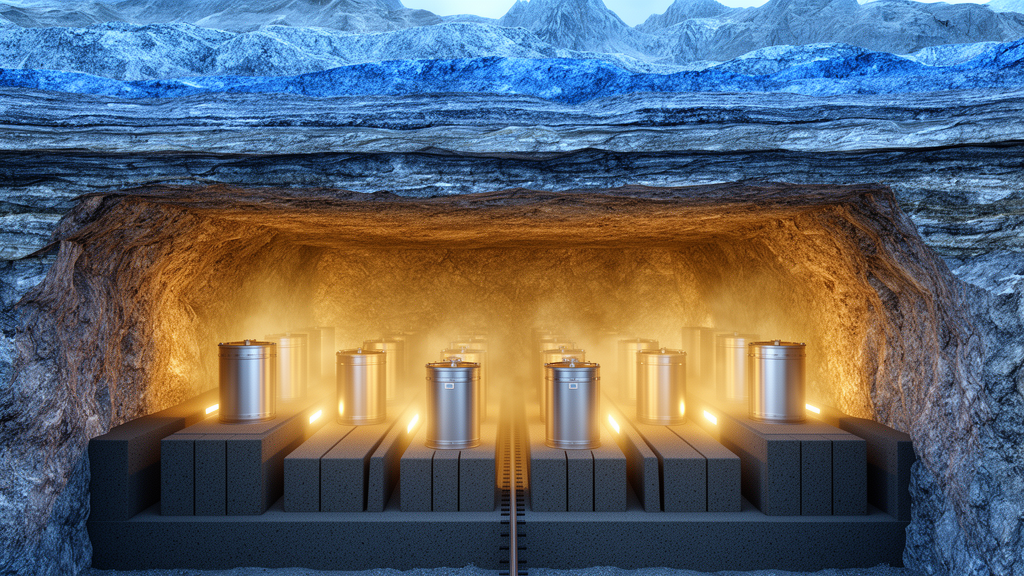
The work forms a central pillar of Nagra’s post-closure safety case, the scientific dossier supporting the general licence application for a combined repository that will hold both high-level waste (HLW), including spent nuclear fuel and vitrified reprocessing waste, and low- and intermediate-level waste (L/ILW). Both waste types are slated for emplacement in spatially separate sections of the facility, hundreds of metres underground within the Opalinus Clay formation. The safety argument rests on a multi-barrier system: steel disposal canisters, compacted bentonite clay buffers around the high-level waste, cementitious backfill in the low- and intermediate-level caverns, and, crucially, the host rock itself, whose minute pore spaces and strong sorption capacity dramatically slow the movement of dissolved radionuclides.
Radiological consequence analysis is the discipline of translating that barrier concept into numbers. The method traces every safety-relevant radionuclide from its initial location in the waste, through canister failure, dissolution, diffusion and any advective groundwater flow, and finally into the biosphere, where it is converted into an effective dose rate for a hypothetical exposed individual. Nagra’s analysis considered roughly 60 radionuclides for liquid-phase transport, spanning the long decay chains and a broad range of fission and activation products, with parameter values drawn from dedicated diffusion and sorption databases for the Opalinus Clay, its confining geological units and the bentonite buffer.
What distinguishes the new analysis is its dual strategy. Alongside a single deterministic reference case built on reference parameter values, Nagra ran 4,000 Monte Carlo realisations in which every relevant parameter was randomly sampled from predefined probability distributions. Aleatoric uncertainties backed by extensive datasets were fitted with probability density functions, while epistemic uncertainties received uniform or log-uniform distributions, and some parameters were deliberately fixed at pessimistic or best-estimate values. Correlation-based sensitivity measures, including Pearson and Spearman coefficients and the modified EASI variance-based index, then revealed which parameters actually control the outcome. To satisfy Swiss regulatory expectations, the team also constructed a bounding case in which every highly sensitive parameter was pushed to its most pessimistic value, a combination so unlikely that it functions as a hypothetical worst-case envelope.
The modelling toolkit spans three linked domains. For the high-level waste near field, the STMAN code simulated a one-dimensional radially symmetric system of waste form, water-filled canister void, concentric bentonite units and surrounding host rock. For the low- and intermediate-level caverns, the VPAC code handled a two-dimensional, bilaterally symmetric cementitious near field. The geosphere was simulated with PICNIC-TD, representing the rock sequence between the bounding Malm and Keuper aquifers as vertical stacks of model legs, with temperature-corrected diffusion coefficients applied via the Arrhenius law. The contaminated zone around the tunnels, the excavation damaged zone, was explicitly included, reflecting the expectation that it will partially reseal but retain slightly elevated hydraulic conductivity.
The headline result is emphatic. In the reference safety scenario, corresponding to the expected evolution of the repository, the total dose rate from the entire facility reaches just 1.5 × 10⁻⁴ millisieverts per year at one million years, peaking at 2.0 × 10⁻⁴ mSv per year around 4.5 million years. That is roughly three orders of magnitude below the Swiss protection criterion of 0.1 mSv per year. Radiotoxicity calculations, a complementary safety indicator recommended by the international PAMINA project, reinforce the picture: throughout the first million years, most radionuclides remain locked in the spent fuel matrix and vitrified waste, and the fraction escaping into the confining geological units carries radiotoxicity several orders of magnitude lower than the original inventory.
One isotope, however, refuses to stay put. Iodine-129 dominates the calculated dose both in the reference case and across a range of alternative scenarios, a finding consistent with safety assessments in Scandinavia, France’s CIGÉO project and other international programmes. The reason is chemical stubbornness: I-129 has a half-life of 15.7 million years, sorbs only weakly to engineered and geological barriers, and faces no solubility limits under repository conditions. Even so, the combination of the slow-dissolving spent fuel matrix, the bentonite buffer and the Opalinus Clay delays its breakthrough into surrounding aquifers over very long timescales, keeping its contribution comfortably within the safety margin.
Carbon-14 received an equally systematic treatment, and here the analysis breaks new ground. Screening showed that C-14 released as methane is the only radionuclide relevant to gas-mediated transport, since other potentially gaseous species are either highly soluble, like iodine-129 and inorganic carbon-14, or short-lived, like tritium. Using a TOUGH3-based two-phase flow model with an innovative macroelement approach, which collapses the entire repository into representative tunnel and shaft elements to cut computational cost by orders of magnitude, Nagra found that gas pressure never builds enough to push C-14 advectively up the sealed shafts in the reference case. Instead, methane dissolves and diffuses through the clay, yielding a maximum dose rate of just 2.8 × 10⁻⁷ mSv per year. A comprehensive re-evaluation of the carbon-14 source term also removed dissolved C-14 as a significant early-period contributor, a major reduction in conservatism compared with earlier assessments.
The probabilistic and sensitivity analyses pinpoint exactly what matters most. For liquid-phase transport, the spent fuel matrix dissolution rate towers over all other parameters, with a Pearson correlation coefficient of 0.95, because it governs how quickly iodine-129 escapes the waste. The remaining influential parameters all concern diffusion, confirming that slow diffusive migration through the containment-providing rock zone is the primary delay mechanism. For gaseous carbon-14, corrosion and degradation rates driving gas generation, shaft seal permeability and diffusion-related properties dominate, with diffusion parameters displaying opposing Pearson and Spearman correlations that neatly reflect the two competing transport regimes: ubiquitous slow diffusion versus rare advective breakthrough along poorly sealed shafts.
Even the deliberately punishing what-if cases fail to break the safety case. Assuming diffusion coefficients ten times higher than the reference upper bound across all rock formations produced the largest dose increase, underscoring diffusion’s central role. Neglecting sorption entirely allowed caesium-135 to displace iodine-129 as the dominant contributor. Doubling-free scenarios such as canister failure at 1,000 rather than 10,000 years, or a hundred-fold faster spent fuel dissolution, raised doses only modestly, and hypothetical hydraulically active confining units connected to regional aquifers lifted the maximum dose rate merely to 2.5 × 10⁻⁴ mSv per year, still hundreds of times below the regulatory limit. Together, the deterministic reference case, the 4,000-realisation Monte Carlo ensemble and the bounding calculations deliver what the Swiss framework demands: a transparent, technically grounded demonstration that the multi-barrier system at Nördlich Lägern is robust, well understood, and capable of protecting future generations across the full sweep of geological time.
Subject of Research: Radiological consequence analysis and barrier efficiency of Switzerland's proposed deep geological repository in Opalinus Clay
Article Title: The safety case for a deep geological repository in Switzerland: radiological consequence analysis and study of the barrier efficiency
Article References: The safety case for a deep geological repository in Switzerland: radiological consequence analysis and study of the barrier efficiency. (n.d.). https://doi.org/10.3389/fnuen.2026.1843948
Image Credits: AI Generated
DOI: 10.3389/fnuen.2026.1843948
Keywords: deep geological repository, radioactive waste, Opalinus Clay, Nagra, iodine-129, carbon-14, radionuclide transport, radiological dose, probabilistic safety analysis, multi-barrier system, spent fuel, Switzerland
Cite Scienmag News
Violet Maxwell. (October 15, 2026). Swiss deep geological repository simulations show dose rates far below safety limits. Scienmag. https://scienmag.com/swiss-deep-geological-repository-simulations-show-dose-rates-far-below-safety-limits/
Violet Maxwell. "Swiss deep geological repository simulations show dose rates far below safety limits." Scienmag, 15 October 2026, https://scienmag.com/swiss-deep-geological-repository-simulations-show-dose-rates-far-below-safety-limits/. Accessed 15 October 2026.
Violet Maxwell. "Swiss deep geological repository simulations show dose rates far below safety limits." Scienmag. October 15, 2026. https://scienmag.com/swiss-deep-geological-repository-simulations-show-dose-rates-far-below-safety-limits/


