


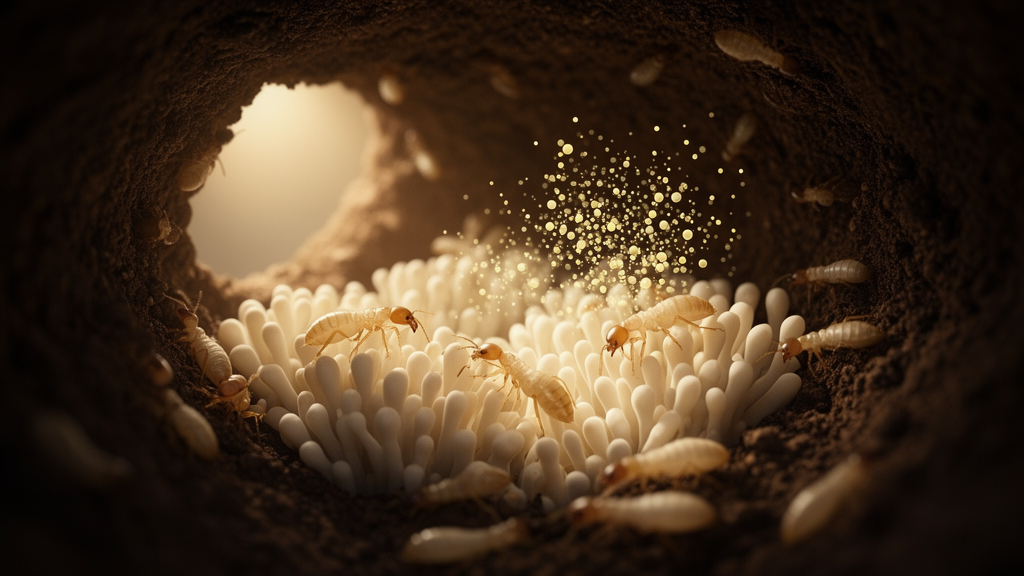
Deep inside the mounds of fungus-growing termites, an invisible war is raging. On one side stand the termites and their cultivated crop, a specialized fungus called Termitomyces that the insects have farmed for millions of years. On the other side lurk two very different enemies: virulent soil-borne pathogens such as Metarhizium, which can wipe out entire colonies, and weedy fungi of the genus Xylaria, which quietly infiltrate the termite gardens and compete with the precious cultivar for nutrients. New research published in IMA Fungus reveals how these insects and their microbial partners mount a two-front defense, combining sharp-eyed hygiene with an arsenal of antibacterial chemistry.
The study, led by researchers surveying termite colonies in Yunnan, China and Chiang Mai, Thailand, focused on two termite genera, Macrotermes and Odontotermes. The team collected intact fungus combs, the spongy garden structures the termites build from partially digested plant matter, along with worker termites from six colonies. Using a culture-dependent dilution-plating approach, they recovered a staggering 600 fungal isolates representing 79 genera, as well as 59 bacterial strains. The sheer diversity captured from these tiny niches underscores how much microbial life thrives within a healthy termite nest, and how much still awaits discovery.
Among the fungal isolates were two unwelcome surprises. First, the researchers found Metarhizium living latently inside what appeared to be a perfectly healthy comb. When they tested one particular strain, isolated from a Macrotermes gilvus colony and closely matching the notorious insect-killing species Metarhizium anisopliae, its virulence was alarming. In laboratory bioassays, termites dipped in a suspension of one hundred million conidia per milliliter began dying within a day, and every infected individual was dead within 96 hours. Control termites, handled identically but without the pathogen, survived at rates above 96 percent. Statistical analysis confirmed the difference was dramatic, with the infected group facing roughly a forty-nine-fold increase in mortality hazard.
The second threat came from Xylaria, a genus of fungi often described as the weeds of the termite farming world. By incubating small fragments of comb in sterile boxes, the team coaxed out 112 Xylaria strains. Multi-locus phylogenetic analysis, combining sequences from four genes, resolved these into 20 distinct clades, ten of which matched previously described species such as Xylaria minima and X. ochraceostroma, while the other ten likely represent entirely new taxa. Remarkably, only two clades appeared in both termite genera; the rest were restricted to either the Chinese Odontotermes or the Thai Macrotermes, hinting at a rich, largely hidden diversity shaped by host and geography.
Perhaps the most striking finding concerns how termites respond to these two enemies. In behavioral assays, the researchers presented termites with agar plugs of Metarhizium, Xylaria and a plain control medium, then measured how much fresh soil the insects piled onto each plug. The response was starkly asymmetric. Termites aggressively buried Metarhizium regardless of whether fungus-comb material was present, depositing on average between 130 and 168 milligrams of soil per plate, compared with negligible amounts for the Xylaria plugs, which received burial effort statistically indistinguishable from the control. This means the insects can tell the difference between a deadly pathogen and a familiar, co-evolved weed, and they react to each accordingly.
The burying behavior is not merely cosmetic. When plugs covered in termite-deposited soil boluses were transferred to fresh growth medium, fungal growth was strongly suppressed. Growth inhibition rates reached roughly 60 to 68 percent for both Xylaria and Metarhizium, suggesting that entombing a threat in soil physically smothers it and may create local hypoxic conditions that fungi struggle to tolerate. The soil itself, sourced from termite mounds and sterilized before the assays, appears to act as both a physical barrier and a substrate teeming with beneficial microbes that the termites deliberately deploy as defensive weapons.
Those microbes are key players in the story. The team isolated 59 bacterial strains belonging to 14 genera, including Bacillus, Pseudomonas, Burkholderia, Brevibacillus, Enterobacter and Serratia, with several genera shared across both termite species and both comb and gut habitats. In dual-culture assays, all twelve tested bacterial isolates inhibited Metarhizium to some degree, with four strains from the genera Bacillus, Brevibacillus and Burkholderia suppressing more than half of fungal growth, sometimes producing clear inhibition zones. Against Xylaria the picture was more nuanced, with only six isolates achieving comparable suppression, and the weed fungus occasionally growing right over bacterial colonies, a sign that it may have evolved some tolerance to microbial antagonism during its long latent residence in healthy combs.
Young termites, it turns out, do not even need to learn these lessons. When the researchers reared incipient colonies from newly paired alates under sterile laboratory conditions and later offered the first-generation offspring food contaminated with Metarhizium conidia, the insects refused to touch it. Within five days, all termites in the contaminated-food treatment had died and their corpses were covered in dense white fungal mycelium, confirming lethal infection, while their activity patterns showed they had avoided the tainted food from the start. This innate avoidance, combined with active burial of threats, suggests that pathogen defense is hardwired into termite behavior rather than acquired through experience.
The chemical basis of the bacterial defense likely involves well-known antifungal compounds. Previous work on fungus-growing termites has identified antibiotics such as natalamycin A and microtermolides from Streptomyces, bacillaene A from Bacillus, macrotermycins from Amycolatopsis and banegasine from Actinomadura, alongside termite-derived antimicrobial peptides like spinigerin and termicin and antifungal enzymes such as beta-1,3-glucanases. The new study adds to this growing catalogue, showing that the bacteria circulating between termite guts and combs, carried there as every comb particle passes through an insect digestive tract, form a distributed chemical shield against invaders.
What emerges from this work is a portrait of a farming system defended not by a single mechanism but by layered redundancy. Termites bury dangerous pathogens on sight, avoid contaminated food innately, entomb threats in microbe-laden soil, and host a community of bacteria whose metabolites suppress both lethal parasites and garden weeds. Meanwhile, Xylaria persists latently in healthy combs, waiting for a chance to pounce, while Metarhizium lurks in the same environment ready to strike. The termites, in turn, hold both at bay through a partnership with their own microbiome, a reminder that some of nature’s most sophisticated agriculture depends as much on the microscopic allies within as on the farmers themselves.
Subject of Research: Microbial diversity and hygiene defenses in fungus-growing termite colonies against Metarhizium and Xylaria
Article Title: Termite sanitary behaviour and their associated bacteria protect against latent Xylaria and entomopathogenic Metarhizium
Article References: Termite sanitary behaviour and their associated bacteria protect against latent Xylaria and entomopathogenic Metarhizium. (n.d.). https://doi.org/10.3897/imafungus.17.211888
Image Credits: AI Generated
DOI: 10.3897/imafungus.17.211888
Keywords: fungus-growing termites, Metarhizium, Xylaria, Termitomyces, social immunity, entomopathogenic fungi, antimicrobial bacteria, fungus comb, Macrotermes, Odontotermes, soil boluses, termite microbiome
Cite Scienmag News
Morgan Morrow. (October 15, 2026). Termites enlist gut bacteria to fight deadly fungal invaders in their gardens. Scienmag. https://scienmag.com/termites-enlist-gut-bacteria-to-fight-deadly-fungal-invaders-in-their-gardens/
Morgan Morrow. "Termites enlist gut bacteria to fight deadly fungal invaders in their gardens." Scienmag, 15 October 2026, https://scienmag.com/termites-enlist-gut-bacteria-to-fight-deadly-fungal-invaders-in-their-gardens/. Accessed 15 October 2026.
Morgan Morrow. "Termites enlist gut bacteria to fight deadly fungal invaders in their gardens." Scienmag. October 15, 2026. https://scienmag.com/termites-enlist-gut-bacteria-to-fight-deadly-fungal-invaders-in-their-gardens/


