


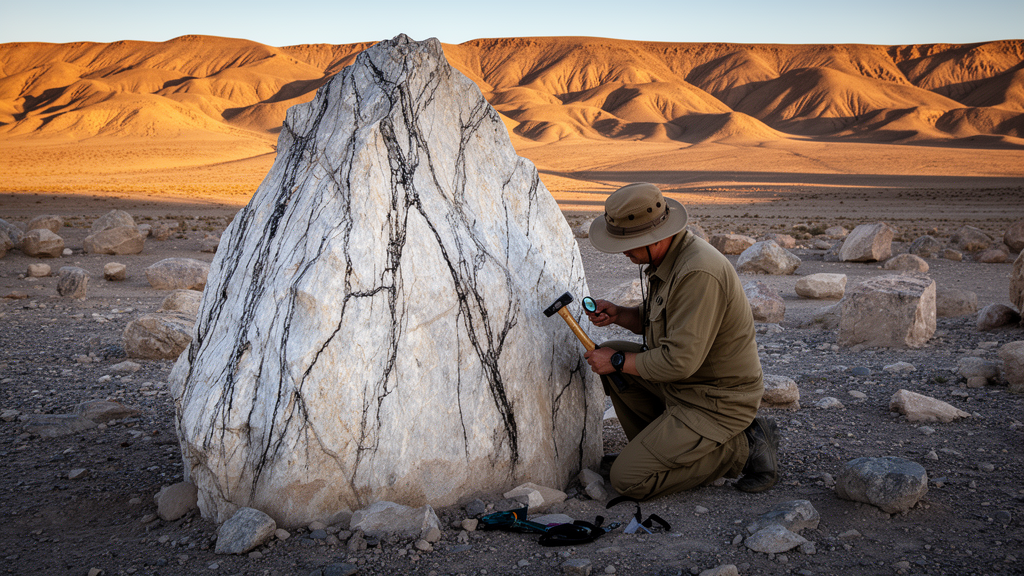
Deep in the mountains of northwest China, a suite of 500-million-year-old granite rocks has been quietly preserving the story of an ocean’s death throes. New research on granitoid intrusions in the Dachadaban area of the North Qilian Orogenic Belt reveals that a single magmatic system evolved from one type of granite into a fundamentally different one over just a few million years, capturing the precise moment when an ancient subduction zone began to collapse into extension. The study, published in Frontiers in Geochemistry, combines zircon and apatite dating with a battery of geochemical tools to reconstruct what was happening deep beneath the Earth’s surface during the Late Cambrian, a pivotal chapter in the assembly of Asian continents.
The North Qilian Orogenic Belt, sandwiched between the Central Qilian Block and the southwestern margin of the North China Craton, is widely regarded by geologists as a natural laboratory for studying ancient plate tectonics. It preserves a nearly complete trench-arc-basin system: slivers of oceanic crust in the form of ophiolites, island-arc volcanic and intrusive rocks, and accretionary complexes that record the opening, subduction, and eventual closure of the Qilian Ocean, a branch of the broader Paleo-Asian Ocean. The Dachadaban ophiolite is exceptionally well preserved, with mid-ocean-ridge-type basalt dated at about 517 million years ago in its lower section and boninite at roughly 487 million years ago above it, documenting the transition from seafloor spreading to subduction initiation.
While the ophiolites and mafic rocks of the region have attracted intense study, the coeval felsic intrusions at Dachadaban had remained curiously under-examined. A team led by Jie Sun and Zhiguo Zhang set out to change that, collecting six samples spanning monzodiorite, granodiorite, and monzogranite from a pluton that sits spatially entangled with the ophiolitic units. Under the microscope, the rocks tell a story of their own: the monzodiorite is built from plagioclase, amphibole, and biotite with a weak gneissic fabric, the granodiorite shows quartz grains flattened and recrystallized by deformation, and the monzogranite is a highly evolved rock dominated by K-feldspar, plagioclase, and quartz with biotite largely replaced by muscovite.
Dating these rocks required two different minerals and two different clocks. Laser ablation inductively coupled plasma mass spectrometry on zircon yielded weighted mean uranium-lead ages of 504 plus or minus 12 million years for the monzodiorite, 505.7 plus or minus 4.3 million years for the granodiorite, and 504.3 plus or minus 3.2 million years for the monzogranite. Apatite, a more obscure but increasingly popular chronometer, gave ages between 512 and 511 million years for the diorites. Although the zircon and apatite ages differ slightly, their uncertainties overlap, pointing to a single magmatic pulse lasting roughly from 512 to 504 million years. That timing dovetails with a regional magmatic flare-up recorded by nearby intrusions such as the Chaidano granite and the Keke complex, marking a major episode of felsic magmatism across the whole orogen.
The chemical fingerprint of the rocks is unmistakably arc-like. They are metaluminous to weakly peraluminous, belong to the high-K calc-alkaline series, and are enriched in large-ion lithophile elements such as rubidium and thorium while depleted in high-field-strength elements like niobium, tantalum, and titanium, the classic signature of magmas generated above a subducting slab. Their rare earth element patterns slope steeply from light to heavy elements, with moderate negative europium anomalies that point to plagioclase either left behind in the source or removed during crystallization. Ratios of niobium to thorium and niobium to tantalum sit close to upper continental crust values, far below what mantle-derived melts would show, signalling a dominantly crustal source.
Strontium and neodymium isotopes pinned that source down more precisely. Initial strontium isotope ratios of 0.7205 to 0.7286 and negative epsilon-neodymium values between minus 9.7 and minus 6.4, with two-stage neodymium model ages clustering around 1.75 to 2.02 billion years, indicate that the magmas were produced mainly by partial melting of Paleoproterozoic crust. But the isotopic mixing calculations also revealed something unexpected: about 20 to 30 percent mantle input, a significantly larger contribution than the 10 to 18 percent estimated for the neighboring Chaidanuo granitoids. The mantle, in other words, was not just a passive heat source but actively injected material into the magma system, a hallmark of basaltic underplating at the base of a thinning lithosphere.
The most striking result comes from thermometry and redox chemistry recorded inside individual zircon crystals. Titanium concentrations in zircon, calibrated against the Ti-in-zircon thermometer, show that the monzodiorites crystallized over a range of roughly 608 to 784 degrees Celsius with an average near 692 degrees, while the monzogranite crystallized across a much hotter window of 659 to 880 degrees, averaging about 826 degrees. In the framework of ‘hot’ versus ‘cold’ granites, the Dachadaban suite records a shift from cooler, more water-rich conditions to genuinely high-temperature magmatism that demands an external heat supply. Meanwhile, cerium and europium anomalies in zircon show oxygen fugacity dropping from relatively oxidized in the intermediate rocks to distinctly reduced in the granite, accompanied by falling water content, a combination that points away from fluid-fluxed arc melting and toward dry, deep-crustal dehydration melting.
Apatite, the humble calcium phosphate mineral that often survives alteration better than its host rock, provided independent confirmation. Its right-inclined rare earth element patterns and trace element ratios place it squarely in the field of I-type granitoids on newly developed discrimination diagrams, and its whole-rock and mineral chemistry collectively trace an evolution from I-type magmas, derived from igneous protoliths, into what geologists classify as A2-type granites: hot, alkali-rich, water-poor rocks associated with the extensional phases of orogenic belts. Experimental petrology supports this linkage, since partial melting of calc-alkaline granodiorite under high-temperature, fluid-absent conditions at around 950 degrees Celsius and 4 kilobars produces melts closely matching the Dachadaban monzogranite’s composition.
Herein lies the study’s central insight: the I-type and A-type granitoids are not separate intrusions from unrelated sources but co-genetic end-members of a single evolving magmatic system. Their ages, isotopic compositions, and trace element patterns are too consistent to be coincidence, and gentle trends in incompatible element ratios favor fractional crystallization as the main evolutionary driver rather than multiple discrete partial melts. The earlier I-type magmas, generated under the thermal perturbation and decompression of a waning subduction zone, themselves became the fertile source rocks that later melted again, drier and hotter, to yield the A2-type granites, a process the authors describe as dehydration melting of the orogen’s own lower crust.
What triggered this transformation? The tectonic discrimination diagrams place the samples in a ‘post-collisional’ field, but the team argues that this label reflects an extensional stress regime rather than true post-collisional collapse. Instead, they favor a back-arc extensional setting driven by slab rollback: as the descending Qilian oceanic plate sank and retreated, the overriding lithosphere thinned, hot asthenosphere welled upward, and basaltic magmas pooled beneath the crust, delivering sustained heat that first produced moderate-temperature, oxidized I-type granites and then pushed the system into the high-temperature, reduced A-type regime. The coexistence of the two granite types thus marks the North Qilian Orogen’s transition from convergence to extension at roughly 512 to 503 million years ago, sandwiched between subduction initiation at about 520 million years ago and final ocean closure at about 445 million years ago. In effect, these ordinary-looking rocks encode a geodynamic pivot point, showing how the slow rollback of a sinking slab can rewrite the thermal and chemical architecture of an entire orogenic belt within a few million years.
Subject of Research: Petrogenesis of Late Cambrian I-type and A-type granitoids and the tectonic transition from subduction to back-arc extension in the North Qilian Orogenic Belt
Article Title: Petrogenesis and tectonic implications of I-type and A-type granitoids in the Dachadaban area, North Qilian Orogenic Belt
Article References: Petrogenesis and tectonic implications of I-type and A-type granitoids in the Dachadaban area, North Qilian Orogenic Belt. (n.d.). https://doi.org/10.3389/fgeoc.2026.1806893
Image Credits: AI Generated
DOI: 10.3389/fgeoc.2026.1806893
Keywords: granitoids, North Qilian Orogenic Belt, zircon U-Pb geochronology, apatite geochemistry, slab rollback, back-arc extension, A-type granite, I-type granite, Sr-Nd isotopes, zircon thermometry, Cambrian magmatism, crust-mantle interaction
Cite Scienmag News
Violet Maxwell. (October 15, 2026). Ancient Granite Rocks Record a Dying Ocean’s Final Days in Northwest China. Scienmag. https://scienmag.com/ancient-granite-rocks-record-a-dying-oceans-final-days-in-northwest-china/
Violet Maxwell. "Ancient Granite Rocks Record a Dying Ocean’s Final Days in Northwest China." Scienmag, 15 October 2026, https://scienmag.com/ancient-granite-rocks-record-a-dying-oceans-final-days-in-northwest-china/. Accessed 15 October 2026.
Violet Maxwell. "Ancient Granite Rocks Record a Dying Ocean’s Final Days in Northwest China." Scienmag. October 15, 2026. https://scienmag.com/ancient-granite-rocks-record-a-dying-oceans-final-days-in-northwest-china/


