


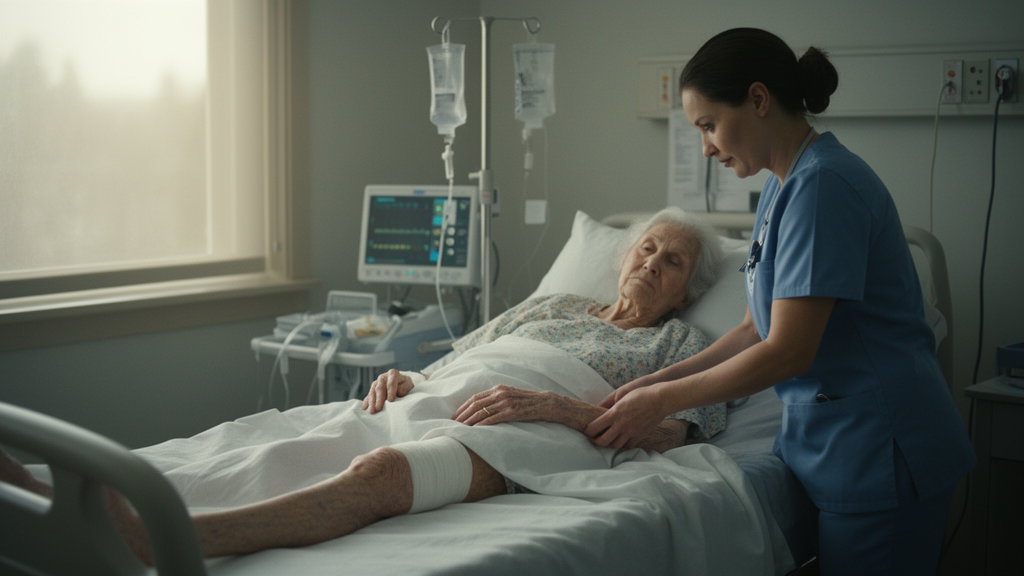
A broken hip in old age has always carried a daunting prognosis, but new research suggests that clinicians may be able to identify, before the first incision is even made, which patients face the gravest danger in the year that follows. A retrospective cohort study conducted at a major hospital in Shanghai and published in Frontiers in Aging has found that two conditions—preoperative frailty and postoperative delirium—each independently double the risk of death within one year of hip fracture surgery, and that when the two occur together, the mortality risk nearly quadruples compared with patients who have neither. The findings, drawn from 1,715 older surgical patients, offer one of the clearest quantifications yet of how these two overlapping syndromes compound one another in one of the most vulnerable populations in medicine.
Hip fractures are among the most consequential injuries of aging. They typically result from low-energy falls in bones weakened by osteoporosis, and they almost always require operative fixation or joint replacement. Despite decades of improvement in anesthetic technique, surgical implants, and perioperative monitoring, one-year mortality after hip fracture surgery still ranges between 10 and 30 percent worldwide—a figure that has proven stubbornly resistant to technological progress. This stubbornness has pushed researchers to look beyond the operating room itself, toward the intrinsic characteristics of the patients, to understand why some older adults survive the operation only to die within months.
The research team, led by investigators at Changhai Hospital of the Naval Medical University and collaborating institutions in Shanghai, focused on two candidate culprits. The first is frailty, a clinical syndrome of diminished physiological reserve in which chronic low-grade inflammation, sarcopenia—the progressive loss of muscle mass—and immunosenescence, the gradual decay of immune function, leave an individual poorly equipped to withstand stressors and slow to recover from them. The second is postoperative delirium, an acute and fluctuating disturbance of consciousness and cognition that emerges in the days following surgery. Delirium is notoriously common after hip fracture repair, in part because the combination of advanced age, emergency injury, pain, anesthetic exposure, and hospitalization creates a near-perfect storm for the aging brain.
Crucially, the researchers treated frailty and delirium not as isolated phenomena but as potentially interacting conditions sharing common pathophysiological ground. Frail patients, with their already compromised reserves, are known to be at heightened risk of developing delirium when subjected to surgical stress, inflammatory surges, and metabolic disruption. Yet most previous studies had examined the two conditions separately, leaving open the question of whether their co-occurrence simply adds risks together or multiplies them. To answer this, the team identified all patients aged 65 and older with radiographically confirmed hip fractures admitted for surgery between 2018 and 2023, excluding those with multiple fractures, pre-existing dementia, tumors, or delirium before the operation. Of 2,659 screened patients, 1,715 entered the final analysis.
Frailty was assessed using the modified five-item frailty index, a pragmatic screening tool that assigns one point each for diabetes, dependent functional status requiring help with daily activities such as bathing and dressing, chronic lung disease, recent congestive heart failure, and hypertension requiring medication. A score of two or more classified a patient as frail. Postoperative delirium was detected through daily screening with the Confusion Assessment Method on the first three days after surgery, supplemented for the remainder of the first week by a validated chart-based identification instrument designed to catch cases—including the easily missed hypoactive form, in which patients become lethargic and withdrawn rather than agitated—that routine observation often overlooks.
The results were striking. Roughly one patient in four (24.0 percent) was frail before surgery, and 16.9 percent developed postoperative delirium. When the researchers sorted patients into four groups—those with neither condition, those with delirium alone, those with frailty alone, and those with both—the one-year mortality gradient was unmistakable. Patients with neither condition fared best, with a one-year death rate of just 5.6 percent. Delirium alone raised that figure to 17.1 percent; frailty alone to 11.6 percent. But in patients who were both frail before surgery and delirious afterward, 28.4 percent died within the year—five times the rate of the healthiest group.
Raw percentages, of course, can be distorted by differences in age, comorbidities, and other baseline characteristics, so the team employed a multivariate landmark Cox regression analysis. This statistical approach is particularly well suited to studies of postoperative complications: by fixing the time origin at postoperative day three—by which point nearly 90 percent of all delirium events had occurred and no patient had yet died—the landmark design eliminates the so-called immortal time bias that can otherwise make exposures like delirium appear spuriously protective or harmful. The models were progressively adjusted for age, sex, body mass index, physical status classification, kidney and cerebrovascular disease, fracture and surgery type, anesthetic technique, timing of admission and surgery, operative blood loss and transfusion, intensive care admission, hemoglobin, and albumin. Even under the fullest adjustment, the associations held firm: delirium without frailty carried a hazard ratio of 2.09, frailty without delirium 2.30, and the combination 3.95, with all confidence intervals excluding the null value.
One subtlety in the data deserves attention: the formal statistical test for interaction between frailty and delirium was not significant, meaning the analysis could not confirm that the combination produces a risk truly greater than the sum of its parts. The hazard ratio of 3.95 is nonetheless consistent with an approximately multiplicative effect—2.09 times 2.30 would predict roughly 4.8—and a parallel sensitivity analysis treating frailty and delirium as separate binary variables found independent hazard ratios of 1.61 and 1.95 respectively. In practical terms, whichever way the statistical model is framed, the coexistence of the two conditions identifies the patients at highest observed risk, and the fivefold spread in mortality across the four groups reveals a heterogeneity hidden within the broad 10-to-30-percent mortality figures usually quoted for hip fracture populations.
The pathophysiological plausibility of these findings is considerable. Frailty reflects a body operating close to the limits of its homeostatic capacity, with depleted reserves across cardiovascular, metabolic, immune, and neurological systems. Surgery imposes an acute inflammatory and hemodynamic load on that system, and the aging brain—already vulnerable through the same inflammatory and vascular processes—may decompensate into delirium. Delirium itself is not merely a transient confusion; it is increasingly understood as a marker of acute brain injury associated with persistent cognitive decline, prolonged hospitalization, functional deterioration, and elevated long-term mortality. In a frail patient, an episode of delirium may trigger a cascade of immobility, aspiration, infection, and deconditioning from which recovery is never complete. The authors caution, however, that the specific mechanisms and, crucially, the interventions that might interrupt this cascade remain to be established by future research.
As with any retrospective single-center study, there are limits to interpretation. The design precludes causal inference, and unmeasured confounders such as perioperative complications and postoperative functional status could partly explain the associations. Chart-based delirium detection may underestimate true incidence, formal baseline cognitive testing was absent, and the five-item frailty index captures only a narrow slice of what geriatricians consider the multidimensional frailty construct. Still, the study’s strengths—a large cohort, complete follow-up of survival status, careful bias-resistant statistical methodology, and comprehensive adjustment—are substantial. For clinicians, the message is actionable in principle: a simple preoperative frailty score requires nothing more than the medical history already in the chart, and vigilance for delirium in the first days after surgery could flag the patients who need the most intensive perioperative care, geriatric co-management, and follow-up. As populations age and hip fractures grow more common worldwide, distinguishing the resilient from the vulnerable may prove one of the most consequential five-minute assessments in geriatric surgery.
Subject of Research: Association of preoperative frailty and postoperative delirium with one-year mortality after hip fracture surgery in older adults
Article Title: Association of preoperative frailty and postoperative delirium with one-year mortality after surgery in older patients with hip fractures
Article References: Zhang, K., Zhang, P., Chen, L., Wang, H., Chen, W., Zhu, Y., Li, D., & Lu, W. (2026). Association of preoperative frailty and postoperative delirium with one-year mortality after surgery in older patients with hip fractures. Frontiers in Aging, 7, Article 1923192. https://doi.org/10.3389/fragi.2026.1923192
Image Credits: AI Generated
DOI: 10.3389/fragi.2026.1923192
Keywords: hip fracture, frailty, postoperative delirium, one-year mortality, geriatric surgery, Cox regression, mFI-5, Confusion Assessment Method, perioperative risk, older adults, anesthesiology, delirium screening
Cite Scienmag News
Beatrice Stafford. (October 15, 2026). Frailty and Postoperative Delirium Together Raise Death Risk Fivefold After Hip Fracture Surgery. Scienmag. https://scienmag.com/frailty-and-postoperative-delirium-together-raise-death-risk-fivefold-after-hip-fracture-surgery/
Beatrice Stafford. "Frailty and Postoperative Delirium Together Raise Death Risk Fivefold After Hip Fracture Surgery." Scienmag, 15 October 2026, https://scienmag.com/frailty-and-postoperative-delirium-together-raise-death-risk-fivefold-after-hip-fracture-surgery/. Accessed 15 October 2026.
Beatrice Stafford. "Frailty and Postoperative Delirium Together Raise Death Risk Fivefold After Hip Fracture Surgery." Scienmag. October 15, 2026. https://scienmag.com/frailty-and-postoperative-delirium-together-raise-death-risk-fivefold-after-hip-fracture-surgery/


