


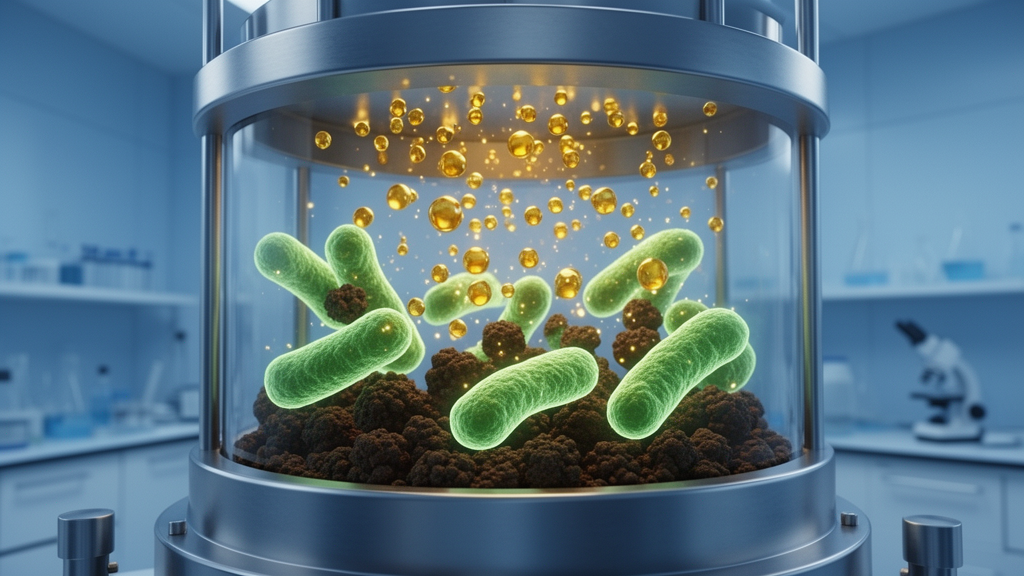
Lignocellulosic biomass—crop stalks, wood chips, agricultural waste—remains the most abundant renewable carbon source on Earth, and for decades biotechnologists have dreamed of converting it cheaply into biofuels and chemicals. There has always been a catch, however. The harsh pretreatment needed to crack open plant cell walls and free the fermentable sugars simultaneously generates a cocktail of toxic by-products: furan aldehydes such as furfural and 5-hydroxymethylfurfural, weak organic acids, and a cloud of phenolic lignin fragments. These compounds slow microbial growth, drain cellular resources, and slash product yields. A new review published in Frontiers in Industrial Microbiology argues that the industry has been throwing money away—literally—by treating these inhibitors as waste to be discarded rather than as raw material to be exploited.
The review, led by Bahgat Fayed and Shaimaa A. Nour of the National Research Centre in Giza, Egypt, together with colleagues in Egypt and the United Kingdom, reframes detoxification as a form of metabolic rewiring. Instead of washing out, over-liming, or adsorbing inhibitors onto activated carbon—steps that remove toxins but also sacrifice sugars and add cost and waste—the authors propose that engineered microbes should actively metabolize the inhibitors, recovering their carbon atoms and reducing power for product formation. In their vision, the detoxification step becomes a profit center rather than a tax on the biorefinery.
The numbers behind this idea are striking. When most microbes neutralize furfural, they do it by reducing the aldehyde to furfuryl alcohol, a reaction that consumes precious NADPH and permanently locks the inhibitor’s five carbon atoms into a dead-end product. But certain bacteria, most thoroughly the soil bacterium Cupriavidus basilensis HMF14, take the opposite route: an aldehyde dehydrogenase oxidizes furfural to 2-furoic acid, generating NADH in the process rather than consuming it. The furoic acid is then activated to its CoA ester, hydroxylated, and cleaved open by dioxygenases to yield 2-oxoglutarate, a central intermediate of the tricarboxylic acid cycle. Every one of the five carbon atoms in the original inhibitor survives. HMF follows a parallel path through 2,5-furandicarboxylic acid before converging on the same downstream route. When researchers transferred the hmf gene cluster from C. basilensis into Pseudomonas putida KT2440, the engineered strain grew on furans as its sole carbon source—proof that inhibitor carbon can be fully assimilated into central metabolism.
Aromatic inhibitors ride a similar conveyor belt. Lignin-derived compounds such as vanillin, ferulic acid, and p-coumaric acid are funneled through the β-ketoadipate pathway: vanillin is oxidized to vanillate, demethylated to protocatechuate, and then cleaved by ring-opening dioxygenases into β-ketoadipate, which feeds the TCA cycle as succinyl-CoA and acetyl-CoA. Even weak acids can be salvaged. Acetate, often abundant in hydrolysates and usually regarded as a nuisance, can be activated by acetyl-CoA synthetase into acetyl-CoA—the universal precursor for lipids, polyketides, and isoprenoids—at the modest cost of one ATP per molecule. Formate released from lignin oxidation can be oxidized by formate dehydrogenase to generate additional NADH, or in principle assimilated through reductive glycine pathways.
The redox dimension is where the review makes perhaps its sharpest technical point. Detoxification enzymes are not merely substrate converters; they are cofactor devices, and their NADH-versus-NADPH specificity can make or break a production strain. The classic cautionary tale is Escherichia coli, whose broad-specificity aldehyde reductase YqhD uses NADPH to reduce furfural. That drain on the NADPH pool starves biosynthesis—including sulfate assimilation—and stalls growth. Deleting yqhD or overexpressing the membrane-bound transhydrogenase PntAB restores NADPH and rescues the cell. In yeast, the NADPH-dependent xylose reductase used in many engineered Saccharomyces cerevisiae strains creates a cofactor imbalance with xylitol dehydrogenase, forcing cells to dump carbon into xylitol or glycerol as redox sinks. NADPH-hungry detoxification, in short, competes directly with the antioxidant systems and anabolic reactions that keep cells alive.
The solution, the authors argue, is to re-engineer cofactor preference itself. Recent protein engineering efforts have shown this is tractable: a carbonyl reductase from Exiguobacterium was computationally redesigned to switch from NADPH to NADH with more than a thousand-fold improvement in cofactor selectivity, and a structure-guided mutant of shikimate dehydrogenase gained a 25-fold boost in NAD-dependent catalytic efficiency. Where cofactor switching fails, auxiliary modules can bridge the gap—transhydrogenases that interconvert NADH and NADPH at the cost of proton motive force, sacrificial-substrate regeneration systems, or fusion proteins that physically tether a detox enzyme to its cofactor-regenerating partner. Peptide-linked fusion enzymes have cut NADPH input requirements by two orders of magnitude in some biocatalytic systems. Even more elegant are enzymes such as aldehyde dehydrogenases, which turn detoxification into a redox-positive event, producing NADH while disarming the toxin.
Crucially, the review insists that detoxification must be matched to the metabolic architecture of each host. For the oleaginous yeast Yarrowia lipolytica, whose cells naturally stockpile lipids, an acetyl-CoA-centered detox route makes the most sense: acetate and aromatic-derived acetyl-CoA feed directly into fatty acid synthesis, the cell’s preferred product. For Pseudomonas species, with their robust aromatic catabolism and TCA-driven aerobic metabolism, routing inhibitor carbon into TCA intermediates is the natural fit. For the ethanol workhorse S. cerevisiae, redox-balanced integration is the challenge, since anaerobic fermentation already teeters on a knife edge of NADH balance. Photosynthetic hosts such as cyanobacteria face yet another constraint: light reactions deliver ATP and NADPH at a fixed ratio that does not match the demands of the Calvin–Benson cycle, and they are acutely sensitive to oxidative stress, making inhibitor metabolism a distant but aspirational goal.
The concept of co-utilization ties the argument together. Rather than detoxifying hydrolysates before fermentation, engineered strains could consume inhibitors alongside the sugars in real, undetoxified hydrolysates. Evidence is already emerging: Rhodococcus jostii RHA1 grows on glucose supplemented with acetate and lignin monomers such as vanillate and ferulate, channeling them into triacylglycerol storage lipids. A thermotolerant Kluyveromyces marxianus strain has co-fermented glucose, xylose, and arabinose together with acetate, formate, furfural, and vanillin, achieving an ethanol yield of 0.46 grams per gram of sugar. The caveat is synergy: mixtures of inhibitors can be more toxic than the sum of their parts, so co-utilization demands hosts with sufficient transport systems, robust acid tolerance, and redox headroom to absorb the extra metabolic load.
The review is candid about the trade-offs. Oxidative detoxification routes depend on oxygen-requiring dioxygenases, ruling them out for strictly anaerobic processes such as butanol fermentation, where inhibitors instead tend to stall as alcohols. Acetate activation costs ATP, and expressing entire heterologous catabolic pathways imposes a protein burden on the host. Poorly balanced pathways can even accumulate toxic intermediates—semialdehydes, quinones—that stress cells more than the original inhibitor. The authors propose a simple guiding equation for module design: the net benefit equals redox relief minus cofactor drain and protein burden, with dynamic, inducible promoters recommended to keep detoxification capacity matched to inhibitor load rather than running constantly at the cell’s expense.
Getting from concept to industrial reality, the authors conclude, will require systemic modeling and rational enzyme redesign at scale. They call for genome-scale models integrated with transcriptomics, metabolomics, and carbon-13 flux analysis, validated in compositionally realistic hydrolysates rather than simplified single-inhibitor media, and for standardized reporting of labeled-carbon fate, cofactor ratios, and overall carbon closure so that carbon-positive detoxification can be distinguished from mere tolerance. If those standards are met, the implications are significant for the economics of second-generation biofuels: every molecule of furfural or acetate that once had to be washed away becomes a small bonus feedstock, shortening fermentation lag phases and nudging yields upward. In the closed-loop biorefinery the authors envision, the poisons of pretreatment become the unsung raw materials of production.
Subject of Research: Metabolic engineering of microbial detoxification pathways to recover carbon and redox power from lignocellulosic inhibitors in biorefineries
Article Title: Detoxification as metabolic rewiring: carbon and redox recovery from lignocellulosic inhibitors in biorefinery hosts
Article References: Fayed, B., Reda, A. E., Abood, A., & Nour, S. A. (2026). Detoxification as metabolic rewiring: carbon and redox recovery from lignocellulosic inhibitors in biorefinery hosts. Frontiers in Industrial Microbiology, 4, Article 1890364. https://doi.org/10.3389/finmi.2026.1890364
Image Credits: AI Generated
DOI: 10.3389/finmi.2026.1890364
Keywords: lignocellulosic biomass, furfural, HMF, detoxification, metabolic engineering, redox balance, cofactor specificity, biorefinery, Pseudomonas putida, Yarrowia lipolytica, acetyl-CoA, inhibitor co-utilization
Cite Scienmag News
Drew Townsend. (October 15, 2026). Poisons Into Profits: Microbes Turn Biomass Toxins Into Fuel Boosters. Scienmag. https://scienmag.com/poisons-into-profits-microbes-turn-biomass-toxins-into-fuel-boosters/
Drew Townsend. "Poisons Into Profits: Microbes Turn Biomass Toxins Into Fuel Boosters." Scienmag, 15 October 2026, https://scienmag.com/poisons-into-profits-microbes-turn-biomass-toxins-into-fuel-boosters/. Accessed 15 October 2026.
Drew Townsend. "Poisons Into Profits: Microbes Turn Biomass Toxins Into Fuel Boosters." Scienmag. October 15, 2026. https://scienmag.com/poisons-into-profits-microbes-turn-biomass-toxins-into-fuel-boosters/


