


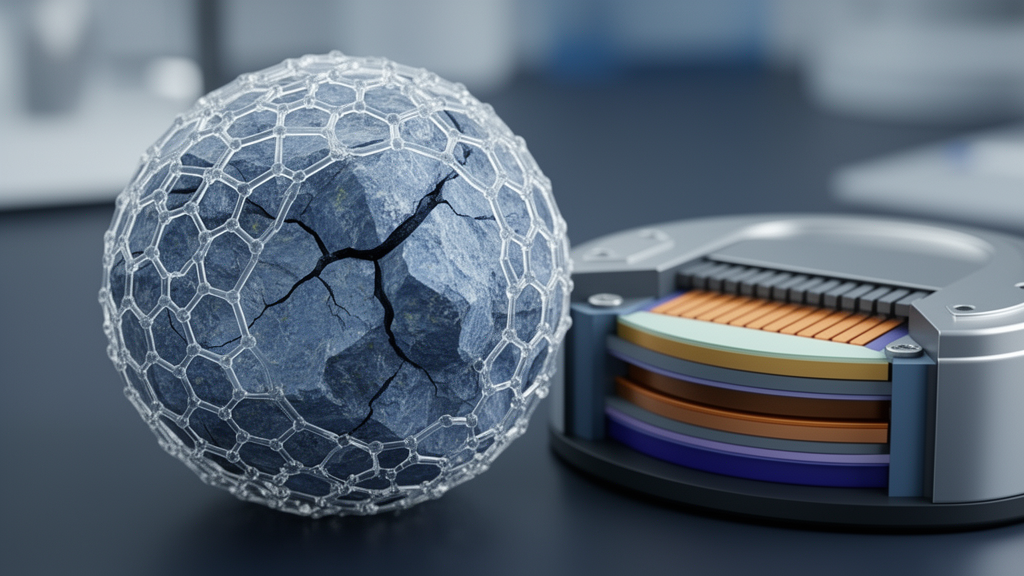
One of the most promising cathode materials for the next generation of electric vehicles has a well-kept secret: it falls apart faster than it should. Nickel-rich lithium nickel manganese cobalt oxide, known in the trade as NMC811, packs a remarkable amount of energy into every gram because roughly eighty percent of its transition-metal content is nickel. That high nickel fraction is precisely what gives the material its high energy density and its relatively low cost, but it is also the source of an escalating durability crisis. Now a research team spanning Malaysia and Romania, led by Yien Leng Leong, Hong Ngee Lim and Nay Ming Huang, has shown that a remarkably simple intervention — coating the cathode particles with graphene nanoplatelets using nothing more than ball milling — can dramatically slow that decay, and, just as importantly, they have used quantum-mechanical simulations to explain exactly why it works.
The scale of the improvement reported in the Journal of Materials Science study is striking. After three hundred charge-discharge cycles at a one-coulomb rate, the uncoated NMC811 cathode retained only 53.9 milliampere-hours per gram of capacity. The graphene-modified counterpart, by contrast, still delivered 101.4 milliampere-hours per gram after the same punishing regimen — nearly double the retained capacity. For a coating step as simple as mechanical mixing, the payoff is the kind of leap that battery engineers usually associate with years of formulation fine-tuning. Understanding where that extra stability comes from, however, required the team to look far deeper than conventional electrochemical testing could reach.
The problems afflicting NMC811 are rooted in its chemistry at high states of charge. When the battery is nearly full, most lithium ions have been pulled out of the layered oxide structure, leaving the remaining lattice in a highly oxidised and energetically precarious state. Three intertwined degradation pathways follow. Transition metal ions, particularly nickel, migrate from their assigned octahedral sites into the lithium layers, gradually destroying the ordered structure that allows lithium to move in and out efficiently. The particle surface reconstructs into new phases that impede ion transport. Most dangerously of all, the lattice oxygen itself becomes unstable and can be released from the crystal, a process that not only permanently damages the material but also raises serious safety concerns, since oxygen release at high states of charge feeds into thermal runaway.
To combat these failure modes, the researchers turned to graphene nanoplatelets, thin sheets of conductive carbon a few atoms thick, applied by ball milling — a mechanical process in which the cathode powder and graphene are tumbled together with milling media until the platelets adhere to the particle surfaces. The approach avoids the solvents, high temperatures and complex chemistry required by many other coating strategies, such as the aluminium oxide, cerium oxide, titanium dioxide and lithium niobate coatings explored by other groups. Earlier work had already hinted that carbon coatings can help: reduced graphene oxide wrappings, graphene ball architectures and amorphous carbon layers have all been shown to improve nickel-rich cathodes. What was missing was a rigorous, atom-by-atom account of how the graphene actually interacts with the cathode surface — and that is where the new study sets itself apart.
The team paired a full suite of experimental diagnostics with density functional theory, the workhorse quantum-mechanical method of computational materials science. On the experimental side, electrochemical impedance spectroscopy probed how readily lithium ions and electrons crossed the interface, rate capability tests measured performance under fast charging, and differential capacity curves tracked subtle changes in the phase behaviour of the cathode as it aged. On the computational side, the researchers calculated the charge density difference, the electron localization function, the total and partial density of states, and — perhaps most tellingly — the formation energy of oxygen vacancies at states of charge ranging from zero to sixty-six percent.
Those oxygen vacancy calculations delivered the study’s central insight. Across every state of charge examined, the graphene-coated material exhibited a higher oxygen vacancy formation energy than bare NMC811. In plain terms, it costs more energy to knock an oxygen atom out of the crystal when the graphene layer is present, which means the lattice oxygen is thermodynamically more stable and less inclined to escape during deep charging. Since oxygen release is one of the most damaging and safety-critical degradation pathways in nickel-rich cathodes, shoring up the oxygen framework strikes the problem at its root. This atomistic picture dovetails neatly with the cycling data: the dramatic difference in capacity retention after three hundred cycles is exactly what one would expect if the primary failure mechanism had been substantially suppressed.
The simulations also revealed something unexpected about the nature of the graphene-cathode bond. The charge density difference and electron localization function analyses showed localised charge redistribution at the interface but only weak electronic coupling between the graphene and the underlying oxide — the signature of an interface dominated by van der Waals forces rather than true chemical bonding. This is a subtle but consequential finding. It means the graphene does not merely act as an inert physical barrier sitting on top of the cathode; instead, the weak interfacial interaction is sufficient to perturb the local electronic structure of the nickel-oxygen framework, as confirmed by the partial density of states analysis, while leaving the cathode’s essential chemistry intact. The researchers describe graphene in this role as an interfacial electronic modifier — a material that improves stability not by building a wall, but by tuning the electronic environment of the surface it touches.
The impedance and rate capability measurements fill in the kinetic half of the story, which is where the study’s title earns its mention of interfacial kinetics. Graphene is one of the best electrical conductors known, and wrapping cathode particles in conductive platelets shortens the path electrons must travel and improves the connectivity of the electrode’s conductive network. Better electronic contact at the particle surface means faster charge transfer reactions, lower interfacial resistance and better performance at high charging rates — properties that matter enormously for fast-charging electric vehicles, where sluggish kinetics translate directly into long waits at the charger. The combination of improved kinetics and improved structural stability is what makes the coating strategy attractive from an engineering standpoint: it addresses the two halves of the battery performance equation simultaneously.
Why does this matter beyond the laboratory? Nickel-rich cathodes like NMC811 are at the heart of the push to extend the driving range of electric vehicles while keeping costs down, and they feature in many commercial cell chemistries already on the road. But durability and safety at high states of charge have remained stubborn obstacles, forcing manufacturers into conservative trade-offs between energy density and lifespan. A modification that can be applied with nothing more exotic than a ball mill — equipment already ubiquitous in cathode production plants — could in principle be integrated into existing manufacturing lines with minimal disruption. The study’s mechanistic clarity also hands other researchers a design principle: rather than searching blindly for coatings, they can now target interfaces that raise oxygen vacancy formation energies while maintaining weak, van der Waals-type coupling to the oxide surface.
There are, of course, the usual caveats that accompany laboratory-scale battery research. The results were obtained in coin-cell-type testing over three hundred cycles, a useful benchmark but a far cry from the thousands of cycles and wide temperature ranges that automotive qualification demands. How the graphene layer behaves over years of cycling, in contact with real electrolytes and at commercial electrode loadings, will only become clear through further work. Even so, the convergence of evidence is compelling: nearly doubled capacity retention, a computationally verified stabilisation of the lattice oxygen, and a physically coherent explanation that ties the experimental observations to the electronic structure of the interface. In a field where incremental gains are the norm, a simple carbon veil that teaches a temperamental cathode to hold itself together is the kind of result that could ripple quickly from journal pages into battery factories.
Subject of Research: Graphene nanoplatelet coating to improve the interfacial kinetics and structural stability of Ni-rich NMC811 lithium-ion battery cathodes
Article Title: Boosting the interfacial kinetics and structural stability of Ni-rich lithium nickel manganese cobalt oxide (NMC811) cathodes via graphene modification: a combined experimental and DFT study
Article References: Leong, Y. L., Lim, H. N., Ibrahim, I., Wan Mohd Abd Kalam, W. N., Mot, A. C., Pop, L. C., Hassan, M. R., Chong, W. G., Mohammad Latif, M. A., Ong, S. C., Ng, R. C. K., & Huang, N. M. (2026). Boosting the interfacial kinetics and structural stability of Ni-rich lithium nickel manganese cobalt oxide (NMC811) cathodes via graphene modification: a combined experimental and DFT study. Journal of Materials Science, 61(42), 33256-33278. https://doi.org/10.1007/s10853-026-13734-4
Image Credits: AI Generated
DOI: 10.1007/s10853-026-13734-4
Keywords: NMC811, lithium-ion batteries, cathode materials, graphene nanoplatelets, density functional theory, oxygen vacancy formation energy, capacity retention, interfacial kinetics, structural stability, van der Waals interface, surface coating, electric vehicles
Cite Scienmag News
Neil Sanderson. (October 15, 2026). Graphene Coating Keeps High-Nickel Battery Cathode from Falling Apart. Scienmag. https://scienmag.com/graphene-coating-keeps-high-nickel-battery-cathode-from-falling-apart/
Neil Sanderson. "Graphene Coating Keeps High-Nickel Battery Cathode from Falling Apart." Scienmag, 15 October 2026, https://scienmag.com/graphene-coating-keeps-high-nickel-battery-cathode-from-falling-apart/. Accessed 15 October 2026.
Neil Sanderson. "Graphene Coating Keeps High-Nickel Battery Cathode from Falling Apart." Scienmag. October 15, 2026. https://scienmag.com/graphene-coating-keeps-high-nickel-battery-cathode-from-falling-apart/


