


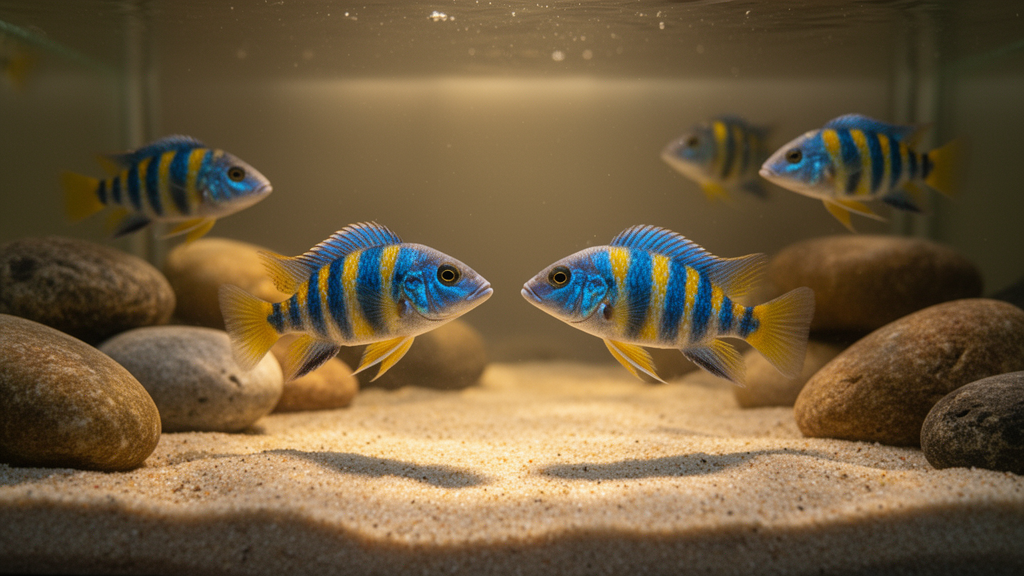
Even before they can reproduce, fish are already running their own version of a playground pecking order, and a new study suggests those early squabbles leave detectable fingerprints on the brain. In research published in Frontiers in Ethology, a team of American scientists reared juvenile Astatotilapia burtoni, a highly social African cichlid, in size-mismatched pairs for just one week. When the fish were briefly separated and then reunited, the larger individuals reliably behaved as dominants, chasing and displacing their smaller partners, and the intensity of that dominance behavior predicted everything from stress hormone levels to neural activity and the birth of new neurons in the forebrain.
The fish, sometimes called Burton’s mouthbrooder, has long served as a model for studying social dominance in adults. In the wild, dominant males defend territories while subordinate males sneak and wait, and adults can flip between these phenotypes with remarkable flexibility, changing their behavior, hormones, and even neural architecture. What has been far less clear is whether juveniles, which routinely form hierarchies in laboratory groups in as little as thirty minutes of interaction, rely on the same biological machinery as adults to navigate these relationships. The new experiment was designed to probe exactly that question by pairing reproductively immature fish and measuring their behavioral, physiological, and neural responses.
The researchers took sixteen juveniles, roughly fourteen months old and showing no visible signs of sexual maturity, from laboratory populations descended from wild-caught ancestors. Because juveniles cannot be sexed before maturity, the study could not separate males from females, but the species hatches at approximately a one-to-one sex ratio and females are known to display male-typical dominance behaviors in the absence of males, so the authors argue the results likely apply across both sexes. Each larger fish, averaging 0.26 grams, was paired with a noticeably smaller partner averaging 0.12 grams, and the eight pairs were housed together for seven days in simple aquaria containing a single terracotta pot as a territory.
On the eighth day came the critical test. Each fish was isolated in a small beaker for roughly two and a half hours, shielded from visual disturbances, before the two partners were simultaneously poured back into their shared tank. Over the following twenty minutes, cameras recorded their every move, and the footage was later scored using specialized behavioral software. The results were striking. Larger and smaller fish differed dramatically in how often they approached and displaced one another, with effect sizes indicating nearly complete separation between the groups. Every larger fish received a positive dominance score, and every smaller fish a negative one. Even the magnitude of the size gap mattered: pairs with bigger size asymmetries produced more lopsided behavior, with the difference in mass explaining an extraordinary 98 percent of the variance in the difference in approaches between partners.
With the hierarchy established on camera, the team turned to physiology. Fish excrete cortisol, the primary stress hormone, across their gills and through waste, so the researchers collected waterborne hormones by placing each fish in a beaker for forty minutes after the reunion. Interestingly, cortisol did not differ between larger and smaller fish, and the one-week pairing itself did not appear to induce chronic stress. But at the individual level, cortisol was tightly correlated with the amount of aggressive behavior an animal performed, with fish that approached and displaced their partners more showing lower cortisol. The authors interpret this counterintuitive pattern as suggesting that receiving aggressive acts, rather than performing them, may trigger an acute but temporary stress response without producing lasting changes in baseline stress.
The next layer of analysis concerned the brain’s social circuitry. Two conserved networks, the Social Behavior Network and the Mesolimbic Reward System, together form the Social Decision-Making Network, a collection of brain regions found across mammals, birds, reptiles, amphibians, and teleost fish that processes social information and guides decisions about aggression, mating, and affiliation. To measure which cells had been recently active, the team used immunohistochemistry to label phosphorylated ribosomal protein S6, or pS6, a marker of increased protein translation that tracks recent neural activation. They focused on three forebrain regions: the Dm3, the putative homolog of the mammalian basolateral amygdala; the Vsm, the putative homolog of the extended amygdala; and the Dc, a region whose homology remains debated.
Here the findings took an unexpected turn. No single brain region showed significant differences in activation between large and small fish. But when the researchers averaged neural response across all three regions, individuals that displayed more dominance behavior showed lower overall neural activity, a relationship that held across approaches, displacements, and time spent in the territory. This negative correlation between aggression and brain activation contrasts with expectations drawn from adult studies, in which dominant males show increased neural responses in specific regions when confronted with intruders. The authors suggest that the social processing driving juvenile behavior during a reunion may be fundamentally distinct from the social processing adults deploy against a territorial challenger, hinting that the same observable behaviors can be built on different mechanistic foundations at different life stages.
The study also delivered a first for the species: the first characterization of neurogenesis in the juvenile A. burtoni telencephalon. Fish boast the most widespread adult neurogenesis of any vertebrate studied to date, and in many species subordinate individuals show reduced birth of new neurons compared with dominants. The team labeled tissue for doublecortin, or DCX, a microtubule-associated protein marking differentiating neurons, and confirmed with co-labeling for the neuronal marker HuC/D that the labeled cells were indeed neural-fated. One week of pairing was not enough to shift neurogenesis between size categories, yet individual levels of DCX again correlated negatively with dominance behavior and with cortisol, meaning that the least aggressive, least stressed fish carried the most newly differentiating neurons.
Beyond the behavioral correlations, the survey of the juvenile brain produced a genuinely novel discovery. The researchers identified the Vsm, homologous to the mammalian extended amygdala, as a potential juvenile-specific site of interior neurogenesis, one not highlighted in prior studies of adults, where labeling in this region was instead restricted to the ventricular border. They also found the Dc to be a particularly active neurogenic niche, lending weight to the argument that this region should be treated as distinct within the teleost forebrain rather than dismissed as an extension of neighboring structures. And during tissue processing, the team noticed abundant DCX expression in the optic tectum, underscoring how broadly new neurons are born across the fish brain.
A principal component analysis that combined behavior, cortisol, neural activity, and neurogenesis into an unbiased multidimensional summary confirmed that behavioral metrics, not physiological or neural variables, were the best predictors of size category. Notably, the larger individuals showed more variation in their component scores, reinforcing the idea that there may be more than one way to be dominant, with each pair generating its own social dynamics that the fish, even as juveniles, attend to closely. The authors caution that a single week of cohabitation, following life in complex social groups, likely reflects plastic responses to context rather than any permanent developmental window. Still, the work reframes what it means to be subordinate at a young age: rather than a state of chronic defeat, juvenile subordination may represent a distinct pre-territorial phase, one in which quieter individuals actually cultivate more new neurons as they wait their turn in the social queue.
Subject of Research: Juvenile social dominance and its effects on stress physiology, neural activity, and neurogenesis in the cichlid fish Astatotilapia burtoni
Article Title: Behavior in asymmetric dominance pairings predicts physiology, neural response, and neurogenesis in a social cichlid fish
Article References: Aquino, E. A., Stern, E. R., Romero, A. M., Spool, J. A., Bambe, T. D., Solomon-Lane, T. K., & Wallace, K. J. (2026). Behavior in asymmetric dominance pairings predicts physiology, neural response, and neurogenesis in a social cichlid fish. Frontiers in Ethology, 5, Article 1888727. https://doi.org/10.3389/fetho.2026.1888727
Image Credits: AI Generated
DOI: 10.3389/fetho.2026.1888727
Keywords: Astatotilapia burtoni, social dominance, neurogenesis, cortisol, cichlid fish, pS6, doublecortin, juvenile behavior, social hierarchy, stress physiology, forebrain, extended amygdala
Cite Scienmag News
Cassandra Pierce. (October 15, 2026). Juvenile Cichlids Build Pecking Orders in a Week, With Surprising Effects on the Brain. Scienmag. https://scienmag.com/juvenile-cichlids-build-pecking-orders-in-a-week-with-surprising-effects-on-the-brain/
Cassandra Pierce. "Juvenile Cichlids Build Pecking Orders in a Week, With Surprising Effects on the Brain." Scienmag, 15 October 2026, https://scienmag.com/juvenile-cichlids-build-pecking-orders-in-a-week-with-surprising-effects-on-the-brain/. Accessed 15 October 2026.
Cassandra Pierce. "Juvenile Cichlids Build Pecking Orders in a Week, With Surprising Effects on the Brain." Scienmag. October 15, 2026. https://scienmag.com/juvenile-cichlids-build-pecking-orders-in-a-week-with-surprising-effects-on-the-brain/


