


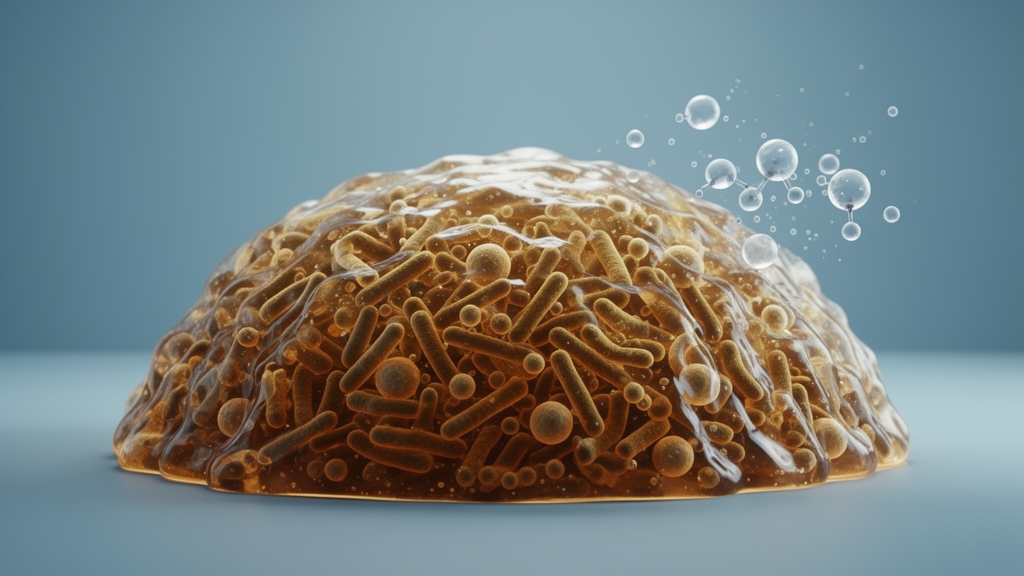
Microorganisms rarely live as free-floating cells in the natural world. Instead, they assemble into structured communities called biofilms, in which bacterial and fungal species, often many of them mixed together, proliferate and behave as a single coordinated entity encased within an extracellular matrix. That sticky matrix, built largely from polysaccharides, proteins and extracellular DNA, is far more than glue. It gives the community structure and stability, captures nutrients, blocks the entry of large molecules such as antimicrobial drugs, and even shelters cells from immune attack. According to a recent review from scientists at the United Kingdom’s Medicines and Healthcare products Regulatory Agency, published in Frontiers in Bacteriology, this deceptively simple lifestyle underpins one of the largest hidden costs in the global economy and one of the most stubborn obstacles in modern medicine.
The economic toll is staggering. A frequently cited estimate suggests biofilms contribute to losses approaching 5 trillion US dollars globally across healthcare, industrial, environmental and infrastructure sectors, although the review’s authors caution that this is a broad aggregate figure and should be interpreted with care. Much of the cost stems from biofouling and corrosion, but healthcare and medical applications represent a substantial share. Biofilms drive foreign-body related infections such as prosthetic joint infections and polymicrobial catheter infections, as well as non-surface associated conditions including cystic fibrosis lung disease, chronic wound infections and recurrent vulvovaginal candidiasis. The consequences include rising healthcare costs, lost working days, increased mortality and significantly diminished quality of life for patients.
What makes biofilm infections so difficult to treat is a layered arsenal of defence mechanisms. On top of conventional genetic resistance, which arises through mutation and horizontal gene transfer, a process that occurs readily in biofilms because densely packed cells are in constant close contact and can exchange DNA through conjugation, biofilms exhibit physical and physiological tolerance unique to the community lifestyle. Antimicrobials often simply fail to penetrate the protective matrix. Neutrophils, the immune system’s frontline phagocytes, can only engulf bacteria smaller than about 10 micrometres, whereas biofilms shielded beneath the matrix can exceed 100 micrometres and are effectively out of reach. Dormant, slow-growing persister cells form readily as oxygen and nutrients become depleted in mature biofilms, rendering cell-wall-targeting drugs such as beta-lactams, glycopeptides and echinocandins ineffective because their targets are simply not being synthesised. Slower cellular metabolism further dampens drug susceptibility. Overlaid on all of this is quorum sensing, a sophisticated chemical communication system in which bacteria and fungi release autoinducer molecules, such as acylated homoserine lactones and autoinducing peptides in bacteria, and farnesol and tyrosol in fungi, to coordinate gene regulation governing biofilm formation, antimicrobial resistance and virulence.
These formidable defences have fuelled an explosion of research into anti-biofilm technologies, from antimicrobial peptides and monoclonal antibodies for prosthetic joint infection to antimicrobial coatings, wound care products, matrix-degrading enzymes, bacteriophage therapies, quorum sensing inhibitors and repurposed drugs. Yet remarkably few human medicines carry a licence with an explicit anti-biofilm claim. Dornase alfa, marketed as Pulmozyme and approved by the US Food and Drug Administration, degrades extracellular DNA and is used in cystic fibrosis, a clinically biofilm-driven disease, but its formal indication is not framed in biofilm terms. Azithromycin, similarly, was never licensed with an anti-biofilm claim despite demonstrating excellent activity against Pseudomonas aeruginosa biofilms under some conditions. The gap between laboratory promise and regulatory approval is wide, and the review argues that a large part of that gap is procedural rather than scientific.
At the heart of the problem lies a reproducibility crisis. Biofilm science depends on a sprawling array of experimental models, from simple high-throughput microtitre plates and the Calgary Biofilm Device to physiologically realistic flow chambers, drip-flow reactors and fermenters. Each model embodies a compromise between mimicking real-world biofilm behaviour and maintaining reproducibility and throughput. Simple assays such as crystal violet staining of biomass are attractive for routine screening but often produce heterogeneous, poorly reproducible results that carry little weight in regulatory decision-making. More complex systems offer physiological relevance but require specialised equipment that differs between laboratories. Growth conditions, including nutrient composition, temperature, flow and shear forces, and surface properties, vary enormously depending on whether the model is meant to represent clinical infection, industrial contamination or an environmental biofilm, and even minor differences in oxygen availability or temperature can alter gene expression, metabolic activity and matrix production. Harvesting and neutralisation methods add further variability, since some antimicrobials alter biofilm adhesion or structural integrity, affecting how cells detach and are counted.
Compounding the methodological chaos is a conceptual one: there is no universally accepted definition of what a biofilm actually is. Descriptions generally involve surface-attached microbial communities embedded in self-produced matrix, but different definitions emphasise different features, from surface attachment and matrix production to community structure, spatial organisation and phenotypic characteristics. This lack of consensus thwarts the comparison of data across studies, the establishment of reference materials and the development of performance standards. The review suggests that simply reaching greater agreement on the defining characteristics of a biofilm would be an important early step towards standardisation, and proposes that biofilm maturity might be better defined through quantitative thresholds of matrix-associated biomarkers, such as carbohydrate content, extracellular DNA and matrix proteins, rather than through arbitrary incubation times like 24 or 48 hours.
Several international initiatives are attempting to impose order. The National Biofilm Innovation Centre, through its International Biofilm Standards Task Group, convenes stakeholders from academia, industry and regulation, including the USA Center for Biofilm Engineering and the Singapore Centre for Environmental Life Sciences Engineering, to collate evidence and disseminate best practice across sectors from human health to water systems. The European COST Action on Building Consensus on Biofilm Regulatory Decision Making is developing a regulatory toolbox through working groups on standardised technologies and data translation. The Biofilm Alliance networks researchers, metrologists, regulators and standardisation bodies with the same goal. Formal written standards are also emerging through a dedicated British Standards Institution committee on biofilms and products and through ASTM standards housed by the American National Standards Institute. But each effort has limitations: academic centres depend on fluctuating funding, COST Actions have fixed four-year lifespans, and neither the collaborative networks nor the standards committees can themselves define regulatory frameworks. Written standards can be inflexible, slow to publish and paywalled, and because biofilms differ fundamentally by species, environment, growth conditions and maturity, a single rigid standard risks being either too simplistic to reflect reality or too complex to reproduce. The review argues instead for performance-based standards that specify key parameters, model system type, organism, growth conditions, contact times, replication strategy and efficacy thresholds, while leaving flexibility in model selection.
Perhaps the most ambitious proposal concerns physical reference materials, the biological equivalent of the calibration weights used in metrology. A universal biofilm reference material is difficult to envisage because biofilms are living, dynamic, context-dependent systems. One approach would be biological reference biofilms, such as well-characterised strains of Pseudomonas aeruginosa grown under tightly controlled flow-cell conditions, with reference values for biomass, thickness, viability, matrix composition and cell density, though such materials would suffer from short shelf-life and species-specificity. Another would be artificial matrix-based materials composed of representative polysaccharides, proteins and extracellular DNA, offering stability and ease of distribution for calibrating imaging systems and evaluating matrix-disrupting technologies. The authors suggest the most realistic path may be analytical reference materials that standardise measurements rather than the biofilm itself. Importantly, they caution that the goal should not be a universal biofilm model, since polymicrobial communities show emergent properties unpredictable from monospecies systems, but rather fit-for-purpose methodologies underpinned by common principles for cultivation, characterisation, reporting and validation.
On the regulatory side, the picture is less bleak than developers often assume. Neither the UK’s MHRA, the European Medicines Agency nor the FDA has biofilm-specific guidance, and anti-biofilm products are instead classified implicitly within broader medicines, medical devices or combination product frameworks according to their primary function. The review argues that many perceived barriers stem from uncertainty rather than genuine obstruction, and it draws a direct parallel with therapeutic bacteriophages. That community believed regulation was incompatible with phage therapy, but engagement with the MHRA revealed that phages fit comfortably within the biological medicines framework; the agency published regulatory considerations and interpretive guidance without creating new regulation, and the EMA and European Pharmacopoeia followed with quality guidelines. The lesson is that regulators routinely evaluate innovative products and welcome early scientific advice, which benefits both parties through horizon scanning. The authors sketch a roadmap: within one to three years, consensus on biofilm definitions, better reporting standards and candidate reference materials; within three to seven years, harmonised performance-based standards and regulatory guidance on evidence for anti-biofilm claims; and within seven to ten years, validated biofilm-specific endpoints embedded in product evaluation worldwide. Achieving that will require sustained collaboration among researchers, industry, metrology institutes, standards bodies and regulators, but if it succeeds, the trillion-dollar microbial cities that currently defeat our antibiotics may finally face a coordinated defence.
Subject of Research: Standardisation and regulatory science challenges for antibiofilm research and innovation
Article Title: Unravelling biofilm complexity: a regulatory science perspective
Article References: Unravelling biofilm complexity: a regulatory science perspective. (n.d.). https://doi.org/10.3389/fbrio.2026.1886299
Image Credits: AI Generated
DOI: 10.3389/fbrio.2026.1886299
Keywords: biofilms, regulatory science, antimicrobial resistance, standardisation, reproducibility, extracellular matrix, quorum sensing, reference materials, MHRA, bacteriophage therapy, cystic fibrosis, medical devices
Cite Scienmag News
Kristina Jarvis. (October 15, 2026). Why Biofilms Defy Treatment and How Regulation Could Finally Catch Up. Scienmag. https://scienmag.com/why-biofilms-defy-treatment-and-how-regulation-could-finally-catch-up/
Kristina Jarvis. "Why Biofilms Defy Treatment and How Regulation Could Finally Catch Up." Scienmag, 15 October 2026, https://scienmag.com/why-biofilms-defy-treatment-and-how-regulation-could-finally-catch-up/. Accessed 15 October 2026.
Kristina Jarvis. "Why Biofilms Defy Treatment and How Regulation Could Finally Catch Up." Scienmag. October 15, 2026. https://scienmag.com/why-biofilms-defy-treatment-and-how-regulation-could-finally-catch-up/


