


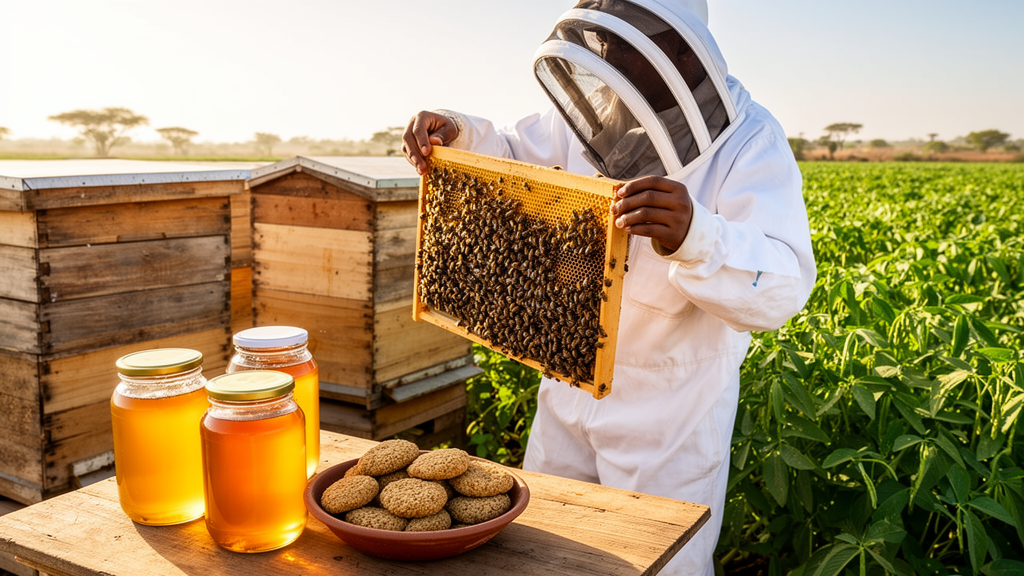
In the highlands of central Ethiopia, the months from July to September bring a silent crisis to the apiary. Flowers vanish, pollen becomes scarce, and honey bee colonies are forced to draw down the protein reserves that fuel brood rearing and colony growth. For beekeepers in wealthy countries, this seasonal dearth is routinely bridged with commercially formulated pollen substitutes, but in Ethiopia, one of Africa’s most important honey producers, such feeding has remained rare. Now a field experiment conducted in central Oromia during the 2023 dearth season offers some of the clearest local evidence yet that a simple, affordable patty made from expeller-pressed soybean cake flour can transform colony performance, and that the choice of protein source matters enormously.
The study, carried out by researchers affiliated with the University of South Africa and published in Frontiers in Bee Science, compared four feeding regimens across twenty honey bee colonies headed by uniformly productive queens. Three diets were formulated from locally available plant proteins: expeller-pressed soybean cake flour, Niger seed cake flour, and mung bean flour, each blended with granulated sugar and a vitamin-mineral premix. The fourth group received only sucrose syrup as a control. Colonies received 250 grams of patty or one liter of syrup per week over four weeks, with patties placed directly above the brood nest to encourage rapid uptake. The design, a completely randomized layout with five colonies per treatment, allowed the team to track feed consumption, sealed brood area, adult bee population, worker weight, pollen stores, honey yield, and economic returns under identical management.
Chemical analysis revealed why the soybean diet stood out. Expeller-pressed soybean cake flour contained 46.0 percent crude protein, well above the 34.5 percent of Niger seed cake and the 20.6 percent of mung bean flour. It also delivered the highest energy content at 368.2 kilocalories per 100 grams, with a moderate fat level of 5.8 percent, a profile consistent with earlier research showing that low-fat soybean flours support brood development and honey storage. Niger seed cake carried the most fiber and fat, while mung bean flour was dominated by carbohydrates at 62.2 percent. Protein content was used as the key indicator of nutritional adequacy because amino acid profiling was not feasible in the laboratory used for the study.
The bees themselves appeared to cast their vote early. Feed consumption differed significantly across treatments over the four feeding rounds, with soybean patties consistently eaten in the largest quantities, peaking at 225 grams per colony in the third round and averaging 177.5 grams across the trial. Niger seed and mung bean patties were eaten far less eagerly, averaging 125.0 and 132.5 grams respectively. Control colonies consumed all the syrup offered. The researchers suggest that the low intake of mung bean flour may reflect its poor palatability, since the whole seed powder was used without roasting, germination, or dehulling, processing steps known to alter fiber content and sensory qualities of legume flours.
Brood development told a similar story. Sealed brood, counted from digital images of both sides of every capped brood frame, was highest in soybean-fed colonies, reaching 16,381 cells in August and a striking 24,420 cells in September, when the soybean group significantly outperformed the Niger seed treatment. Mung bean colonies actually led in August with 16,953 cells but collapsed to 15,077 by September, while control colonies hovered near 13,000 and Niger seed colonies fell below 10,000 in both months. Because sealed brood represents the next generation of workers, these counts translate directly into a colony’s capacity to forage, thermoregulate, and fill honey combs when conditions improve.
Honey yield, the outcome most beekeepers care about, differed significantly among treatments. Soybean-fed colonies produced a mean of 14.75 kilograms of honey per colony, followed by the syrup-only control at 11.22 kilograms, with Niger seed and mung bean colonies trailing at 9.73 and 8.12 kilograms. The differences were not universal across every metric, however. Adult bee population growth and worker body weight showed no statistically significant treatment effects, and bee bread, the stored pollen packed into cells, also varied without reaching significance. The authors attribute these null results to natural variability in pollen availability, foraging activity, and seasonal floral dynamics, noting that rainfall in 2023 was comparatively low and discontinuous, particularly in September, which may have shaped pollen dispersal in ways that overshadowed the dietary treatments.
The economic analysis, perhaps the most consequential part of the study for its intended audience, translated these biological results into money. Using a farm-gate honey price of 600 Ethiopian birr per kilogram, ten soybean-fed colonies produced 114 kilograms of honey and 68,400 birr in revenue, against total costs of about 20,095 birr including labor, sugar, feed ingredients, and equipment depreciation. That yielded a net income of 48,305 birr, a benefit-cost ratio of 3.40, and a return on investment of 240.39 percent. The control group ranked second with a 155.47 percent return, Niger seed managed only marginal profitability at 22.20 percent, and mung bean flour actually produced a slight financial loss with a benefit-cost ratio below one, driven by its low consumption and poor honey yield.
For smallholder beekeepers, the practical recommendation is strikingly simple. The authors suggest feeding 250-gram patties of expeller-pressed soybean cake flour per colony per week, placed on the top bars of the brood combs above the brood cluster and covered with wax paper to prevent moisture loss. The ingredients, soybean cake, sugar, and a vitamin-mineral premix, are affordable and locally adaptable, addressing the central barrier that has kept supplemental feeding rare in Ethiopia: the absence of cost-effective, nutritionally balanced formulations suited to local markets and conditions. Because honey bees in Ethiopia belong to the distinct highland-adapted subspecies Apis mellifera simensis, locally validated feeding strategies carry particular value for the country’s diverse agro-ecological zones.
The researchers are careful to flag the limits of their evidence. The experiment ran for a single season, with only five colonies per treatment and a short feeding window, so the findings may not generalize across years, locations, and environmental conditions. Weather data were compiled retrospectively from nearby meteorological records rather than monitored continuously, and amino acid profiling of the diets was not possible. The authors call for multi-season, multi-location trials to optimize amino acid balance and to explore fermented plant-based protein sources as alternatives.
Even with those caveats, the study fills an important gap. It provides baseline experimental evidence that locally milled protein cakes, rather than imported commercial feeds, can sustain brood rearing and boost honey harvests through the lean season, and that palatability and protein concentration together determine whether a supplement pays for itself. In a country where beekeeping is a vital source of income across highland, midland, and lowland zones, a patty that more than doubles a colony’s honey yield during the dearth could reshape how Ethiopian beekeepers manage the hardest months of the year, turning a seasonal liability into an opportunity for measurable profit.
Subject of Research: Effects of locally formulated pollen substitute diets on honey bee colony performance and honey yield in central Ethiopia
Article Title: Effects of nutritional supplementation on honey bee Apis mellifera L. brood development, colony population growth, and honey yield in central Ethiopia
Article References: Hailemariam, W. A., C.A, M., & Mokolopi, B. G. (2026). Effects of nutritional supplementation on honey bee Apis mellifera L. brood development, colony population growth, and honey yield in central Ethiopia. Frontiers in Bee Science, 4, Article 1813470. https://doi.org/10.3389/frbee.2026.1813470
Image Credits: AI Generated
DOI: 10.3389/frbee.2026.1813470
Keywords: honey bees, Apis mellifera, pollen substitute, soybean cake, Ethiopia, dearth period, brood development, colony nutrition, honey yield, beekeeping, cost-benefit analysis, Effects
Cite Scienmag News
Daisy Hatcher. (October 15, 2026). Soybean patties boost honey bee colonies and yields in Ethiopian trial. Scienmag. https://scienmag.com/soybean-patties-boost-honey-bee-colonies-and-yields-in-ethiopian-trial/
Daisy Hatcher. "Soybean patties boost honey bee colonies and yields in Ethiopian trial." Scienmag, 15 October 2026, https://scienmag.com/soybean-patties-boost-honey-bee-colonies-and-yields-in-ethiopian-trial/. Accessed 15 October 2026.
Daisy Hatcher. "Soybean patties boost honey bee colonies and yields in Ethiopian trial." Scienmag. October 15, 2026. https://scienmag.com/soybean-patties-boost-honey-bee-colonies-and-yields-in-ethiopian-trial/


