


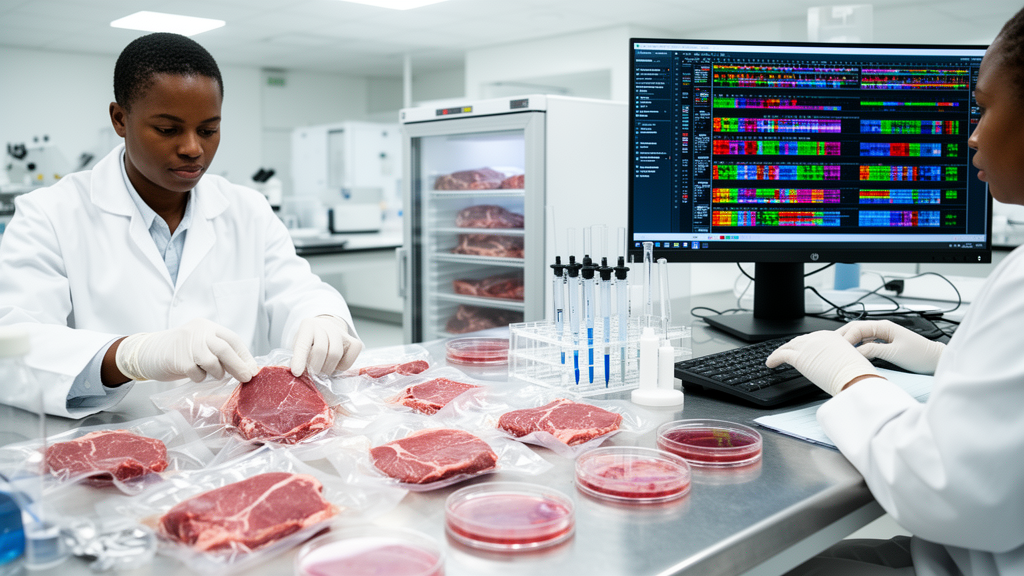
Yersinia enterocolitica is one of the most under-appreciated players in the world of foodborne disease. While Salmonella and Escherichia coli dominate headlines, this cold-loving bacterium quietly circulates through pork, beef and dairy chains across the globe, causing yersiniosis, an intestinal illness that can mimic appendicitis and, in some lineages, trigger serious complications. What has been missing is a clear picture of which genetic variants circulate in South Africa, a country where the pathogen is increasingly recognised along the meat production continuum but has never been genomically characterised in depth. A new study published in BMC Genomics has now filled that gap, sequencing bacteria recovered from retail meat and comparing them against hundreds of genomes drawn from food sources worldwide.
The research team, led by Mmabatho Mashapo and Thendo Mafuna of the University of Johannesburg together with colleagues at the University of South Africa and the Agricultural Research Council’s Onderstepoort Veterinary Research, analysed 23 isolates obtained from beef and pork samples purchased at retail outlets. After quality filtering, 18 high-quality whole genomes were retained. These were then placed alongside 356 publicly available food-associated genomes in a comparative framework, allowing the South African isolates to be situated within the global population structure of the species for the first time.
The methodological backbone of the study was core genome multilocus sequence typing, or cgMLST, a technique that compares the sequences of hundreds to thousands of genes shared by all strains in a species. By tallying the differences at these core loci, cgMLST produces a fine-grained measure of genetic relatedness that can reveal transmission chains, geographic clusters and evolutionary lineages with a resolution that older fingerprinting methods cannot match. In this analysis, the combined dataset resolved into four major lineages, and the South African isolates fell predominantly within a clade designated HC1490_10, a group that is widely distributed internationally.
Traditional multilocus sequence typing, which examines a smaller set of housekeeping genes and assigns each strain a sequence type or ST, added another layer of detail. The local isolates represented 11 distinct sequence types, including several that are potentially uncommon in the published literature: ST661, ST329, ST173 and ST352. At the same time, the researchers detected ST3, ST18 and ST178 among the South African samples, sequence types that belong to lineages known to be prevalent and widely distributed around the world. This mix of locally distinctive and globally shared types suggests that the meat supply carries both endemic diversity and strains with international connections.
Beyond relatedness, the team explored the pan-genome, the total complement of genes found across all strains of the species. Bacteria typically split their gene pool into a core of universally conserved genes and a vast accessory genome of genes present in only some strains. Yersinia enterocolitica showed what geneticists call an open pan-genome: as more genomes are added, new genes keep appearing, a pattern driven by a high proportion of accessory and so-called cloud genes, particularly in the global dataset. Open pan-genomes are signatures of substantial genomic plasticity, indicating that the species readily gains and loses DNA through horizontal gene transfer, the exchange of genetic material between organisms that reshapes bacterial populations over ecological timescales.
One of the most consequential questions for any foodborne pathogen survey is antimicrobial resistance. Here the study delivered a nuanced result. Profiling of the resistome, the full set of resistance-associated genes, revealed a conserved intrinsic resistome dominated by beta-lactamase genes, notably blaA and ampC, along with efflux-associated determinants that pump antibiotics out of the cell. These intrinsic genes are part of the species’ normal genetic makeup and are not typically associated with clinical treatment failure. By contrast, acquired resistance genes, which bacteria pick up from other organisms and which often confer clinically relevant drug resistance, were detected only at low frequencies, and intriguingly, they were confined to isolates belonging to the HC1490_10 clade.
The mobile genetic element analysis shed light on how this plasticity is achieved. The researchers identified a diverse array of plasmids, the small circular DNA molecules that bacteria exchange readily, and prophages, viral genomes integrated into the bacterial chromosome. Both play major roles in horizontal gene transfer and genome plasticity. Encouragingly, however, no plasmid-associated antimicrobial resistance genes were detected in the isolates studied, suggesting that the mobile elements circulating in these meat-associated populations are not currently ferrying clinically important resistance determinants between strains.
Virulence, not resistance, is the other half of the public health equation, and it was here that the study produced its most reassuring finding. The South African isolates lacked the plasmid-associated pathogenicity determinants that define dangerous strains, including the genes encoding the Type III secretion system, a molecular syringe that pathogenic yersiniae use to inject effector proteins into host cells and subvert the immune response. The local isolates were consequently classified as non-pathogenic biotype 1A. In stark contrast, the pathogenic lineage represented in the global dataset, designated HC1490_2, harboured both chromosomal and plasmid-encoded virulence factors, the full toolkit required to cause disease in humans.
These results place South African retail meat in a comparatively favourable light but come with important caveats. The dominance of non-pathogenic biotype 1A strains suggests a currently low virulence risk from the meat samples examined. Yet the presence of globally distributed lineages, including the clade in which acquired resistance genes were concentrated, underscores the potential for pathogenic variants to emerge or be introduced. Food production systems are dynamic, and the same open pan-genome that makes Yersinia enterocolitica so genomically flexible means that virulence and resistance traits can, in principle, move between lineages when conditions allow.
The authors argue that their findings make a direct case for integrating whole-genome sequencing into food safety and One Health surveillance frameworks, an approach that connects human, animal and environmental health into a single monitoring system. Genomic surveillance of this kind can trace contamination routes, flag the arrival of pathogenic clones, and detect emerging resistance before it becomes a clinical problem. For a country whose meat industry feeds millions and exports internationally, the message is clear: the bacteria on the supermarket shelf carry a genomic record of where they came from, and reading that record routinely could help keep one of food safety’s quieter threats from ever getting louder.
Subject of Research: Genomic epidemiology and antimicrobial resistance of Yersinia enterocolitica in South African meat and global populations
Article Title: Whole-genome sequencing reveals the genomic epidemiology of Yersinia enterocolitica in South African meat and global populations
Article References: Whole-genome sequencing reveals the genomic epidemiology of Yersinia enterocolitica in South African meat and global populations. (n.d.). https://doi.org/10.1186/s12864-026-13409-z
Image Credits: AI Generated
DOI: 10.1186/s12864-026-13409-z
Keywords: Yersinia enterocolitica, whole-genome sequencing, genomic epidemiology, antimicrobial resistance, virulence factors, pan-genome, cgMLST, food safety, meat contamination, South Africa, One Health, biotype 1A
Cite Scienmag News
Daisy Hatcher. (October 15, 2026). Genomes of Meat-Borne Yersinia Reveal South Africa’s Place in a Global Food Safety Puzzle. Scienmag. https://scienmag.com/genomes-of-meat-borne-yersinia-reveal-south-africas-place-in-a-global-food-safety-puzzle/
Daisy Hatcher. "Genomes of Meat-Borne Yersinia Reveal South Africa’s Place in a Global Food Safety Puzzle." Scienmag, 15 October 2026, https://scienmag.com/genomes-of-meat-borne-yersinia-reveal-south-africas-place-in-a-global-food-safety-puzzle/. Accessed 15 October 2026.
Daisy Hatcher. "Genomes of Meat-Borne Yersinia Reveal South Africa’s Place in a Global Food Safety Puzzle." Scienmag. October 15, 2026. https://scienmag.com/genomes-of-meat-borne-yersinia-reveal-south-africas-place-in-a-global-food-safety-puzzle/


