


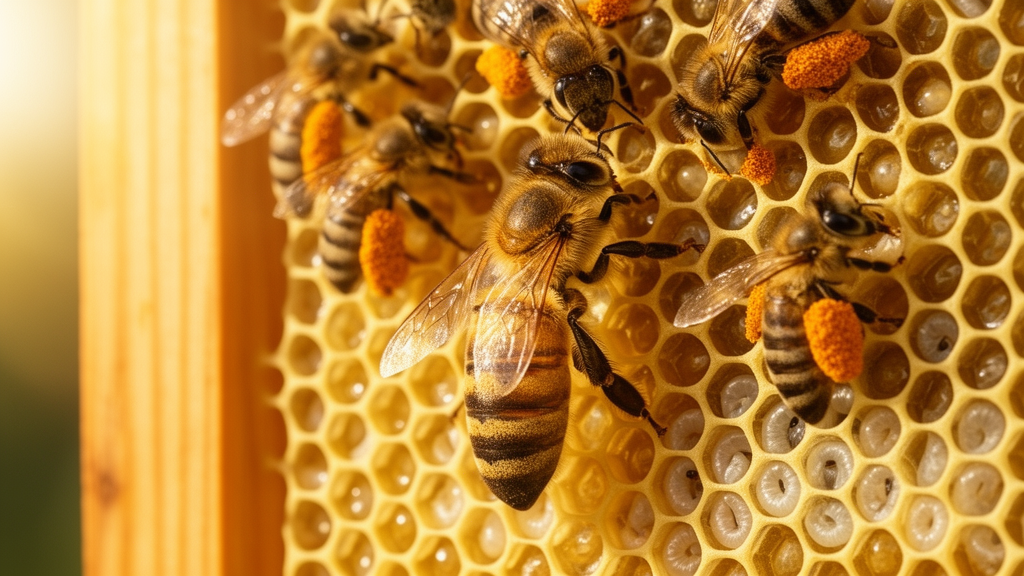
Honey bee colonies are dying at alarming rates across much of the world, and researchers increasingly agree that no single culprit is to blame. Pesticides, parasites such as the Varroa mite, predators, and landscapes stripped of forage by monoculture farming all combine to push colonies over the edge. Because laboratory experiments struggle to reproduce such tangled combinations of stressors, ecologists have turned to computational models that can simulate an entire colony responding to its environment day by day. One of the most influential of these tools is BEEHAVE, an individual-based honey bee model that has been used in more than 25 studies to explore everything from hornet predation to pesticide exposure. Now, a team of researchers has rebuilt the model’s most fundamental assumption: the queen’s egg-laying rate.
In the original BEEHAVE model, developed by Becher and colleagues, the queen lays eggs according to a fixed bell-shaped curve over the year. The timing of the start, peak, and end of egg laying is hard-wired into the code, and because egg laying drives the demography of the entire colony, this single imposed curve effectively determines everything else. The curve is based on average conditions in Central Europe, drawing on data stretching back to Bodenheimer’s work in 1937. That means the model is well suited to Central European apiaries but poorly suited to regions where the season starts earlier or lasts longer, and to a warming world in which flowering phenology is shifting. Climate change can advance the onset of flowering, and warmer late-winter temperatures are known to trigger earlier brood rearing. If egg laying begins earlier, Varroa mites, which reproduce inside capped brood cells, gain a head start on their exponential growth and can inflict far more damage.
The new study, published in the journal Individual-based Ecology, introduces a modified version of the model called BEEHAVE-PPE, short for Pollen Pheromone Egg-laying. Instead of dictating the queen’s egg-laying rate from a curve, the researchers asked whether realistic seasonal colony dynamics could emerge from a feedback loop involving pollen stores, brood pheromones, and ambient temperature. The idea is biologically grounded: honey bee larvae produce brood pheromones that are known to stimulate worker bees to forage for pollen, increasing the size of pollen loads and shortening the rest periods between foraging trips. More brood means more pheromone, more pheromone means more pollen foragers, and more pollen means better nutrition for the queen, who can then lay more eggs, producing still more brood. The model closes this positive feedback loop and lets the seasonal rhythm of the colony arise from it.
The mechanics of the new module are deliberately simple. Each day, the egg-laying rate is calculated as the product of the stored pollen in grams and a new parameter called EggsPerPollen, set at 18 eggs per gram of pollen, capped by the queen’s physiological maximum of 1,600 eggs per day. Because a queen cannot ramp her output up and down instantaneously, the daily rate is smoothed with a ten-day moving average, a pragmatic approximation of physiological inertia in egg production. On the foraging side, the model tracks a dimensionless brood pheromone variable: every larva produces 0.1 units of pheromone per day, and the total is divided by the number of adult bees to give a ratio that determines how strongly the colony is pushed toward collecting pollen rather than nectar. Two new parameters, influenceLim and concScale, control the maximum strength of this pheromone effect and how quickly bees respond to rising concentrations.
One of the more inventive assumptions concerns temperature. The researchers implemented temperature-dependent degradation of brood pheromones using the Arrhenius equation, a standard chemical kinetics relationship, with a reference temperature of 27 degrees Celsius and an activation energy of 147 kilojoules per mole. At first glance this seems odd, since honey bees carefully regulate the temperature of their hive. But outside temperature affects active foragers, and temperature still varies in parts of the comb outside the brood nest. The consequence in the model is striking: in spring, when brood is abundant and newly emerged adults are few, the pheromone-to-bee ratio is high, driving pollen collection and fueling colony growth. In midsummer, the adult population swells relative to the brood while high temperatures accelerate pheromone breakdown, so foragers shift toward nectar and egg laying falls. As temperatures cool in autumn, pheromone degradation slows and a modest second wave of brood production becomes possible.
The model also had to grapple with the peculiar biology of winter bees, the long-lived workers that differ physiologically from their summer sisters and serve as living nutrient stores that help launch the first brood cycle of the year. Because BEEHAVE does not distinguish between winter and summer worker types, the researchers treated only bees hatched in the current simulation year as contributors to the pheromone ratio, effectively treating the previous year’s bees as winter bees. This prevents the overwintering population from diluting the brood-pheromone signal so severely that the feedback loop could never start in spring. The authors are candid that this is a structural approximation rather than an empirically validated mechanism, adopted because direct data on the overwintering-to-spring transition are lacking.
To calibrate the six new parameters, the team turned to monitoring data from 250 colonies in France, using the NetLogo tool BehaviorSearch to search parameter space. Because field data were only available from March to October, a continuous reference curve for the full year was constructed by cubic-spline interpolation and used as the calibration target. Sensitivity was assessed with both local one-at-a-time analyses and global methods based on the Morris and Sobol frameworks. The results were revealing. Colony outcomes were most strongly influenced by the temperature- and pheromone-related parameters: the Arrhenius reference temperature dominated the local analysis, while activation energy and the pheromone concentration scaling parameter were the dominant drivers in the global analyses. In practical terms, this means anyone hoping to apply BEEHAVE-PPE to a different climate would need to recalibrate the temperature-response and pheromone-response parameters carefully for local conditions.
Under average weather conditions and a resource-rich landscape, the model performed impressively. Simulated colonies grew through spring, peaked in early summer, and declined afterward, matching the timing of the empirical data from France. Notably, the summer decline began while foraging hours were still near their seasonal maximum in July, which points to persistently high summer temperatures, rather than a lack of foraging time, as the driver: heat accelerates pheromone degradation, suppresses pollen collection, and thereby curtails egg laying. When the researchers ran simulations with unlimited nectar and pollen available year-round, the population climbed to a single higher peak of roughly 34,000 adult bees in June, and the timing of peak and decline still tracked the empirical curve. Varying the queen’s maximum daily egg output mainly changed colony size rather than the shape of the seasonal trajectory, suggesting the emergent dynamics are reasonably robust.
The model’s weaknesses are just as informative as its successes. Pollen-driven egg laying alone could not produce realistic dynamics; the pheromone and temperature components were essential. More seriously, when the researchers tested prolonged periods of adverse weather that prevented foraging, the model failed. Short interruptions in pollen intake merely dampen the feedback loop, causing temporary population dips followed by recovery. But repeated or extended disruptions can tip the colony into a vicious cycle: less pollen means fewer eggs, fewer larvae mean less pheromone, and a weaker pheromone signal means even less pollen collection, potentially ending in colony mortality. The authors suggest that buffering mechanisms already present in BEEHAVE, such as brood cannibalism and nurse bees metabolizing their own reserves, could rescue the model from this fragility, but only after substantial re-engineering to track explicit nutrient states in brood and nurse cohorts.
The researchers are explicit that BEEHAVE-PPE is not ready to replace the original model and is not intended for direct practical use. Its assumptions about brood pheromone production and degradation are heuristic and remain unverified, and even the best-performing configuration breaks down under sustained bad weather. Yet, as modeling theorists Grimm and Berger have argued, more is often learned from a model’s limitations than from its calibrated successes. By demonstrating that a queen’s egg-laying rate plausibly emerges from pollen availability, brood signaling, and temperature, the study converts a fixed input into a testable hypothesis. The authors hope it will spur empirical work measuring how pollen supply, brood pheromones, and temperature jointly govern egg-laying behavior, and theoretical work on feedback dynamics within colonies. If that research confirms the mechanism, honey bee models could finally shed their Central European assumptions and become reliable predictors for colonies facing a rapidly changing climate.
Subject of Research: Emergent queen egg-laying rate in the BEEHAVE-PPE honey bee colony model driven by brood pheromones, temperature, and pollen availability
Article Title: Food for thought: could the queen's egg-laying rate in the BEEHAVE honey bee model emerge from the effects of brood pheromones, weather conditions, and pollen availability?
Article References: Lammers, D., Requier, F., Focks, A., & Groeneveld, J. (2026). Food for thought: could the queen's egg-laying rate in the BEEHAVE honey bee model emerge from the effects of brood pheromones, weather conditions, and pollen availability?. Individual-based Ecology, 2, Article e185721. https://doi.org/10.3897/ibe.2.185721
Image Credits: AI Generated
DOI: 10.3897/ibe.2.185721
Keywords: honey bees, BEEHAVE model, egg-laying rate, brood pheromones, pollen foraging, temperature, individual-based modeling, colony dynamics, Varroa mite, climate change, model calibration, Apis mellifera
Cite Scienmag News
Drew Townsend. (October 15, 2026). Honey Bee Model Lets the Queen’s Egg-Laying Emerge from Pheromones, Weather and Pollen. Scienmag. https://scienmag.com/honey-bee-model-lets-the-queens-egg-laying-emerge-from-pheromones-weather-and-pollen/
Drew Townsend. "Honey Bee Model Lets the Queen’s Egg-Laying Emerge from Pheromones, Weather and Pollen." Scienmag, 15 October 2026, https://scienmag.com/honey-bee-model-lets-the-queens-egg-laying-emerge-from-pheromones-weather-and-pollen/. Accessed 15 October 2026.
Drew Townsend. "Honey Bee Model Lets the Queen’s Egg-Laying Emerge from Pheromones, Weather and Pollen." Scienmag. October 15, 2026. https://scienmag.com/honey-bee-model-lets-the-queens-egg-laying-emerge-from-pheromones-weather-and-pollen/


