


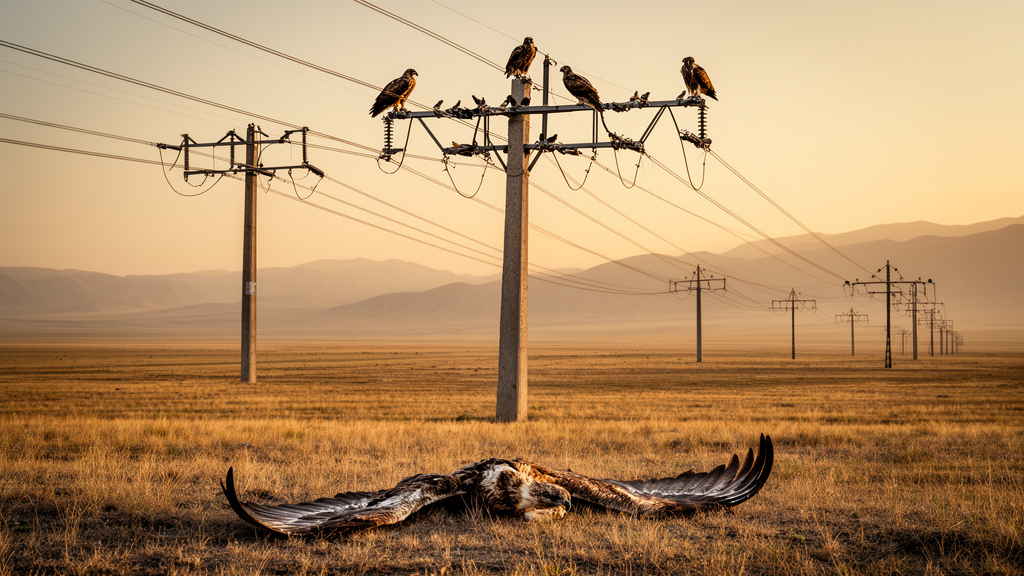
Along the windswept steppes of northwestern Armenia, a quiet toll is mounting beneath the wires. A pilot survey, the first of its kind for the country, has documented 252 electrocuted birds representing at least 15 species along roughly 114 kilometres of medium-voltage distribution lines, and researchers warn that the true figure is almost certainly far higher. The findings, published in the journal Caucasiana, offer the first systematic field evidence that Armenia’s expanding electricity network is killing birds of prey, corvids and other species at rates that demand urgent mitigation.
The study was conducted during two contrasting periods in 2024. Between late May and the end of July, the team surveyed lines in the Armavir, Ararat and Kotayk provinces, focusing on areas near the Khosrov Forest State Reserve and the Metsamor and Sardarapat Important Bird Areas. Then, from mid-September to early November, attention shifted to Shirak province, a major raptor migration corridor dominated by high-altitude steppe and agricultural mosaics with sparse tree cover. In total, the surveyors walked transects along 2,071 poles, examining a 40-metre-wide belt centred on each line.
The technical logic behind electrocution is straightforward. On low- and medium-voltage distribution lines, birds die when they bridge the gap between energised conductors, or between a conductor and grounded hardware such as a metal crossarm, while perching or taking off. Concrete poles with closely spaced, uninsulated components are particularly dangerous, which is why the team prioritised them over wooden poles once initial inspections suggested they posed the greater risk. Carcasses found within a five-metre radius of a pole were classified as probable electrocution victims, and each was logged with species, pole type, coordinates and distance from the structure.
The seasonal and regional contrast was stark. During the breeding season across Armavir, Ararat and Kotayk, the team recorded just 24 electrocution cases. In Shirak during autumn migration, they recorded 228. The authors caution that this difference may reflect both seasonal patterns and landscape differences rather than a single cause, but the pattern is consistent with a well-known mechanism: open steppe and farmland with few natural perching structures forces birds onto power infrastructure. Shirak’s lines connect villages across open fields where the only elevated perches are poles.
Species composition tells its own story. Eurasian magpies led the count with 49 records, followed by common kestrels and rooks with 34 each, western jackdaws with 33 and common buzzards with 31. Together these five species accounted for nearly 72 percent of all casualties. Raptors made up 97 individuals, or 38.5 percent of the total, a figure with real conservation weight because many raptors are large-bodied, slow-reproducing species whose populations are sensitive to even modest increases in adult mortality. Among the victims were species listed in the Red Book of Animals of Armenia: a juvenile golden eagle, a Eurasian eagle-owl and lesser kestrels, all classified as Vulnerable, plus four probable Armenian gulls from the colony at Lake Arpi.
Age data, though fragmentary, added a troubling dimension. Of the 53 individuals whose age could be determined, 83 percent were juvenile or immature; within the raptor subset, the figure rose to 91 percent of 34 age-determined birds. Young raptors, still perfecting their hunting and perching skills, appear especially vulnerable to poorly designed poles. Sex could rarely be determined from carcass condition, precluding comparisons between males and females.
Pole type mattered. Of the 252 records, 239, or 94.8 percent, occurred on concrete poles, and 216, or 85.7 percent, were on intermediate poles, the single-pole structures that dominate the network. Anchor poles and switch poles were implicated far less often. The authors stress that this pattern partly reflects their own survey design, which deliberately prioritised concrete lines and excluded wooden-only lines in the second phase, so relative risk between materials cannot be directly compared. Still, the concentration of deaths on a specific, well-defined infrastructure type is precisely what makes targeted retrofitting feasible.
Spatial mapping revealed unmistakable hotspots. The most critical cluster lay around Lake Arpi National Park, a Ramsar-listed wetland that hosts Armenia’s only known breeding site for the Dalmatian pelican and a large colony of Armenian gulls. There, parallel uninsulated 10 kV lines run about 20 metres apart along the lakeshore, cutting through grassland heavily used by raptors and waterbirds. Other hotspots included the stretch between Zorakert and Paghakn villages, the route from Paghakn to Ardenis, and the Bavra–Tavshut highway. Raptor-specific mapping flagged the Hartashen–Tashir line, where a golden eagle, multiple buzzards and kestrels died, and the Karaberd–Maralik section in open steppe. One pole in Shirak accounted for ten carcasses.
The study also produced an unusual bonus dataset: informal carcass persistence observations. Because scavenger removal and observer detection rates could not be formally measured, the reported numbers represent minimum mortality, a limitation the authors acknowledge openly. But by marking fresh carcasses and revisiting them, the team found that buzzard and kestrel remains often persisted for more than a month in open grassland, and one golden eagle carcass stayed on its pole for at least 301 days, from late September 2024 to late July 2025, eventually mummified. High persistence of large raptor remains suggests detection probability in this landscape may be relatively good, though small carcasses likely vanish faster. Notably, only nine carcasses bore visible burn marks, ranging from singed toes to a magpie whose body and surrounding grass were scorched, meaning the absence of burns cannot rule out electrocution as a cause of death.
The path forward is well established elsewhere. Insulating energised components, reconfiguring crossarms, installing perch deterrents and routing lines away from key habitats have all been shown to cut electrocution deaths substantially without compromising power delivery. Encouragingly, the survey noted roughly seven kilometres of newer, fully insulated cable lines near villages in Ararat province where no casualties were recorded. The researchers call on Electric Networks of Armenia and other line owners to prioritise retrofitting at the identified hotspots, especially around Lake Arpi and the Shirak migration corridors, and urge the government to embed bird-safe standards into energy planning, technical regulations and environmental assessment. As the authors frame it, power infrastructure represents a form of human–wildlife conflict in which essential development imposes severe but entirely preventable biodiversity losses, and Armenia now has the first evidence base to act on.
Subject of Research: Bird electrocution mortality on medium-voltage distribution power lines in Armenia
Article Title: Avian mortality associated with medium-voltage distribution lines in selected regions of Armenia: results of a pilot survey
Article References: Harutyunyan, L., Kovalev, V., Markosyan, A., Tarasyan, N., Aghajanyan, L., & Gudkov, M. (2026). Avian mortality associated with medium-voltage distribution lines in selected regions of Armenia: results of a pilot survey. Caucasiana, 5, 41-57. https://doi.org/10.3897/caucasiana.5.e188959
Image Credits: AI Generated
DOI: 10.3897/caucasiana.5.e188959
Keywords: bird electrocution, power lines, Armenia, raptors, Shirak province, Lake Arpi National Park, concrete poles, migration, Red Book species, mitigation, South Caucasus, conservation
Cite Scienmag News
Margaret Porter. (October 15, 2026). Power Lines Kill Hundreds of Birds in First Systematic Survey of Armenia’s Grid. Scienmag. https://scienmag.com/power-lines-kill-hundreds-of-birds-in-first-systematic-survey-of-armenias-grid/
Margaret Porter. "Power Lines Kill Hundreds of Birds in First Systematic Survey of Armenia’s Grid." Scienmag, 15 October 2026, https://scienmag.com/power-lines-kill-hundreds-of-birds-in-first-systematic-survey-of-armenias-grid/. Accessed 15 October 2026.
Margaret Porter. "Power Lines Kill Hundreds of Birds in First Systematic Survey of Armenia’s Grid." Scienmag. October 15, 2026. https://scienmag.com/power-lines-kill-hundreds-of-birds-in-first-systematic-survey-of-armenias-grid/


