


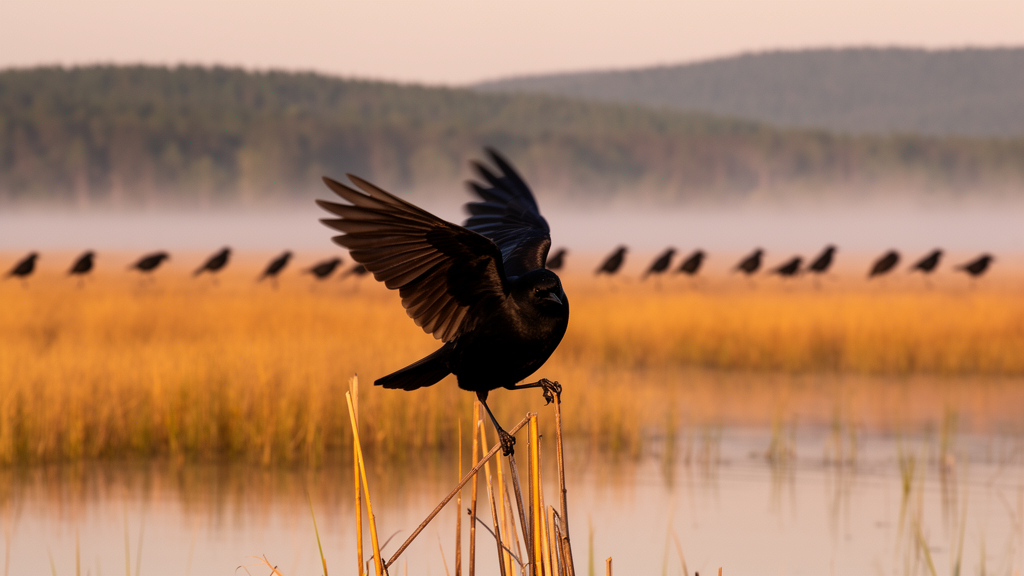
The New World blackbirds — the family Icteridae, which includes orioles, grackles, cowbirds, meadowlarks, caciques, and oropendolas — are among the most familiar songbirds in the Americas, yet their deep evolutionary geography has been contested for nearly eighty years. In 1946, the legendary ornithologist Ernst Mayr argued that the family originated in South America and colonized northward, even before the Isthmus of Panama fully formed. A major new analysis published in Frontiers of Biogeography now overturns that scenario in striking detail: the blackbirds began in North America and swept south in a stepwise march, reaching South America millions of years earlier than the celebrated land bridge that supposedly connected the two continents.
The research team, working with 104 of the family’s roughly 106 recognized species, combined four complementary analytical approaches: phylogenetic bioregionalization, probabilistic ancestral range estimation, biogeographic stochastic mapping, and geography-dependent diversification modeling. First, the authors divided the Americas into biogeographic units that reflect evolutionary history rather than political or climatic boundaries. Using breeding-range maps converted into a grid of one-degree cells, they calculated Simpson’s phylogenetic index of dissimilarity, which measures how much shared evolutionary branch length turns over between neighboring assemblages while remaining insensitive to differences in species richness. Hierarchical clustering of that matrix, evaluated with cophenetic correlation, identified UPGMA as the best algorithm, and the elbow method settled on six distinct regions: the Nearctic, the Andes, Amazonia, Southern South America, Patagonia, and a Mesoamerican-Caribbean region.
With these six evolutionary provinces in hand, the team compared eighteen models of range evolution spanning three dispersal hypotheses — unconstrained movement among all regions, dispersal restricted by geographic distance, and a gradual, directional model favoring southward movement. Under each hypothesis they tested the classic DEC, DIVALIKE, and BAYAREALIKE frameworks, with and without a founder-event speciation parameter. A likelihood ratio test between the best adjacent-area and best gradual models showed that the gradual, directional model fit significantly better. Under that winning DEC model, dispersal was estimated at 0.377 and extirpation at 0.093, and the ancestral range reconstruction placed the origin of the entire family squarely in the Nearctic, with overwhelming probability concentrated in the North American bioregion.
Biogeographic stochastic mapping, run across one thousand simulated histories, then turned that static reconstruction into a dynamic narrative. The average history contained about 161 dispersal events but only about 33 range contractions, and most cladogenetic events — roughly 55 per map — were within-region, in situ speciation events rather than vicariant splits. The timing is the headline. The first colonists reached Mesoamerica around 7.53 million years ago, Amazonia around 6.06 million years ago, the Andes around 5.84 million, Southern South America around 4.83 million, and finally Patagonia around 2.68 million years ago. That southward cascade follows a clear relay: the Nearctic exported lineages into Mesoamerica, which funneled birds into both Amazonia and the Andes, and Amazonia in turn seeded the southern cone. Patagonia, colonized last and rarely, acted as a peripheral sink with almost no outward flow.
The most provocative implication concerns the Isthmus of Panama. The earliest dispersal from North to South America, at roughly 6 million years ago, predates the traditionally accepted closure of the isthmus, generally placed between about 3 and 2.7 million years ago. That timing instead aligns with a documented dispersal wave of the Great American Biotic Interchange around 6 million years ago and with the expansion of open habitats across northern South America driven by Andean uplift between roughly 9 and 6 million years ago. In other words, the first blackbirds to reach South America may have crossed water or used early proto-isthmian connections, riding a wave of grassland expansion rather than waiting for a land bridge. This fits emerging fossil evidence that North American mammals had already accumulated in Mesoamerica through the Miocene before exchanging with South America between roughly 7 and 3 million years ago.
Why would grass-loving birds be primed for such a journey? The earliest branching lineages of the family — the meadowlarks and their allies, including Xanthocephalus, Dolichonyx, Sturnella, and Leistes — are associated with open habitats, which the study identifies as the family’s ancestral niche. As the global climate dried through the late Miocene and Pliocene, C4 grasslands and savannas expanded across the Americas, displacing woody biomes. The blackbirds appear to have tracked their ancestral open-country niche southward, a textbook case of niche conservatism, following the habitat rather than adapting to new ones. Individual subclades tell more varied stories: caciques and oropendolas tracked retreating forests into Amazonia, orioles diversified explosively in Mesoamerica during the Pliocene and even reversed the flow back into North America during the Pleistocene, and the grackles split into a Mesoamerican lineage and one that radiated into Amazonia as grasslands spread.
Mesoamerica emerged as the study’s most dynamic character. It was the first Neotropical region colonized, the greatest net source of dispersers, the site of the most in situ speciation events (about 22 per stochastic map, largely during the Pleistocene), and the region with the highest range contractions, suggesting intense lineage turnover. The authors suggest that Pleistocene climatic oscillations repeatedly fragmented habitats there, generating the allopatric conditions that drove divergence in groups such as orioles and grackles. Amazonia, meanwhile, served as the continental entry point and a major speciation center, consistent with its broader role as the source of over 2,800 lineages across Neotropical biodiversity. Intriguingly, the Andes acted mainly as a corridor rather than a diversification hotspot — a contrast with montane clades like tanagers and sparrows — plausibly because open-habitat birds with high dispersal ability treat the mountains as connective terrain rather than an isolating barrier.
The diversification analysis delivered the study’s conceptual twist. Comparing null, GeoSSE, and GeoHiSSE models, the full GeoHiSSE model — which allows both observed geographic states and unmeasured hidden rate classes to shape speciation and extinction — won decisively, capturing 93.6 percent of Akaike weight. Two hidden regimes emerged. In one, rates were moderate and geographically structured, with North American endemics diversifying deeply and South American endemics showing speciation partly offset by extinction. In the other, the pattern flipped entirely: North American endemics showed near-zero subsequent diversification, while widespread lineages exhibited extraordinarily rapid cladogenesis, splitting into endemic daughter lineages on each continent. Crucially, model-averaged speciation rates ended up broadly comparable across regions — 0.334 per million years for widespread lineages, 0.314 for South American endemics, and 0.234 for North American endemics — meaning neither continent enjoys an intrinsic speciation advantage.
The upshot is that geography governs where blackbirds went, but not how fast they split into new species. The same region yields wildly different diversification rates depending on a lineage’s hidden regime, pointing to unmeasured biological drivers. The authors point to plausible candidates supported by work across the broader Emberizoidea superfamily: ecological specialization, which predicts speciation rates in the group, along with social behavior and sexual selection — plumage and song divergence are known engines of cladogenesis in icterids and their relatives. Dispersal ability, by contrast, shows no significant relationship with speciation in the clade. Formally testing these hypotheses will require integrating traits like diet breadth, dichromatism, and song structure directly into future diversification models.
In a satisfying historical footnote, the study vindicates both of its intellectual predecessors at once. Mayr was right about the stepwise, region-by-region colonization he imagined in 1946 — but wrong about its direction. Barker and colleagues were right in 2015 that the family is North American in origin — and this analysis now supplies the fine-grained sequence, timing, and mechanism they could not resolve. The New World blackbirds, it turns out, are a story of northern origins, southbound relay across a dynamic Mesoamerican hub, grassland-fueled expansion ahead of the Panama land bridge, and a speciation engine driven less by maps than by the biology of the birds themselves.
Subject of Research: Historical biogeography and diversification of the New World blackbirds (Icteridae)
Article Title: The historical biogeography of the New World blackbirds ( Icteridae )
Article References: Arango, A., & Gokhale, C. S. (2026). The historical biogeography of the New World blackbirds (Icteridae). Frontiers of Biogeography, 19, Article e202331. https://doi.org/10.21425/fob.19.202331
Image Credits: AI Generated
Keywords: Icteridae, historical biogeography, Nearctic origin, Great American Biotic Interchange, Isthmus of Panama, biogeographic stochastic mapping, GeoHiSSE, phylogenetic bioregionalization, C4 grasslands, speciation, Neotropics, Ernst Mayr
Cite Scienmag News
Violet Maxwell. (October 15, 2026). New World Blackbirds Began in the North, Then Marched South Millions of Years Early. Scienmag. https://scienmag.com/new-world-blackbirds-began-in-the-north-then-marched-south-millions-of-years-early/
Violet Maxwell. "New World Blackbirds Began in the North, Then Marched South Millions of Years Early." Scienmag, 15 October 2026, https://scienmag.com/new-world-blackbirds-began-in-the-north-then-marched-south-millions-of-years-early/. Accessed 15 October 2026.
Violet Maxwell. "New World Blackbirds Began in the North, Then Marched South Millions of Years Early." Scienmag. October 15, 2026. https://scienmag.com/new-world-blackbirds-began-in-the-north-then-marched-south-millions-of-years-early/


