


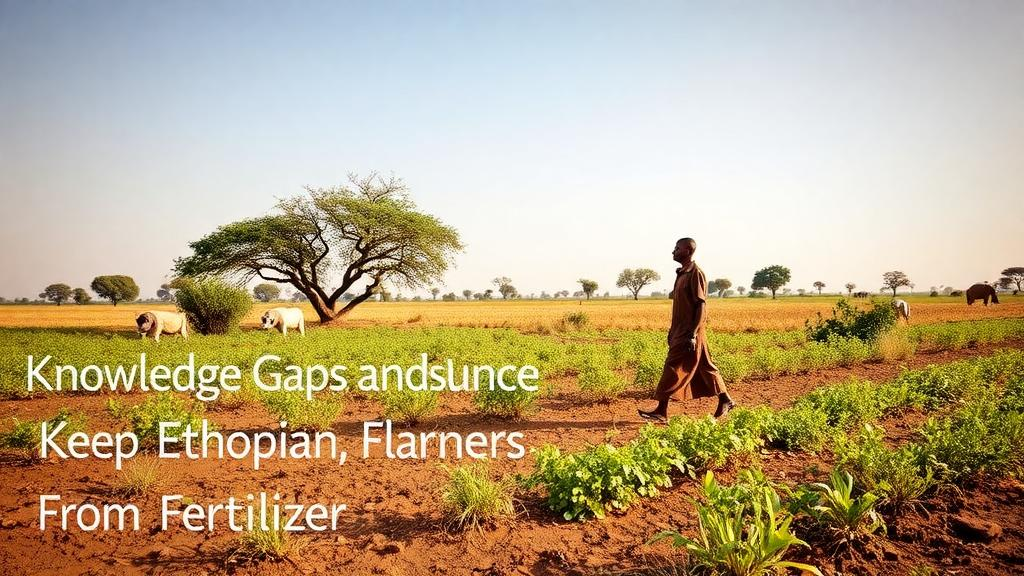
In the drought-prone highlands and lowlands of northeastern Ethiopia, a quiet crisis is unfolding beneath the surface of the region’s cereal fields. Farmers in the Amhara Region’s dryland farming systems are applying only a fraction of the fertilizer that agronomists recommend, and a new study of 304 smallholder households reveals exactly why. The research, published in Innovations in Agriculture, disentangles two decisions that are often conflated in agricultural policy: whether a farmer chooses to adopt inorganic fertilizer at all, and how much of it they spread once they do. By treating these as separate behavioral hurdles, the study uncovers a striking asymmetry. Access to extension services, technical knowledge, market prices, and proximity to input suppliers govern the first decision, while cooperative membership, farm size, income, and detailed application knowledge determine the second. The finding has immediate implications for how governments and development agencies design interventions aimed at closing the region’s persistent yield gap.
The stakes could hardly be higher. Agriculture anchors Ethiopia’s economy, contributing roughly a third of gross domestic product and employing between 80 and 85 percent of the population. With arable land scarce, raising productivity per hectare is the primary pathway to national food security, and inorganic fertilizers such as urea and NPS are central to that strategy. Previous research has shown what is possible when inputs are used properly: combining recommended fertilizer rates with improved crop varieties can multiply yields two to three times, and fertilizer paired with optimal sowing dates and agronomic practices has boosted grain yields by 122 percent compared with untreated controls. Yet in the northeastern districts of the Amhara Region, adoption and application rates remain stubbornly low, and most earlier studies of fertilizer behavior were conducted in agroecological settings with rainfall patterns, soil fertility, and climatic conditions that differ markedly from these drylands.
To fill that evidence gap, the researchers purposively selected three districts known for low or negligible fertilizer use: Sekota in the Wag-himra zone, Tehuledere in South Wollo, and West Belesa in Central Gondar. The districts span a remarkable range of conditions. Sekota sits at altitudes of 1,500 to 2,200 meters and receives a meager 350 to 650 millimeters of erratic annual rainfall. Tehuledere, by contrast, enjoys roughly 1,030 millimeters of rain a year at elevations reaching 2,900 meters. West Belesa, a lowland sorghum zone, endures average temperatures of 33.5 degrees Celsius. From a population of 1,673 cereal-producing households, the team drew a stratified sample using multistage sampling, ultimately analyzing 304 valid observations after a 2.875 percent non-response rate. Households were split between fertilizer users and non-users living in the same kebeles, allowing direct statistical comparison of the two groups.
The methodological heart of the study is the Double Hurdle model, an econometric framework originally developed by Cragg in 1971. Unlike the Tobit model, which forces adoption and intensity into a single underlying process, or the Heckman selection model, which is poorly suited to corner solutions where many observations are genuine zeros, the Double Hurdle model treats the adoption decision and the intensity of use as two independent stochastic processes. The choice was not arbitrary. A likelihood ratio test statistic of 2,344.287 vastly exceeded the critical chi-square value of approximately 20.337 at the five percent significance level, and the model posted a lower Akaike Information Criterion than the Tobit alternative. An insignificant inverse Mills ratio confirmed the absence of sample selection bias, ruling out the need for a Heckman correction. Variance inflation factors showed no problematic multicollinearity among the explanatory variables.
The descriptive statistics alone tell a compelling story. Sixty-three percent of sampled households used fertilizer while 37 percent did not, but the two groups diverged sharply on institutional and cognitive variables rather than on demographics. A decisive 85.34 percent of users had access to extension services, compared with just 37.17 percent of non-users, a difference significant at the one percent level. Even more dramatic was technical knowledge: 72.77 percent of users understood fertilizer application techniques, while only 11.50 percent of non-users did. Cooperative membership also differed significantly, with 80.10 percent of users belonging to cooperatives against 68.14 percent of non-users. Intriguingly, the continuous variables showed no significant differences between groups. Age, family size, farm experience, livestock holdings, farm size, market distance, and income were statistically indistinguishable between users and non-users, suggesting that the adoption divide is institutional and informational rather than a matter of who farmers are.
The probit stage of the model quantified these effects. Each additional extension contact raised the probability of adoption by 2.1 percent, while farmers with adequate application knowledge were 13 percent more likely to use fertilizer than those without. Favorable perceptions of fertilizer added 3.7 percentage points to adoption probability, confirming that subjective beliefs about yield benefits matter alongside objective constraints. Geography and price worked in the opposite direction: every additional minute of walking time to an input distribution center reduced the likelihood of adoption by 0.02 percent, and higher fertilizer prices cut adoption probability by 2.0 percent. These marginal effects may appear small individually, but in communities where input centers are an hour’s walk away and prices fluctuate with import costs, they compound into the stark adoption disparities observed between villages.
The truncated regression stage, modeling intensity among adopters, produced its own surprises. Knowledge of fertilizer application emerged as the single most powerful driver: households with a firm grasp of application techniques applied 30.18 kilograms more fertilizer per hectare than their less-informed counterparts, an effect significant at the one percent level. Cooperative membership added 11.69 kilograms per hectare, reflecting the power of collective bargaining and shared knowledge in connecting farmers to inputs. Annual income exerted a positive but tiny per-unit effect, its significance lying in what it represents: the liquidity that resource-poor households need to purchase inputs at all. Market distance again proved a barrier, with each additional minute of travel reducing application by 0.189 kilograms per hectare. Fertilizer price negatively affected intensity as well, and prior experience with fertilizer application contributed positively.
Perhaps the most counterintuitive result concerns farm size. Each additional hectare of land was associated with a 9.27 kilogram reduction in fertilizer applied per hectare, an effect significant at the one percent level. The authors interpret this as a strategic trade-off: farmers with larger holdings prioritize total volume, spreading limited resources across a broader landscape, while smallholders treat every plot as a critical asset and apply inputs intensively to maximize yield per square meter. This pattern echoes earlier findings from Ethiopia and elsewhere showing that smaller-scale farmers invest more heavily in per-unit land productivity to compensate for their lack of acreage. For policymakers, it suggests that blanket fertilizer subsidies may be absorbed differently depending on farm scale, and that per-hectare targeting may be more effective than per-household distribution.
The fertilizer intensity index laid bare the magnitude of the underutilization problem. On average, farmers applied just 19.01 kilograms of urea per hectare and 24.32 kilograms of NPS per hectare, against national recommendations of 50 and 100 kilograms respectively. That translates into application gaps of 61.98 percent for urea and 75.68 percent for NPS, meaning that more than three-quarters of the recommended nitrogen and phosphorus nutrition never reaches the region’s sorghum, teff, and cereal fields. Bridging even part of this gap could substantially raise crop yields in a region where food insecurity is chronic. The study’s recommendations follow directly from its two-hurdle structure: strengthen extension services and demonstration trials to shift perceptions and build knowledge, expand decentralized input distribution to cut travel costs, implement market stabilization mechanisms to keep prices predictable, and support cooperatives that demonstrably intensify input use among their members.
What makes this research resonate beyond Ethiopia is its methodological lesson. Because adoption and intensity respond to different levers, interventions that successfully convince farmers to try fertilizer may do little to change how much they apply, and vice versa. A cooperative that supplies affordable urea will not help a farmer who lacks the knowledge to apply it correctly; an extension agent who teaches application techniques cannot help someone who cannot afford the input or reach the depot. In the drylands of Amhara, as the 304 households surveyed here make clear, closing the fertilizer gap requires crossing both hurdles at once.
Subject of Research: Determinants of inorganic fertilizer adoption and application intensity among smallholder farmers in the dryland farming systems of the Amhara Region, Ethiopia
Article Title: An empirical analysis of the determinants of fertilizer adoption and intensity: Evidence from the dryland farming systems of Amhara Region, Ethiopia
Article References: Wubet, A., & Bizuayehu, S. (2026). An empirical analysis of the determinants of fertilizer adoption and intensity: Evidence from the dryland farming systems of Amhara Region, Ethiopia. Innovations in Agriculture, 9, Article e179304. https://doi.org/10.3897/ia.2026.179304
Image Credits: AI Generated
Keywords: fertilizer adoption, Ethiopia, Amhara Region, smallholder farmers, double hurdle model, dryland agriculture, extension services, food security, agricultural intensification, cooperatives, urea, NPS fertilizer
Cite Scienmag News
Alan Morgan. (October 15, 2026). Knowledge Gaps and Distance Keep Ethiopian Dryland Farmers From Fertilizer. Scienmag. https://scienmag.com/knowledge-gaps-and-distance-keep-ethiopian-dryland-farmers-from-fertilizer/
Alan Morgan. "Knowledge Gaps and Distance Keep Ethiopian Dryland Farmers From Fertilizer." Scienmag, 15 October 2026, https://scienmag.com/knowledge-gaps-and-distance-keep-ethiopian-dryland-farmers-from-fertilizer/. Accessed 15 October 2026.
Alan Morgan. "Knowledge Gaps and Distance Keep Ethiopian Dryland Farmers From Fertilizer." Scienmag. October 15, 2026. https://scienmag.com/knowledge-gaps-and-distance-keep-ethiopian-dryland-farmers-from-fertilizer/


