


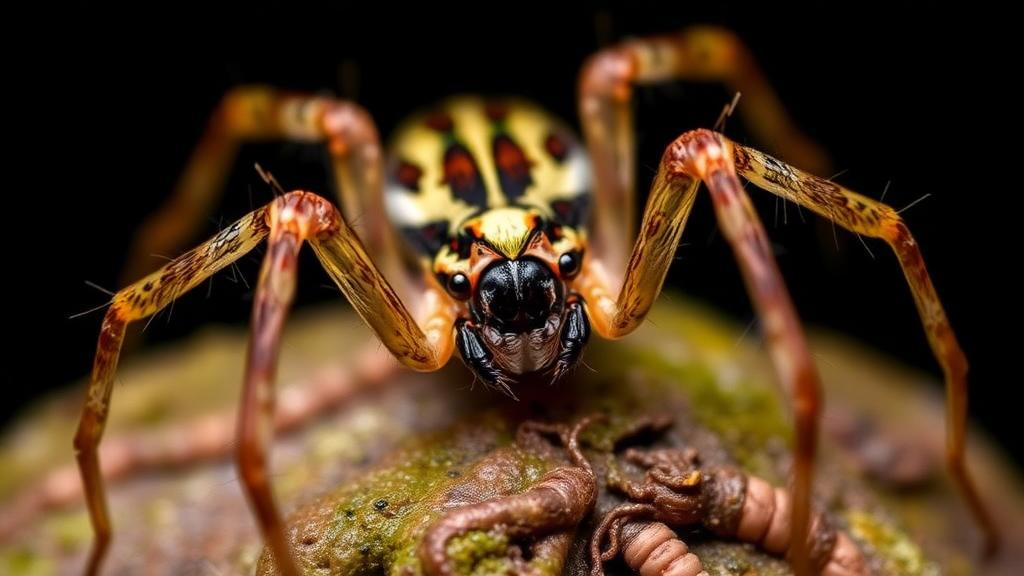
Deep in the rugged savannah of South Africa’s Limpopo Province, a four-decade scientific effort has finally been tallied, and the numbers are remarkable. Researchers working under the South African National Survey of Arachnida, known as SANSA, have published the first complete annotated checklist of the spiders of the Waterberg District, documenting 600 species from 54 families and 292 genera. That single district, a landscape of sandstone mountains, plateaus and bushveld, harbours 25.6 percent of the entire known spider fauna of South Africa and 66.3 percent of the spider fauna of Limpopo Province. Nine of the recorded species live nowhere else on Earth.
The scale of the achievement is hard to overstate. South Africa’s national checklist currently recognises 2,348 spider species, so a single district accounting for more than a quarter of that total is an extraordinary concentration of diversity. The Waterberg result also compares favourably with the Soutpansberg Mountain range, one of the country’s best-sampled arachnid landscapes, where 58 families and 585 species have been recorded. The same four families dominate both regions: the jumping spiders, or Salticidae, lead with 95 Waterberg species, followed by the crab spiders, Thomisidae, with 80, the orb-web weavers, Araneidae, with 52, and the ground-dwelling Gnaphosidae with 48. At the other extreme, 14 families are represented by a single species each, a pattern that hints at how many rare or specialised lineages persist in the district’s varied habitats.
Technically, the checklist is more than a species tally. For every one of the 600 species, the authors compiled global distribution data, an endemicity score and a conservation assessment following the criteria of the International Union for Conservation of Nature. Spatial analyses calculated the Extent of Occurrence as the minimum convex polygon around all observed records, and the Area of Occupancy using occupied two-square-kilometre grid cells, alongside the elevational range of each species. The results show that 546 species, or 91 percent, are widely distributed with no known threats and are classified as Least Concern. Thirty-four species, 5.6 percent, remain Data Deficient, usually because they are known from only one sex, from old museum material without precise locality data, or because their taxonomic identity is uncertain. Seven species, 1.2 percent, are of special conservation concern, and 13 species could not be evaluated at all due to unresolved taxonomy.
The endemicity breakdown tells its own story about how spiders disperse. Because many spiders balloon, drifting on silk threads carried by wind, wide distributions are common: 245 species, 40.8 percent, are endemic to the Afrotropical Region, and 145 species, 24.2 percent, are endemic to southern Africa. But 164 species, 27.3 percent, are South African endemics, and within that group 17 species are restricted to Limpopo Province. Nine of those are known only from the Waterberg District itself, including three jumping spiders collected more than a century ago by the celebrated French arachnologist Eugene Simon at the Makapan Caves: Araegeus mimicus, Langona manicata and Plexippus rubrogularis. Simon, working from the Muséum national d’Histoire naturelle in Paris, visited the caves between 1894 and 1903 and described 15 new species from the site, eight of which are Waterberg endemics.
The conservation picture includes species that demand urgent attention. Among the seven species of special concern are four listed as Rare, one as Critically Rare and two as Vulnerable. The Critically Rare species is Quamtana nylsvley, a pholcid spider known only from the Nylsvley wetland, a Ramsar site in the upper reaches of the Nyl River. The Vulnerable species include Idiops pretoriae, a trapdoor spider, and Xevioso lichmadina, a phyxelid. The Rare category includes Pterinochilus lapalala, a baboon spider endemic to the district, along with Australutica africana, Hortipes contubernalis and Vendaphaea lajuma. The IUCN applies the term rare to species found in isolated geographical locations, and such small populations are considered threatened because they are less likely to recover from ecological disasters. All seven require further collection and monitoring to clarify their distributions.
What makes the Waterberg so rich? The district is a rugged, ecologically complex landscape where mountain sourveld gives way to broad-leaved bushveld and sandy savannah. Upper slopes are dominated by Protea caffra and Faurea saligna bushveld with patches of summit sourveld, mid-slopes carry broad-leaved deciduous bushveld with species such as Diplorhynchus condylocarpon, and sandy plateaus and valleys support Burkea africana and Terminalia sericea savannah with Combretum woodland on shallow rocky soils. Ravines, cliffs and drainage lines create specialised microhabitats, while the Nylsvley wetland supports distinct plant and bird communities. Approximately 90 percent of the district retains natural habitat or is under conservation management, with intact ecological corridors connecting mountains, wetlands, plains and rivers. Over 80 percent remains in a natural state, protected in national parks, game farms, biosphere zones and private reserves.
The data behind the checklist accumulated through an unusually diverse set of projects. Formal surveys began with the establishment of the National Collection of Arachnida in 1967 under the Agricultural Research Council. The South African Savannah Biome project, run by the Council for Scientific and Industrial Research at Nylsvley Nature Reserve from 1974 to 1990, collected spiders with sweep nets and beating, eventually yielding more than 400 records representing 175 species, three of which proved new to science. An Agricultural Research Council quelea project sampled 6,379 spiders monthly on six farms in the Springbok Flats between 2002 and 2003, producing 245 species and three more new species. Marakele National Park was surveyed in October 2010, yielding 130 species from 35 families, including a newly described species named Cheiracanthium foordi. More than 50 sites were sampled overall, using standardised protocols with pitfall traps for ground dwellers, beating and sweep-netting for plant dwellers, and by-catch from canopy fogging, Malaise traps and pan traps.
The identification effort was itself a technical challenge. More than 10,263 specimens were sampled, and only 14 species that were immature, new or taxonomically unresolved could not be determined to species level. Most material was identified by Professor Ansie Dippenaar-Schoeman, while Corinnidae, Salticidae and Trachelidae species were identified by Professor Charles Haddad of the University of the Free State. Voucher specimens are housed at the National Collection of Arachnida in Pretoria, except those from the recent Foundational Biodiversity Information Programme Waterberg Biodiversity Project, which are held at the Ditsong National Museum of Natural History. That project, running from October 2022 to February 2024, sampled all field layers across an elevational range of 900 to 2000 metres above sea level to determine the relative importance of elevation, aspect and habitat structure on spider diversity.
Public participation played a surprising role in the science. Members of the Spider Club of Southern Africa undertook surveys and donated specimens, and the late Peter Webb participated in two BioBlitzes on the farm Zandrivier, photographing hundreds of spiders that have been uploaded to iNaturalist and the Waterberg BioQuest website, which contains more than 300 spider photographs. This citizen science stream fed directly into the national database, illustrating how public involvement can underpin formal biodiversity informatics.
The Waterberg is not formally recognised as a biodiversity hotspot, but its conservation significance is now backed by hard data. Over 650,000 hectares of the district were designated a UNESCO Biosphere Reserve in 2001, and the area includes a Key Biodiversity Area of international significance, defined as a site that contributes significantly to the global persistence of biodiversity. The district encompasses significant proportions of the global extent of two geographically restricted ecosystems, the Waterberg-Magaliesberg Summit Sourveld and the Faurea saligna and Protea caffra Bushveld, meeting KBA Criterion B4. The authors conclude that based on the spider data, the Waterberg District qualifies as a global Key Biodiversity Area, meeting at least two official KBA criteria. The greatest threats to the region’s spider diversity are climate change and increased urbanisation and agricultural activities. Future sampling should focus on the mountain’s higher elevations, which remain undersampled, and where the neighbouring Soutpansberg suggests more endemic species await discovery. Several species from the Araneidae, Oxyopidae, Theridiidae and Thomisidae have been identified as new to science and await formal description, a process that will only increase the number of Waterberg endemics.
Subject of Research: The faunistic diversity of the spiders ( Arachnida , Araneae ) of the Waterberg District in the Limpopo Province of South Africa
Article Title: The faunistic diversity of the spiders ( Arachnida , Araneae ) of the Waterberg District in the Limpopo Province of South Africa
Article References: Dippenaar-Schoeman, A. S., Munyai, T. C., Bird, T. L., & Foord, S. H. (2026). The faunistic diversity of the spiders (Arachnida, Araneae) of the Waterberg District in the Limpopo Province of South Africa. African Invertebrates, 67(2), 125-154. https://doi.org/10.3897/afrinvertebr.67.191055
Image Credits: AI Generated
DOI: 10.3897/AfrInvertebr.67.191055
Keywords: faunistic, diversity, spiders, Arachnida, Araneae, Waterberg, District, Limpopo, Province, South, Africa, scientific research
Cite Scienmag News
Margaret Porter. (October 15, 2026). Waterberg spiders reveal 600 species and nine found nowhere else. Scienmag. https://scienmag.com/waterberg-spiders-reveal-600-species-and-nine-found-nowhere-else/
Margaret Porter. "Waterberg spiders reveal 600 species and nine found nowhere else." Scienmag, 15 October 2026, https://scienmag.com/waterberg-spiders-reveal-600-species-and-nine-found-nowhere-else/. Accessed 15 October 2026.
Margaret Porter. "Waterberg spiders reveal 600 species and nine found nowhere else." Scienmag. October 15, 2026. https://scienmag.com/waterberg-spiders-reveal-600-species-and-nine-found-nowhere-else/


