


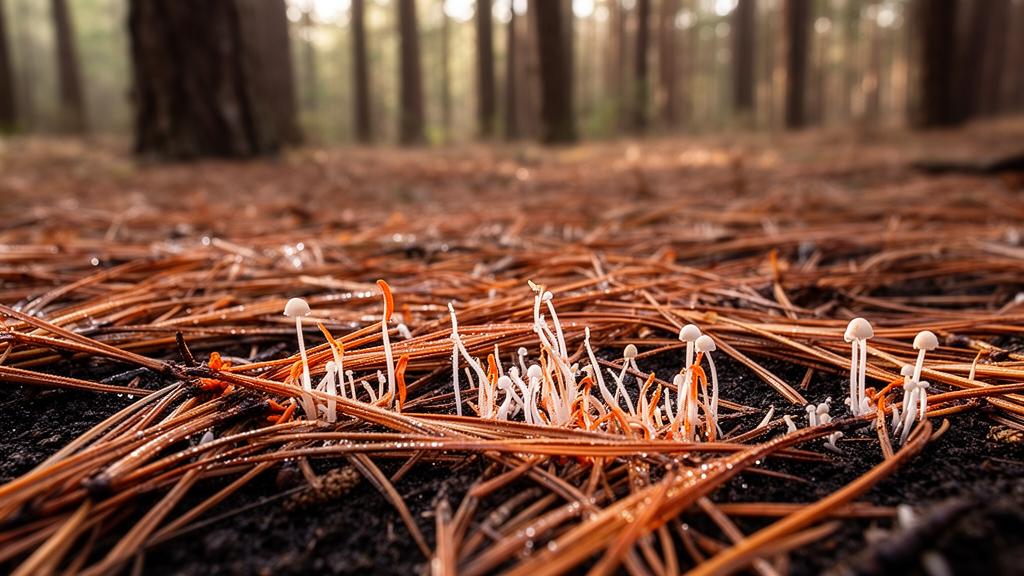
Deep in Taiwan’s Huisun Experimental Forest Station, two pine species grow on the same ridge, separated by less than half a kilometer, yet they have evolved opposite answers to the same question: how to live with fire. Pinus taiwanensis, an endemic species, tolerates surface fires with thick bark and self-pruning branches. Pinus morrisonicola, by contrast, avoids fire altogether, thriving in humid, low-nutrient stands where blazes rarely ignite. A new study published in IMA Fungus shows that this evolutionary divergence does not stop at the trees themselves—it extends underground and into the forest floor, shaping entirely different fungal communities that decompose their fallen needles.
The research team, led by scientists investigating the link between plant fire-adaptive strategies and microbial decomposition, conducted a reciprocal litterbag experiment at DuJuan Ridge. They collected freshly fallen needles from both pine species and incubated them in both native and foreign forest stands, tracking decomposition over six months. What they found was striking: the fire-avoiding P. morrisonicola litter lost roughly 24 percent of its mass at both sites, while the fire-tolerant P. taiwanensis litter lost only 15 to 16 percent. The difference, they discovered, was written into the chemistry of the needles themselves.
Initial chemical analysis revealed that P. morrisonicola needles contained significantly higher nitrogen and a lower carbon-to-nitrogen ratio than P. taiwanensis needles. This stoichiometric advantage made the fire-avoiding species’ litter inherently more palatable to microbial decomposers. Using carbon-13 nuclear magnetic resonance spectroscopy, the researchers traced how organic carbon bonds shifted during decomposition, finding that the two species followed distinct chemical trajectories. Aromatic carbon content increased in both litter types as lignin accumulated relative to other compounds, but phenolic carbon decreased only in P. taiwanensis litter, suggesting that its recalcitrant structure demanded a fundamentally different enzymatic approach from the fungal community.
To unravel the fungal succession underlying these divergent decomposition dynamics, the team deployed genome-resolved metagenomics. They reconstructed 170 fungal metagenome-assembled genomes from the decomposing needles and profiled their lignocellulolytic enzyme repertoires. The results revealed a clear temporal pattern: early decomposition was dominated by Ascomycota, particularly Dothideomycetes and Leotiomycetes, which rapidly colonized the litter and initiated the breakdown of easily accessible biopolymers like cellulose and hemicellulose.
As the supply of labile substrates dwindled, a functional shift occurred. The highly recalcitrant P. taiwanensis litter selectively recruited Basidiomycota, including members of Agaricales and Trechisporales, equipped with diverse lignin-modifying enzymes. The researchers observed a late-stage surge in the abundance of genes encoding ligninolytic enzymes, precisely mirroring established empirical models of litter decomposition that describe a carbohydrate-dominated early stage followed by a lignin-dominated late stage. This functional partitioning was more pronounced in the P. taiwanensis forest, implying a direct adaptation of the resident microbiome to the more chemically resistant nature of its native litter.
The enzymatic profiling uncovered fascinating details about how different fungal orders specialize in distinct decomposition tasks. Sordariales exhibited the highest gene copy numbers for both cellulolytic and ligninolytic enzymes, while Trechisporales was specifically enriched in lignin peroxidase genes. Agaricales harbored the highest average number of ligninolytic enzyme genes despite ranking lower in cellulolytic potential, confirming their role as late-stage lignin specialists. Meanwhile, Xylariales displayed versatile capabilities in both cellulolytic and ligninolytic degradation, acting as generalists throughout the decomposition process.
Intriguingly, the study found that forest stand identity acted as a secondary driver of decomposition rather than a primary one. While the home-field advantage hypothesis predicted that litter would decompose faster in its native environment, the data showed no statistically significant support for strong home-field effects during the early decomposition stage. Instead, P. taiwanensis litter actually decomposed slightly faster when incubated in the P. morrisonicola forest, likely because the fire-avoiding stand’s higher humidity and denser canopy coverage sustained robust fungal activity that compensated for the litter’s recalcitrance.
The research also revealed that the continuous input of newly fallen leaves from the canopy served as a primary source of fungal inoculum for the experimental litterbags. Many early-colonizing ascomycetes are known leaf endophytes that adopt a latent saprotrophic lifestyle as leaves senesce. These dormant saprobes, arriving from fresh surrounding litterfall, rapidly colonized the decomposing needles and acted as a reservoir of early-stage decomposing microorganisms, jumpstarting the biopolymer breakdown process.
Perhaps the most compelling insight from this study is the eco-evolutionary feedback loop it illuminates. The fire-tolerant P. taiwanensis produces recalcitrant litter with long needles that create a low-density, highly flammable fuel bed, promoting fire recurrence. Frequent fires drive periodic fungal turnover, disrupting long-term fungal successions and limiting the establishment of late-stage ligninolytic specialists. Conversely, the fire-avoiding P. morrisonicola inhabits a humid, high-turnover environment with inherently lower litterfall accumulation, producing less fuel and reducing fire susceptibility. This stable, low-disturbance environment provides the temporal continuity needed for complex fungal networks to develop and effectively partition late-stage decomposition tasks.
The findings demonstrate that a plant’s fire-adaptive strategy acts as a strong environmental filter, shaping litter chemistry to recruit specific taxonomic and functional fungal assemblages. By integrating taxonomic composition with functional gene profiles, this research provides a mechanistic understanding of how plant traits, microbiome assembly, and ecosystem-level fire dynamics are intricately linked. As climate change alters fire regimes globally, understanding these plant-fungal interactions becomes increasingly critical for predicting carbon cycling, fuel bed formation, and the future of fire-prone forest ecosystems worldwide.
Subject of Research: Fungal succession in pine litter decomposition shaped by divergent fire-adaptive strategies
Article Title: Metagenomic profiling reveals that divergent fire-adaptive strategies drive distinct fungal succession in pine litter decomposition
Article References: Fang, Y.-H., Liu, H.-N., Chen, Y.-J., Hsu, T.-W., Chiu, C.-A., Chiang, P.-N., & Huang, C.-L. (2026). Metagenomic profiling reveals that divergent fire-adaptive strategies drive distinct fungal succession in pine litter decomposition. IMA Fungus, 17, Article e201414. https://doi.org/10.3897/imafungus.17.201414
Image Credits: AI Generated
DOI: 10.3897/imafungus.17.201414
Keywords: fire ecology, fungal succession, litter decomposition, metagenomics, pine forests, lignin degradation, Taiwan, carbon cycling, Metagenomic, profiling, reveals, divergent
Cite Scienmag News
Roger Howard. (October 15, 2026). Fire strategies of pines shape which fungi break down their needles. Scienmag. https://scienmag.com/fire-strategies-of-pines-shape-which-fungi-break-down-their-needles/
Roger Howard. "Fire strategies of pines shape which fungi break down their needles." Scienmag, 15 October 2026, https://scienmag.com/fire-strategies-of-pines-shape-which-fungi-break-down-their-needles/. Accessed 15 October 2026.
Roger Howard. "Fire strategies of pines shape which fungi break down their needles." Scienmag. October 15, 2026. https://scienmag.com/fire-strategies-of-pines-shape-which-fungi-break-down-their-needles/


