


Deep beneath the bogs, forests, and boulder-strewn plains of northern Finland lies some of Europe’s most promising ground for the metals that power modern technology: rare earth elements, niobium, tantalum, cobalt, and platinum group metals. But there is a catch. The bedrock that hosts these critical raw materials is buried under meters of glacial till, the jumbled sediment left behind by ice sheets that scraped across the continent during repeated Quaternary glaciations. With almost no bedrock outcrops to examine, explorers have traditionally relied on laborious sampling campaigns and expensive laboratory analyses, a slow and costly process at a time when the European Union is urgently trying to secure domestic supplies of the metals used in batteries, catalytic converters, and smart technologies.
Now a team from the Oulu Mining School at the University of Oulu and the Geological Survey of Finland has developed and tested a methodological concept that could change how exploration is done in glaciated terrain. In a study published in Frontiers in Geochemistry, Pertti Sarala and Marja Lehtonen present an integrated workflow combining field-based heavy mineral concentration, portable X-ray diffraction (pXRD) and X-ray fluorescence (pXRF) analyzers, and automated laboratory mineral identification using field emission scanning electron microscopy with energy-dispersive spectroscopy (FE-SEM-EDS). The concept, developed during the European Regional Development Fund-funded Indika project between 2016 and 2019, was evaluated across four study areas in northern and central Finland, and the results show that it can accelerate exploration, cut costs, and reliably identify the indicator minerals that betray the presence of critical metal deposits hidden beneath the ice-carved landscape.
The key insight behind the work is that indicator minerals, minerals that are more abundant and more widely distributed in bedrock than the ore minerals themselves, can serve as practical proxies for mineralization. Heavy mineral analysis has long been a mainstay of exploration for gold, diamonds, and magmatic nickel-copper-platinum group element deposits, typically relying on large samples of 10 to 100 kilograms from which the heaviest grains, those with specific gravity above 3.3 grams per cubic centimeter, are separated by gravity-based concentration. But the method has a blind spot when it comes to critical metals. Many of the indicator minerals characteristic of rare earth element deposits, such as monazite, xenotime, pyrochlore, and columbite, are difficult to identify visually under a microscope, and some have densities lower than the minerals traditionally recovered in heavy mineral concentrates, meaning they slip through conventional enrichment processes entirely. Until now, no well-established method existed for their efficient separation from sediment samples.
To close that gap, the researchers systematically optimized sample handling and enrichment techniques. Till samples of roughly 12 liters, about 20 to 25 kilograms each, were collected in triplicate from hand-dug and tractor-excavated test pits, with parallel samples reserved for field testing, laboratory analysis, and reference. In the laboratory, samples were wet-sieved under a 1-millimeter size fraction and processed on a shaking table, chosen because an experienced operator can control the density of the resulting concentrate and the method is gentler on fragile mineral grains than a Knelson concentrator. Magnetite was then removed by weak and strong magnetic separation, and the heaviest fractions were isolated by heavy liquid separation using undiluted methylene iodide at 3.3 grams per cubic centimeter, which proved more effective than the lithium heteropolytungstate solution, which suffered from high sample loss and imprecise separation. The results demonstrated that indicator mineral separation can be significantly optimized through tailored processing, with the 63 to 150 micrometer heavy fraction providing the most reliable indicator mineral data.
The field-based component of the workflow proved equally important. At each sampling site, the researchers compared two concentrating techniques applied to subsamples of the same material: a spiral concentrator, also known as a Gold hound concentrator, and a Knelson concentrator. Spiral concentrates, weighing only tens of grams, were usually suitable for direct microscopic examination, while Knelson concentrates, weighing hundreds of grams, required further post-processing such as micro-panning or heavy liquid separation. Under field conditions, micro-panning emerged as the most practical and cost-effective method for isolating the heaviest mineral fraction, with magnetite typically removed from the concentrates to reduce the volume that must be examined. This parallel application of field and laboratory concentration methods allowed the team to evaluate which approach works best for different sample sizes, grain-size fractions, and specific gravity classes.
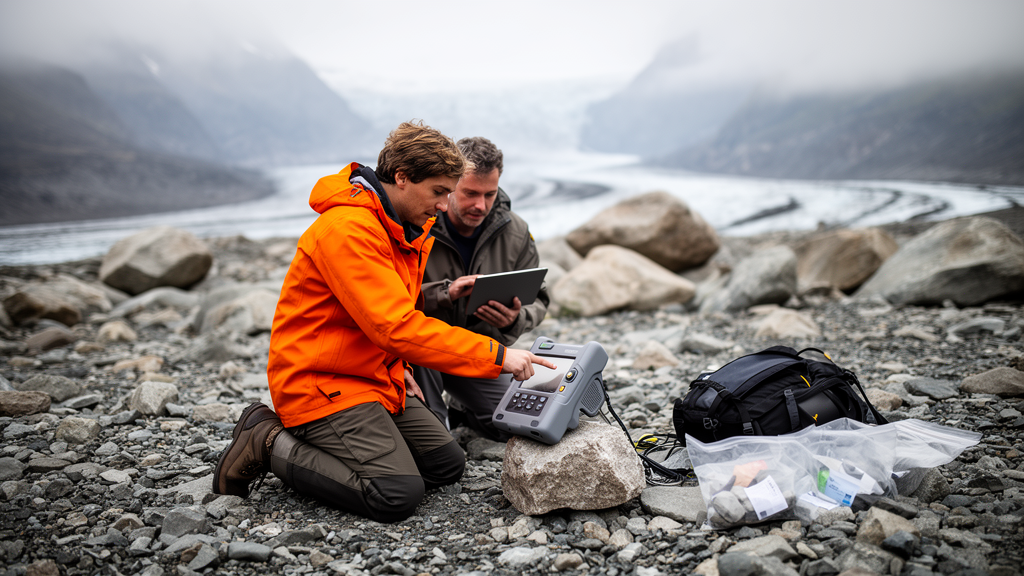
The analytical heart of the new concept lies in the portable instruments that bring the laboratory into the field. The researchers used an Olympus Terra portable XRD analyzer and an Olympus Innov-X Delta portable XRF analyzer to analyze concentrated till samples directly at sampling sites. The pXRF instrument, equipped with a 4-watt X-ray tube and a high-resolution silicon PIN diode detector, determined more than 40 elements in GeoChem mode with each measurement taking just 40 seconds. The pXRD analyzer, though producing diffraction patterns of lower quality than laboratory instruments due to its faster measurement speed and narrower angular range of 5 to 55 degrees, reliably identified the most common indicator minerals, including zircon, monazite, and xenotime, directly in the field. Measurement times ranged from approximately 15 minutes to more than an hour depending on the quality of the diffraction pattern obtained, with the clearest results achieved when peaks were well resolved and background noise was low.
Validation of the field-based results came from the automated FE-SEM-EDS analyses performed at the Geological Survey of Finland in Espoo. Using a JEOL JSM 7100F field emission scanning electron microscope coupled to an Oxford Instruments X-Max 80 square millimeter EDS, the researchers analyzed between 10,000 and 20,000 mineral grains per preparation in automated runs, with EDS spectra generated from the center of the longest grain diameter for grains with a minimum size of 7 micrometers equivalent circular diameter. The method enabled accurate imaging, analysis, and quantification of the mineral grains in till samples, and revealed significant observations relevant to exploration, such as the identification of inclusions within indicator mineral grains and correlations between indicator mineral concentrations and associated mineralogy that can be used to assess the type and characteristics of the source rock. Variations in grain size and morphology may even indicate the length of glacial transport distance.
The case studies in northern Finland confirmed the robustness of the integrated approach across different geological settings. At the Mäkärä gold-rare earth element prospect in the Tana Belt, one of the most prospective regions for rare earths and gold in northern Europe, the indicator mineralogy demonstrated a highly enriched rare earth-bearing mineral assemblage dominated by monazite, columbite, and xenotime, supporting earlier assessments of the area’s high rare earth potential. At Kyörtesselkä near the Sokli carbonatite massif, a funnel-shaped multistage pluton enriched in niobium, tantalum, zirconium, rare earths, and uranium, the concentrates yielded columbite, monazite, pyrochlore, rhabdophane, ancylite, and xenotime, confirming the recognized critical raw material potential of the region. At the tailings of the former Rautuvaara iron-copper mine, which operated from 1962 to 1988, the analyses identified tungsten-bearing rutile with tungsten contents between 1.5 and 5 weight percent, along with monazite, cobaltite, and small amounts of gold, demonstrating that old mine waste can be re-evaluated as a potential source of critical minerals within a circular economy framework.
The comparison between portable and laboratory XRD analyses revealed both the power and the limitations of the field instruments. While pXRD identified the same major minerals as laboratory XRD in most cases, the reported abundances varied significantly not only between portable and laboratory analyses but also between different laboratories, making precise quantitative comparison difficult. Some minerals, such as biotite, chlorite, and calcite, were almost entirely absent from pXRD results, either because their diagnostic diffraction peaks lie outside the narrow angular range of the portable analyzer or because of the amorphous or metamictic state of the mineral. Conversely, pXRD could identify minerals that FE-SEM analysis missed, such as minerals with identical elemental compositions but different crystal structures that produce distinct diffraction patterns. The researchers concluded that portable analyzers are most effective when used as part of a multi-method exploration strategy rather than as standalone tools, with laboratory validation providing the necessary confirmation for critical raw material exploration.
The practical implications of the study are substantial. By enabling rapid screening of samples in the field, the portable analyzers allow exploration programs to prioritize only the most promising samples for costly laboratory analyses, resulting in significant cost savings and faster decision-making during exploration campaigns. The documented outcomes from the piloting at the Vuolijoki site, where a one-day sampling campaign traced the potential source of surficial boulders containing elevated rare earth concentrations, support industrial use and future exploration projects. As the European Union and Finland push to reduce dependence on imported critical raw materials, the ability to explore efficiently under meters of glacial cover could prove decisive in discovering the domestic deposits that high-technology industries need. The new concept has proven effective for discovering new sources of critical minerals, accelerating exploration, and reducing costs, offering a template that companies and research projects across the glaciated terrain of the Northern Hemisphere can now apply.
Subject of Research: Geochemistry
Article Title: On-site geochemical and indicator mineral analytical techniques in critical raw-metal exploration in the glaciated terrain
Article References: Sarala, P., & Lehtonen, M. (2026). On-site geochemical and indicator mineral analytical techniques in critical raw-metal exploration in the glaciated terrain. Frontiers in Geochemistry, 4, Article 1866020. https://doi.org/10.3389/fgeoc.2026.1866020
Image Credits: AI Generated
DOI: 10.3389/fgeoc.2026.1866020
Keywords: critical raw materials, indicator minerals, portable XRD, portable XRF, glaciated terrain, heavy mineral analysis, FE-SEM-EDS, rare earth elements, mineral exploration, Finland, On-site, geochemical
Cite Scienmag News
Donald Wallace. (October 15, 2026). Portable XRD and XRF analyzers accelerate critical mineral exploration in glaciated terrain. Scienmag. https://scienmag.com/portable-xrd-and-xrf-analyzers-accelerate-critical-mineral-exploration-in-glaciated-terrain/
Donald Wallace. "Portable XRD and XRF analyzers accelerate critical mineral exploration in glaciated terrain." Scienmag, 15 October 2026, https://scienmag.com/portable-xrd-and-xrf-analyzers-accelerate-critical-mineral-exploration-in-glaciated-terrain/. Accessed 15 October 2026.
Donald Wallace. "Portable XRD and XRF analyzers accelerate critical mineral exploration in glaciated terrain." Scienmag. October 15, 2026. https://scienmag.com/portable-xrd-and-xrf-analyzers-accelerate-critical-mineral-exploration-in-glaciated-terrain/


