


Gobies are, by species count, the most successful family of marine fishes on Earth. With 1,440 recognized species spread across tropical, subtropical and temperate waters, from coral reefs to estuaries and even freshwater streams, these small, often cryptic fish dominate the fish fauna of reef environments. Yet their true diversity remains largely unknown, a consequence of tiny body sizes, broad distributions and ecological habits that make species boundaries notoriously difficult to draw. A new cytogenetic study, published in Comparative Cytogenetics, adds a chromosomal dimension to this puzzle by presenting the first karyotypic characterization of two Atlantic goby species, and the results could hardly be more striking.
The study, led by researchers at the Federal University of Rio Grande do Norte in northeastern Brazil, analyzed Coryphopterus glaucofraenum (Gill, 1863), a reef-dwelling species, and Evorthodus lyricus (Girard, 1858), a marine and estuarine species. Both range broadly along the western Atlantic, from the United States to southern Brazil, making them ideal candidates for a comparative analysis. Using classical cytogenetic techniques combined with base-specific fluorochrome staining, the team uncovered a level of karyotypic divergence between the two species that reinforces just how chromosomally dynamic the family Gobiidae really is.
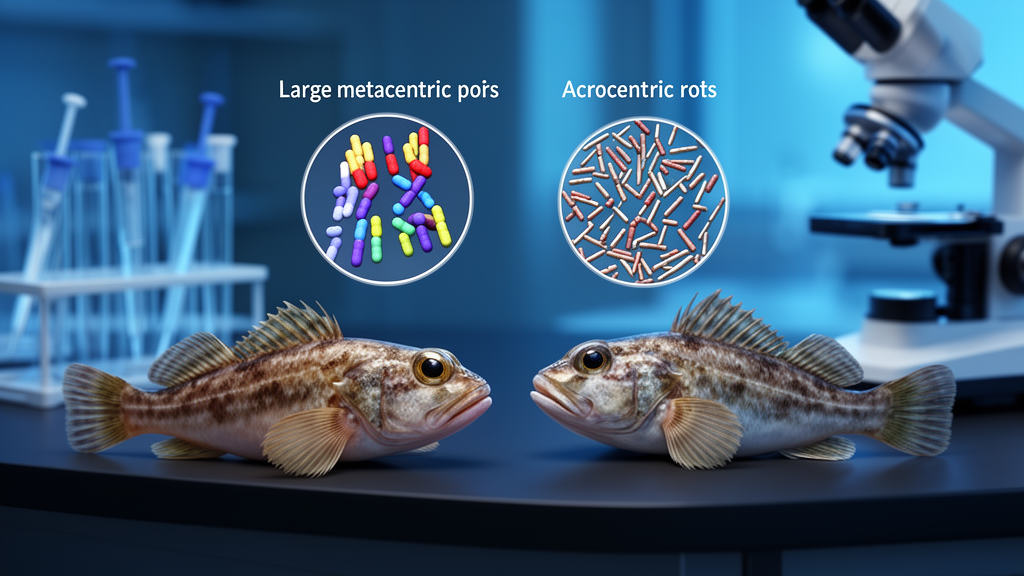
Evorthodus lyricus exhibited a diploid number of 2n = 46, with a fundamental number (FN) of 92, corresponding to a karyotype composed of 22 metacentric and 24 submetacentric chromosomes. Coryphopterus glaucofraenum, by contrast, presented 2n = 40 with an FN of only 42, its karyotype comprising just one pair of submetacentric chromosomes and 38 acrocentric chromosomes. These are not subtle differences. The two species differ substantially in both chromosome number and chromosomal morphology, a divergence that places them at opposite ends of the karyotypic spectrum documented for Atlantic gobies.
The diploid number of 2n = 46 is considered the basal condition for the family Gobiidae, inherited from an ancestral karyotype of 46 acrocentric chromosomes. However, E. lyricus does not retain this ancestral morphology. Its extensive complement of two-armed chromosomes, reflected in the high fundamental number of 92, indicates that intense chromosomal rearrangements, likely pericentric inversions or centromere repositioning events, have reshaped the ancestral acrocentric karyotype into one dominated by metacentric and submetacentric elements. In other words, even a species retaining the basal diploid number has undergone substantial structural chromosomal evolution.
Coryphopterus glaucofraenum tells a different evolutionary story. Its diploid number of 2n = 40 falls below the basal condition, and the presence of acrocentric pairs that are disproportionately larger than the remaining chromosomes in the karyotype suggests that tandem fusion acted as the primary rearrangement mechanism. This pattern, in which chromosomes fuse end-to-end rather than at centromeres, has been documented in other gobiids, including Gobius paganellus, and appears to be a recurring theme in the karyotypic diversification of the family. The researchers note that conventional cytogenetic protocols lack the resolution needed to map precise structural breakpoints, leaving open questions about whether pericentric inversions or centromere repositioning, or tandem versus centric fusions, drove the observed patterns. High-resolution molecular cytogenetics will be needed to test these hypotheses directly.
Beyond chromosome number and morphology, the study examined heterochromatic regions using C-banding and identified the major ribosomal DNA sites using silver staining (Ag-NOR) followed by sequential staining with the fluorochromes CMA3 and DAPI. In both species, the Ag-NOR sites occupy terminal positions on the short arms of two-armed chromosome pairs, pair 2 in E. lyricus and pair 1 in C. glaucofraenum. These sites are heterochromatic and represent the only chromosomal regions showing a CMA3-positive, DAPI-negative staining pattern, indicating they are GC-rich. This condition, in which ribosomal sites are heterochromatic and GC-rich, is found in the nucleolar organizer pairs of various species within the family and constitutes a consistent cytotaxonomic marker for many fish groups.
The distribution of heterochromatin differed conspicuously between the two species. In E. lyricus, heterochromatic regions were prominent and terminally distributed on most chromosomes, while in C. glaucofraenum they were reduced and located primarily in centromeric regions. This heterogeneity matters because heterochromatic regions, rich in various types of repetitive sequences including 5S rDNA sites, have been suggested to facilitate chromosomal fusion events in marine Percomorpha species. Among Gobiidae, evidence of heterochromatic heterogeneity has been identified in several Mediterranean species, including Gobius paganellus, G. niger, G. cobitis and Zosterisessor ophiocephalus, as well as the Atlantic species Bathygobius soporator. This heterogeneity has been implicated in the occurrence and fixation of chromosomal modifications, including centric fusions and fissions, and has also been linked to the emergence of heteromorphic sex chromosomes in some gobiids.
Notably, the cytogenetic analyses revealed no sex-linked chromosome heteromorphisms between male and female specimens in either species. The researchers analyzed nine individuals of E. lyricus (four males, five females) and seven individuals of C. glaucofraenum (four males, three females), examining approximately thirty metaphase spreads per individual. While heterochromatin dynamics have been associated with sex chromosome emergence in other gobiid species, neither C. glaucofraenum nor E. lyricus shows any cytogenetic evidence of sex-specific chromosomal differences, suggesting that if sex chromosomes exist in these species, they are not yet morphologically differentiated.
The broader significance of these findings lies in what they reveal about the relationship between chromosomal change and speciation in Gobiidae. A karyotype of 2n = 46 acrocentric chromosomes is considered basal for the family, yet 84% of cytogenetically described gobiid species diverge from this ancestral pattern, with diploid numbers ranging from 2n = 30 in Neogobius euricephalus to 2n = 56 in Gobionellus microdon. This extraordinary numerical and structural variation suggests a close relationship between diversification processes and chromosomal modifications. Karyotype alterations have the potential to reduce recombination frequencies and produce chromosomally incompatible subpopulations, a mechanism that can drive speciation by creating reproductive barriers between groups with divergent karyotypes.
The majority of available cytogenetic data for gobies has historically come from studies on Mediterranean and Pacific species, with Atlantic representatives remaining understudied. By providing the first chromosomal characterization of two Atlantic goby species with broad geographic distributions, this study helps fill a significant gap and underscores the value of cytogenetic data for discovering new species, uncovering population structures, identifying sex chromosomes and pinpointing major shifts in repetitive DNA. As the field of goby cytogenetics continues to mature, each newly characterized species adds critical evidence to the emerging picture of a family whose evolutionary success has been accompanied, and perhaps enabled, by remarkable chromosomal flexibility.
Subject of Research: Karyotypic diversity in the Gobiidae : A comparative analysis of two Atlantic species
Article Title: Karyotypic diversity in the Gobiidae : A comparative analysis of two Atlantic species
Article References: de Lima-Filho, P. A., da Costa, G. W. W. F., da Silva, S. A. S., & Molina, W. F. (2026). Karyotypic diversity in the Gobiidae: A comparative analysis of two Atlantic species. Comparative Cytogenetics, 20, 187-194. https://doi.org/10.3897/compcytogen.20.206266
Image Credits: AI Generated
DOI: 10.3897/compcytogen.20.206266
Keywords: Gobiidae, karyotype, cytogenetics, Atlantic gobies, chromosomal evolution, tandem fusion, Ag-NOR, heterochromatin, speciation, Comparative Cytogenetics, Karyotypic, diversity
Cite Scienmag News
Gavin Prescott. (October 15, 2026). Chromosomes reveal striking karyotypic divergence in two Atlantic gobies. Scienmag. https://scienmag.com/chromosomes-reveal-striking-karyotypic-divergence-in-two-atlantic-gobies/
Gavin Prescott. "Chromosomes reveal striking karyotypic divergence in two Atlantic gobies." Scienmag, 15 October 2026, https://scienmag.com/chromosomes-reveal-striking-karyotypic-divergence-in-two-atlantic-gobies/. Accessed 15 October 2026.
Gavin Prescott. "Chromosomes reveal striking karyotypic divergence in two Atlantic gobies." Scienmag. October 15, 2026. https://scienmag.com/chromosomes-reveal-striking-karyotypic-divergence-in-two-atlantic-gobies/


