


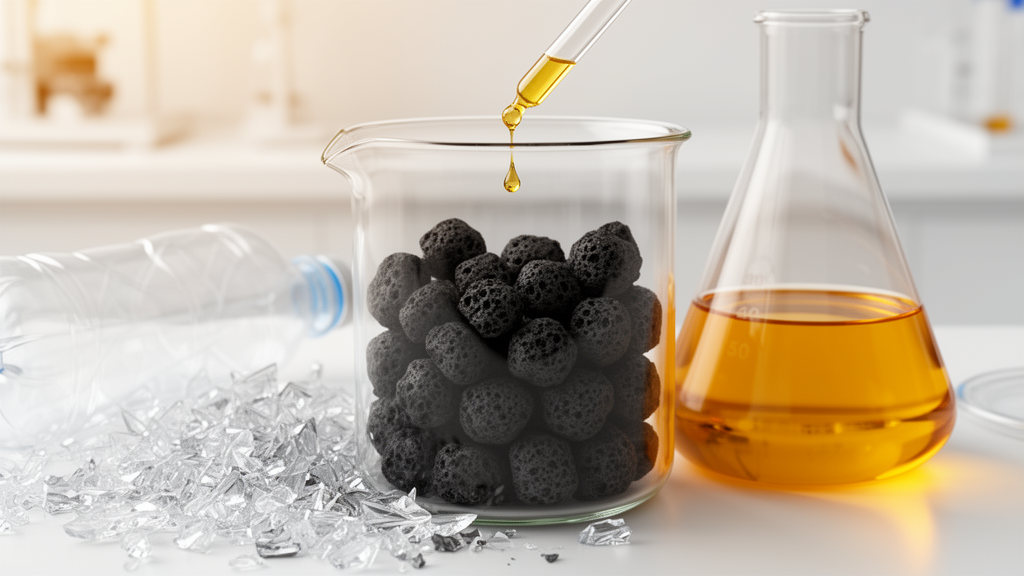
Discarded soft drink bottles collected from the streets of Manaus, in the Brazilian Amazon, have been transformed into porous carbon acid catalysts that convert oleic acid into biodiesel-grade methyl oleate with 88% efficiency. The study, published in Frontiers in Carbon by researchers at the Federal University of Amazonas, demonstrates a chemical upcycling route that simultaneously addresses two pressing problems: the mounting accumulation of polyethylene terephthalate (PET) waste and the search for sustainable, reusable catalysts for biofuel production.
The scale of the plastic problem provides the backdrop. Approximately 330 million tons of plastic are produced annually, and projections cited in the study indicate that plastic waste generation may reach 12 billion tons by 2050. PET alone accounts for roughly 30% of global plastic consumption, finding its way into beverage bottles, food packaging, containers, and textile fibers. Although mechanical recycling of PET is encouraged, effective recycling rates remain limited by collection difficulties, separation costs, and contamination. Because these polymers degrade slowly and can release toxic compounds such as phthalates and bisphenol-A, and because they fragment into microplastics already detected in water, soil, and air, researchers are increasingly turning to chemical upcycling strategies that convert plastic residues into high-value functional materials.
The Brazilian team chose one of the most ambitious of these strategies: turning PET waste into solid acid catalysts for esterification reactions related to biofuel production. The synthesis began with transparent two-liter bottles from a single soft drink brand, collected in Manaus, washed, dried, and cut into small pieces to ensure reproducibility. The plastic pieces were then subjected to chemical activation in aqueous medium with either zinc chloride (ZnCl2) or potassium carbonate (K2CO3) in a 1:1 mass ratio, heated at 80 °C for 3 hours under magnetic stirring, followed by heat treatment at 100 °C for 24 hours. The activated samples were carbonized in a tubular oven under a nitrogen atmosphere at temperatures ranging from 500 to 700 °C for the ZnCl2 route, while the K2CO3 route required 800 °C. After washing with hydrochloric acid solution and drying, the materials were functionalized by sulfonation in concentrated sulfuric acid, anchoring sulfonic acid (–SO3H) groups onto the carbon structure to confer catalytic activity.
The choice of activating agent proved decisive. ZnCl2 promotes pore formation through oxidative, templating, and gasification mechanisms: during pyrolysis, thermal dehydration of zinc oxide chloride hydrate generates gaseous ZnCl2, which reacts with carbon atoms via reduction reactions, eliminating parts of the carbon atoms and leaving behind channels that form the pore network. K2CO3, by contrast, develops pores primarily through dehydration reactions, the water-gas reaction, and the formation of gaseous potassium metal via reduction of the carbonate by carbon atoms above 760 °C. These distinct mechanisms produced markedly different textures. The K2CO3-activated sample CPK-8 achieved the highest specific surface area of 732 m2 g−1 and total pore volume of 0.61 cm3 g−1, with micropore and mesopore volumes of 0.28 and 0.32 cm3 g−1 respectively. The ZnCl2-activated sample carbonized at 600 °C, CPZn-6, reached 272 m2 g−1 with total, micropore, and mesopore volumes of 0.36, 0.14, and 0.22 cm3 g−1. Nitrogen adsorption isotherms classified the ZnCl2-derived materials as IUPAC type I(a), dominated by micropores centered around 0.9 nm, while CPK-8 showed type I(b) isotherms with H4 hysteresis characteristic of micro-mesoporous carbons with pores centered at 0.7 nm.
Counterintuitively, the material with the highest surface area was not the best catalyst. The K2CO3-activated sample achieved only 65% conversion of oleic acid to methyl oleate, and its performance decreased by 52% after the first reuse. The researchers attribute this to the fact that activation with K2CO3 favors more stable carbon surfaces with lower concentrations of oxygenated functional groups, which hinders effective incorporation of sulfonic acid groups during functionalization. The catalytic behavior of sulfonated carbons, the study concludes, depends more on the density and accessibility of acidic sites than on surface area alone.
The best overall performance came from CPZn-6*, the ZnCl2-activated sample carbonized at 600 °C and sulfonated at 80 °C for 2 hours. This catalyst achieved 88% conversion to methyl oleate and remained effective through the third reuse cycle, a stability advantage over comparable plastic-derived catalysts reported in the literature, which typically show pronounced conversion decreases after the second cycle. The sulfonic group density of CPZn-6*, measured by Boehm titration at 1.31 mmol g−1, is comparable or superior to catalysts derived from coconut shells (0.63–1.18 mmol g−1) and microwave-assisted syntheses (1.12 mmol g−1). Notably, CPZn-6* achieved its high conversion under relatively mild sulfonation conditions of 80 °C for 2 hours, whereas previous PET-derived catalysts required severe conditions of 150 °C for 15 hours and exhibited surface areas below 133 m2 g−1. Increasing the carbonization temperature from 500 to 700 °C raised conversion from 63% to 90% for CPZn-7*, but that catalyst, despite slightly higher acidity of 1.43 mmol g−1, lost stability after the second cycle. The 600 °C activation condition apparently promoted the most stable incorporation of –SO3H groups within the porous structure, contributing to improved resistance against leaching.
An extensive characterization campaign validated the structure and chemistry of the materials. Thermogravimetric analysis recorded three mass loss events for the activated carbons: water desorption between 30 and 150 °C, decomposition of the carbonaceous material between 150 and 350 °C, and thermal decomposition of the PET polymer into volatile species such as CO2 between 360 and 500 °C. For the sulfonated samples, mass losses between 150 and 360 °C attributed to strongly attached sulfonic groups were 14%, 10%, and 15% for CPZn-5*, CPZn-6*, and CPZn-7* respectively, consistent with the Boehm titration results. FT-IR spectroscopy confirmed covalently bonded sulfonic groups through a vibration band at 1,025 cm−1 associated with the O=S=O bond, while thermogravimetry coupled to mass spectrometry detected released water, SO2, and SO3 gases from decomposition of the sulfonic functionalities. Scanning electron microscopy revealed rough, irregular surfaces with cavities of various sizes in the activated carbon, which facilitate reagent diffusion and acid group anchoring; after sulfonation, the surface became smooth and compact. Energy-dispersive spectroscopy showed an increase in oxygen (16% by weight) and sulfur (5% by weight) after sulfonation, confirming effective anchoring of the acid sites.
X-ray photoelectron spectroscopy provided the most precise picture of how sulfur is bonded to the carbon matrix. The C1s spectrum of CPZn-6* showed a peak at 286.1 eV assigned to C–S bonds, strongly suggesting that sulfur was chemically incorporated into the carbonaceous structure rather than merely physically adsorbed. The high-resolution S2p spectrum revealed the characteristic doublet at 167.8 and 168.9 eV, binding energies characteristic of sulfur in the S6+ oxidation state associated with sulfonic acid groups. The O1s spectrum showed a component at approximately 534.0 eV attributed to O=S=O species, providing additional evidence of successful functionalization. According to the literature cited by the authors, the presence of C–S bonds in highly defective carbons derived from polymeric precursors contributes to improved thermal and chemical stability of sulfonated catalysts, explaining the resistance to leaching observed during reuse cycles.
The catalytic optimization revealed clear parameter sensitivities. Sulfonation temperature mattered greatly: 80 °C yielded the maximum 88% conversion, while 60 °C dropped the yield to approximately 70%, and temperatures above 100 °C also reduced performance, apparently because excessive temperatures partially degrade the carbonaceous structure and its anchoring sites. Sulfonation time, by contrast, was not the predominant parameter, with conversion stabilizing around 85% from 2 to 8 hours, suggesting rapid saturation of sulfonic groups on the PET-derived carbon matrix. In the esterification reaction itself, conducted in a high-pressure reactor with an oleic acid to methanol molar ratio of 1:12 and 5% catalyst loading, conversion increased with temperature up to 100 °C and with reaction time up to 1 hour, both reaching the 88% maximum. Higher temperatures decreased the yield, likely because accelerated methanol evaporation reduces reactant availability, and longer reaction times favored interaction of the water byproduct with the hydrophilic sulfonic groups, contributing to partial deactivation through competitive adsorption and site hydration.
The deactivation mechanism was confirmed spectroscopically. After four consecutive reaction cycles, the FT-IR band at 1,025 cm−1 attributed to sulfonic groups disappeared, and thermogravimetric profiles of the reused catalyst showed reduced mass loss associated with sulfonic group decomposition, corroborating the conversion drop below 50% in the third cycle due to leaching of the –SO3H groups. The catalytic activity of CPZn-6*, the authors conclude, is strongly associated with the preservation of surface acidic groups during reuse. Despite this limitation, the study demonstrates that PET waste can be converted into functional carbon-based catalysts with potential application in sustainable biofuel processes, offering what the researchers describe as a sustainable and promising alternative for reusing PET waste while mitigating the environmental problems associated with plastic accumulation in landfills, soils, and oceans.
Subject of Research: Porous carbons from pet waste: structure–property relationships and catalytic performance in esterification reactions
Article Title: Porous carbons from pet waste: structure–property relationships and catalytic performance in esterification reactions
Article References: Porous carbons from pet waste: structure–property relationships and catalytic performance in esterification reactions. (n.d.). https://doi.org/10.3389/frcrb.2026.1873847
Image Credits: AI Generated
DOI: 10.3389/frcrb.2026.1873847
Keywords: PET waste, porous carbon, heterogeneous catalysis, esterification, biodiesel, sulfonation, plastic upcycling, Frontiers in Carbon, Porous, carbons, waste, structure
Cite Scienmag News
Bethany Barker. (October 15, 2026). Turning PET Bottle Waste Into Acid Catalysts for Biodiesel. Scienmag. https://scienmag.com/turning-pet-bottle-waste-into-acid-catalysts-for-biodiesel/
Bethany Barker. "Turning PET Bottle Waste Into Acid Catalysts for Biodiesel." Scienmag, 15 October 2026, https://scienmag.com/turning-pet-bottle-waste-into-acid-catalysts-for-biodiesel/. Accessed 15 October 2026.
Bethany Barker. "Turning PET Bottle Waste Into Acid Catalysts for Biodiesel." Scienmag. October 15, 2026. https://scienmag.com/turning-pet-bottle-waste-into-acid-catalysts-for-biodiesel/


