


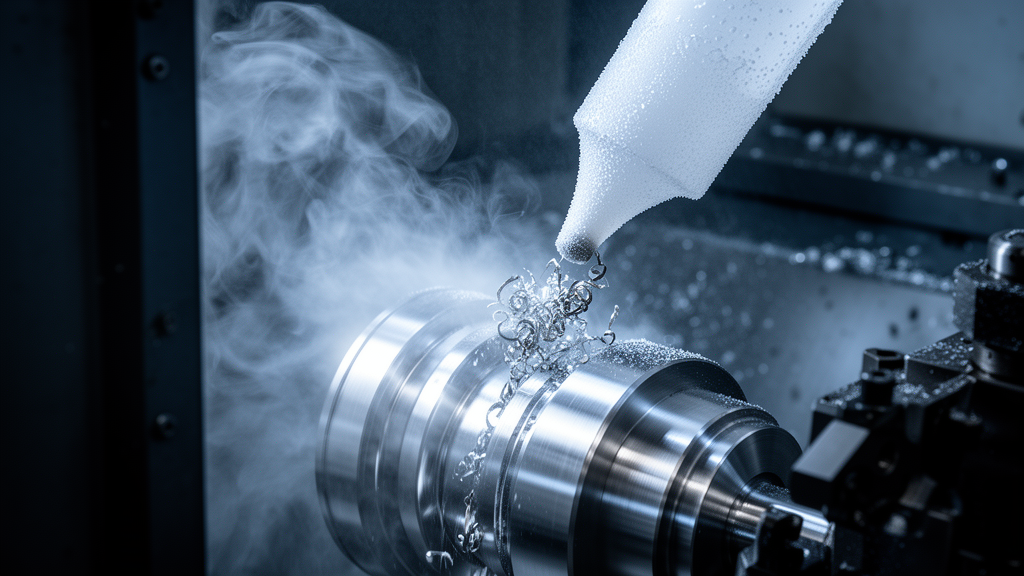
Machining the nickel-based superalloy Hastelloy C-276 has long been one of the more stubborn problems in modern manufacturing. The alloy, prized in chemical reactors, marine hardware, and aerospace components for its extraordinary resistance to corrosion and heat, is equally notorious on the shop floor. Its high strength, pronounced tendency to work-harden, and remarkably low thermal conductivity mean that nearly all the heat generated during cutting stays concentrated at the tool tip and the freshly machined surface. The result is rapid tool wear, degraded surfaces, and subsurface damage that can compromise parts destined for the most demanding service environments. A new study published in Discover Sustainability proposes an unusual remedy: a hybrid lubri-cooling strategy that combines biodegradable ester oil, ethanol, and dry ice within a minimum quantity lubrication framework.
The research team, led by Binayak Sen of the Chennai Institute of Technology with collaborators from institutions across India and Ethiopia, set out to address the twin thermal and tribological loads that plague machining of this alloy. Conventional flood cooling drowns the cutting zone in large volumes of fluid, raising environmental and disposal concerns while often failing to penetrate the actual tool-chip interface. Minimum quantity lubrication, by contrast, delivers a finely atomized mist of just milliliters per hour, but on its own it struggles to remove the intense heat produced when cutting superalloys. The new strategy layers three mechanisms on top of one another: cryogenic cooling from sublimating carbon dioxide, evaporative heat dissipation from ethanol, and boundary lubrication from vegetable-derived ester oil.
At the heart of the approach is a carefully characterized family of ethanol–ester oil mixtures. The researchers prepared blends at volumetric ratios of 1:0.25, 1:0.5, and 1:1 and measured their density, thermal conductivity, specific heat capacity, and viscosity under both ambient and dry-ice-chilled conditions. The 1:0.5 formulation emerged as the best compromise, offering enough lubricating film strength from the ester component while remaining fluid enough to be transported efficiently through the MQL nozzle as an aerosol. Too much oil would throttle flow and reduce evaporative cooling; too little would leave the cutting zone starved of lubrication and vulnerable to adhesive wear against the sticky, work-hardening alloy.
Introducing dry ice into the mixture transformed its transport properties in striking ways. The measured effective thermal conductivity of the chilled fluid rose by approximately 11 to 17 percent, while the apparent viscosity plummeted by 73 to 95 percent and the measured specific heat capacity dropped by 40 to 50 percent. The authors are careful to note that these cryogenic readings represent effective responses of a transient liquid–carbon dioxide gas system rather than the properties of a stable single-phase liquid. Sublimation, gas fraction, and bubble formation all influence what the instruments register. Even so, the practical implication is clear: the dry-ice-laden mixture flows more easily, carries cooling capacity directly into the cutting zone, and releases it through both phase change and evaporation precisely where temperatures peak.
To test whether the laboratory measurements translated into real machining benefits, the team performed milling experiments on Hastelloy C-276 under the hybrid strategy and compared the results against dry machining. The differences were substantial. Surfaces machined under the hybrid condition reached a hardness of approximately 525 HV, compared with 435 HV under dry cutting, and the hardened layer extended roughly 50 micrometers into the subsurface. In many machining contexts, subsurface softening or thermal damage is the enemy; here, the controlled cryogenic environment appears to promote a beneficial, uniform surface hardening, likely through altered deformation mechanics and reduced thermal softening at the surface.
Surface finish improved just as dramatically. The average surface roughness fell from 1.32 ± 0.04 micrometers under dry machining to 0.61 ± 0.02 micrometers under the hybrid strategy, a reduction of approximately 54 percent. The machined surfaces also displayed a more uniform morphology, with fewer of the smeared, torn, and thermally degraded features that typically accompany high-temperature cutting of nickel alloys. For components such as gas turbine seals, chemical processing valves, and offshore equipment, a smoother and more consistently hardened surface translates directly into longer fatigue life, better corrosion resistance, and reduced need for secondary finishing operations.
The physics behind these gains is worth unpacking. When the atomized ethanol–ester mist, seeded with dry ice particles, strikes the hot cutting zone, several things happen nearly simultaneously. The dry ice sublimates, absorbing latent heat and generating a burst of cold carbon dioxide gas that mechanically sweeps away chips and hot vapor. The ethanol, with its high volatility, evaporates rapidly, drawing further heat from the surface. Meanwhile, the ester oil, which is far less volatile, survives long enough to form a thin lubricating film at the tool-chip interface, reducing friction and the shear heating that friction generates. Because the mixture is delivered in minute quantities, the process avoids the waste stream of conventional coolant systems while outperforming them where it matters most: at the microscopic contact points where cutting actually happens.
The environmental dimension of the work is significant. Ester oils derived from vegetable sources are biodegradable and far less hazardous to workers than the petroleum-based emulsions that dominate industrial machining. Carbon dioxide, while a greenhouse gas when released, can be sourced from captured or recycled streams, and the quantities involved in cryogenic machining are modest compared with the energy and waste costs of flood cooling. The hybrid strategy thus aligns with a broader push in manufacturing research toward sustainable machining, in which the goal is not merely to cut faster but to cut cleaner, with less fluid, less energy, and less end-of-pipe treatment.
There are, of course, caveats and open questions. The thermophysical measurements under cryogenic conditions are effective values for a dynamic, bubbling, sublimating system, and the authors acknowledge that sublimation dynamics and gas fraction may affect how those numbers should be interpreted. Scaling the approach from laboratory milling to industrial machining centers will require attention to dry ice handling, nozzle design, mixture stability over time, and cost. The study also focused on a specific set of milling conditions; tool life, cutting forces, and performance across a wider parameter space remain to be fully mapped. Still, the reported improvements in hardness, roughness, and surface morphology provide a strong proof of concept.
If the results hold up at scale, the implications could reach well beyond Hastelloy C-276. Other difficult-to-machine alloys, including titanium alloys and austenitic stainless steels, share the same combination of low thermal conductivity and high strength that makes cryo-lubrication attractive. The idea of tuning a three-component fluid, ethanol for evaporation, ester for lubrication, and dry ice for cryogenic punch, offers a flexible template that manufacturers could adapt to different materials and cutting regimes. For an industry under pressure to reduce coolant consumption and carbon footprint while machining ever-tougher materials for the energy transition, a mist of ethanol, plant-based oil, and frozen carbon dioxide may prove to be a remarkably elegant answer.
Subject of Research: Hybrid cryogenic minimum quantity lubrication for machining Hastelloy C-276
Article Title: A dry ice-assisted ethanol–ester oil hybrid lubri-cooling strategy for enhanced surface integrity of hastelloy C-276
Article References: A dry ice-assisted ethanol–ester oil hybrid lubri-cooling strategy for enhanced surface integrity of hastelloy C-276. (n.d.). https://doi.org/10.1007/s43621-026-05015-6
Image Credits: AI Generated
DOI: 10.1007/s43621-026-05015-6
Keywords: Hastelloy C-276, minimum quantity lubrication, dry ice cooling, ethanol–ester oil, surface integrity, surface roughness, surface hardening, cryogenic machining, superalloys, tribology, sustainable manufacturing, thermophysical properties
Cite Scienmag News
Violet Maxwell. (October 15, 2026). Dry Ice and Ethanol Mixture Cools Machining of Tough Superalloy, Cuts Roughness by Half. Scienmag. https://scienmag.com/dry-ice-and-ethanol-mixture-cools-machining-of-tough-superalloy-cuts-roughness-by-half/
Violet Maxwell. "Dry Ice and Ethanol Mixture Cools Machining of Tough Superalloy, Cuts Roughness by Half." Scienmag, 15 October 2026, https://scienmag.com/dry-ice-and-ethanol-mixture-cools-machining-of-tough-superalloy-cuts-roughness-by-half/. Accessed 15 October 2026.
Violet Maxwell. "Dry Ice and Ethanol Mixture Cools Machining of Tough Superalloy, Cuts Roughness by Half." Scienmag. October 15, 2026. https://scienmag.com/dry-ice-and-ethanol-mixture-cools-machining-of-tough-superalloy-cuts-roughness-by-half/


