


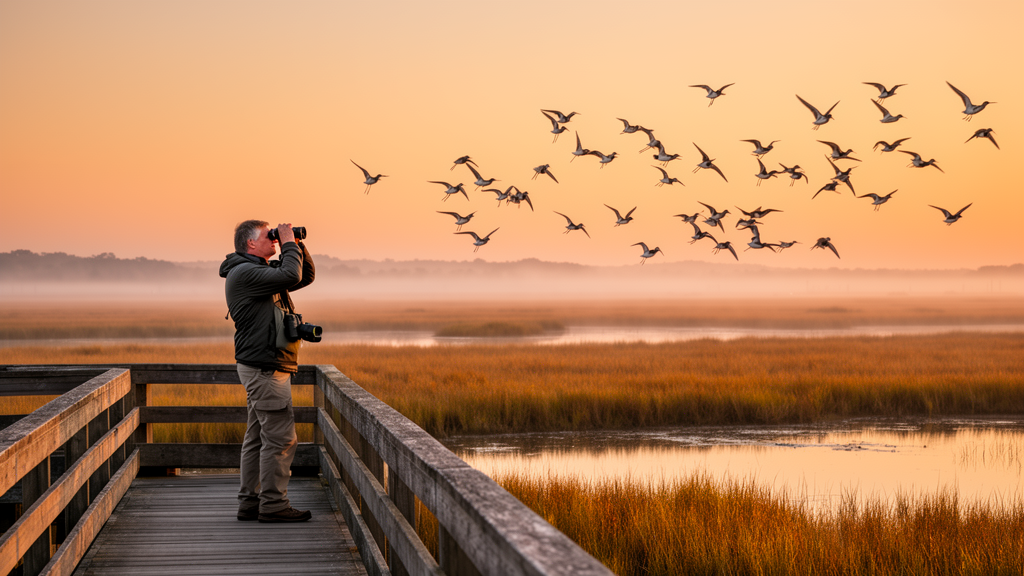
Birdwatching has quietly become one of the most economically and culturally significant ways that Americans connect with nature, yet scientists have struggled to pin down exactly what benefits the practice delivers. A new comparative study published in Frontiers in Bird Science takes on that challenge by examining two of the country’s most celebrated estuarine birding destinations: Barnegat Bay in New Jersey, on the Atlantic Flyway, and San Francisco Bay in California, on the Pacific Flyway. The research, led by Paisley Blair and colleagues at the University of Wyoming’s Haub School of Environment and Natural Resources, offers one of the most granular portraits to date of how the intangible rewards of birding are produced, perceived, and shaped by place.
The stakes of the question are far from trivial. Birding participants in the United States spend an estimated 279 billion dollars annually, support roughly 1.4 million jobs, and generate more than 90 billion dollars in income. Beyond the economics, birding has been linked to measurable improvements in cognition and mental well-being. But when it comes to the formal framework of ecosystem services, the benefits people obtain from ecosystems, traditionally grouped into provisioning, regulating, supporting, and cultural categories, the cultural side of the ledger has remained stubbornly hard to characterize. Nonmaterial benefits such as identity, skill, and experience resist the monetary valuation methods that work well for recreation’s market footprint, and coastal ecosystems have been especially under-examined in this respect.
To cut through that ambiguity, the team adopted a framework that breaks cultural ecosystem service benefits into four distinct categories: experiences, the ways people encounter and perceive ecosystems, from tranquility to the thrill of observing a species; identities, how individuals understand themselves in relation to the natural world; capabilities, the knowledge and skills that engagement with nature cultivates; and cultural goods, the tangible products such as festivals and guided events that both enable participation and generate social benefits. The researchers argue that this decomposition makes seemingly unmeasurable benefits identifiable and, crucially, usable in conservation planning.
Because culture is so deeply tied to place, generalizing about birding benefits from a single site is risky. The study therefore employed a most-similar-systems comparative design. Barnegat Bay and San Francisco Bay share key ecological and recreational characteristics: both are major multi-bay estuarine systems, critical migratory stopovers on their respective coastal flyways, and established birdwatching destinations of genuine cultural importance. Yet they differ dramatically in scale and context. Barnegat Bay encompasses roughly 280 square kilometers of shallow lagoon habitat behind developed barrier islands, with a year-round watershed population of 560,000 that nearly doubles in summer. San Francisco Bay spans about 4,134 square kilometers, is home to nearly 8.5 million people, and has lost more than 90 percent of its historic wetlands to urban development, making the surviving habitat all the more precious to shorebirds and waterfowl.
Rather than surveying a statistically representative sample of birdwatchers, a notoriously difficult group to sample given the enormous gradient from casual backyard observers to obsessive listers, the researchers turned to 31 key informants: experienced practitioners including conservation NGO staff, tourism professionals, government agency employees, and birding guides, many of them dedicated birders themselves. Sixteen informants came from Barnegat Bay and fifteen from San Francisco Bay, recruited through purposive and snowball sampling and interviewed in person or by phone between August 2025 and February 2026. A mixed-methods questionnaire of 27 items combined multiple-choice and Likert-scale questions with open-ended prompts, and responses were analyzed through deductive coding based on the four benefit categories, supplemented by inductive sub-codes for threats, diversity, and rare bird sightings that emerged from the data itself.
The most striking finding was what dominated: experiences. Fourteen of sixteen Barnegat Bay informants and thirteen of fifteen San Francisco Bay informants spontaneously discussed experiential dimensions of birding, far more than any other benefit category. And within experiences, one motif rose above all others at both sites: the sighting of rare or vagrant birds, species that are difficult to detect or that appear far outside their normal range. Nine of sixteen Barnegat Bay informants emphasized rarity, often more frequently than any single iconic species, while five San Francisco Bay informants did the same. This aligns with the ecology of coastal flyways, where vagrant occurrences are more common than inland, and it underscores that unpredictability and novelty, not just charismatic flagship species, drive much of birding’s recreational value.
The character of those experiences, however, diverged sharply between the estuaries. Barnegat Bay informants overwhelmingly framed birding around tranquility and escape, with fourteen of sixteen reporting that birders come to find calm and to flee urban environments while watching wildlife. San Francisco Bay informants were split on both points, with only 54 percent agreeing that tranquility was a draw and 47 percent agreeing that escaping cities motivated visitors. Instead, Bay Area informants tied meaningful experiences to individual factors: where a birder comes from, and how specialized their skills are. One informant noted that the single most iconic species for any visitor is highly specific to their origin, observing that a phenomenal birder once arrived thrilled to see snowy egrets, birds locals consider commonplace. Seasonality structured experience at both sites, with waterfowl defining winter, migratory shorebirds dominating spring and fall, and breeding terns, avocets, and stilts anchoring summer in the Bay.
Identity and capabilities revealed equally telling contrasts. Contrary to expectations from cultural ecosystem services research, neither community tied its identity to a single iconic bird species; fourteen of sixteen Barnegat Bay informants and twelve of fifteen San Francisco Bay informants rejected that idea. Instead, identity operated as a subculture of practice. San Francisco informants discussed it far more often, describing a community split between community-science birders who monitor the bay for conservation and rarity chasers who pursue vagrants from South America or Asia, and characterizing the region as home to some of the best birders in the world. Barnegat Bay identity, when it surfaced, was about conversion into birding, as one tourism professional put it, a lot of fishermen are converted birders. On capabilities, informants at both sites agreed the general public lacks bird knowledge, a gap the authors argue demands attention from wildlife and land managers, since expertise remains concentrated among dedicated participants without intentional outreach.
Cultural goods exposed perhaps the sharpest regional divide. Twelve Barnegat Bay informants confirmed local birding events exist, and five described a rich crossover with coastal heritage: the Old Time Barnegat Bay Decoy and Gunning Show, the Pine Barrens Jamboree, and the Pinelands Short Course all blend birding with maritime tradition and regional culture. San Francisco Bay events, by contrast, from the Point Reyes Birding and Nature Festival to the Berkeley Bird Festival and Audubon-led walks offered nearly every day, remained largely insulated within the birding community itself, with little crossover programming. The authors interpret this as evidence that Barnegat Bay’s birding economy is embedded in broader coastal leisure and heritage tourism, while the Bay Area’s is a specialized, self-contained subculture.
The study’s broader message is that cultural ecosystem service benefits are co-produced through interactions between ecosystems, places, and cultural practices rather than being static attributes of any landscape, and that experiences, identities, capabilities, and cultural goods reinforce one another in loops: a rare sighting builds experience, experience forges identity, identity sharpens skill. Because the findings rest on a modest, purposively sampled pool of expert informants, the authors caution they are exploratory characterizations rather than population-level measurements. Even so, the practical implications are concrete. Managers in tranquil, heritage-rich Barnegat Bay might emphasize accessibility and multi-use coastal tourism, while San Francisco Bay managers could support advanced birding opportunities, habitat diversity, and community-science partnerships. And because unethical practices such as flushing birds or luring them with bait can harm vulnerable species, understanding what birders actually seek, especially the outsized demand for rarities, could let managers convert that enthusiasm into financial, educational, and conservation gains. As human dependence on cultural ecosystem services grows faster than on provisioning services, and as these benefits prove difficult to recover once degraded, place-grounded research like this may become the foundation for protecting them.
Subject of Research: Stakeholder perceptions of birdwatching benefits as cultural ecosystem services in Atlantic and Pacific flyway estuaries
Article Title: Characterizing stakeholder perceptions of birdwatching benefits as a cultural ecosystem service: a comparative study of Atlantic and Pacific flyway estuaries
Article References: Blair, P., Koprowski, J., Stoellinger, T., Williamson, R., & Dunning, K. (2026). Characterizing stakeholder perceptions of birdwatching benefits as a cultural ecosystem service: a comparative study of Atlantic and Pacific flyway estuaries. Frontiers in Bird Science, 5, Article 1895040. https://doi.org/10.3389/fbirs.2026.1895040
Image Credits: AI Generated
DOI: 10.3389/fbirs.2026.1895040
Keywords: birdwatching, cultural ecosystem services, estuaries, Barnegat Bay, San Francisco Bay, Atlantic Flyway, Pacific Flyway, rare bird sightings, birder identity, heritage tourism, conservation management, mixed methods
Cite Scienmag News
Glenn Wilkins. (October 15, 2026). Rare Birds and Estuary Culture: What Two American Flyways Reveal About Birding’s Hidden Value. Scienmag. https://scienmag.com/rare-birds-and-estuary-culture-what-two-american-flyways-reveal-about-birdings-hidden-value/
Glenn Wilkins. "Rare Birds and Estuary Culture: What Two American Flyways Reveal About Birding’s Hidden Value." Scienmag, 15 October 2026, https://scienmag.com/rare-birds-and-estuary-culture-what-two-american-flyways-reveal-about-birdings-hidden-value/. Accessed 15 October 2026.
Glenn Wilkins. "Rare Birds and Estuary Culture: What Two American Flyways Reveal About Birding’s Hidden Value." Scienmag. October 15, 2026. https://scienmag.com/rare-birds-and-estuary-culture-what-two-american-flyways-reveal-about-birdings-hidden-value/


