


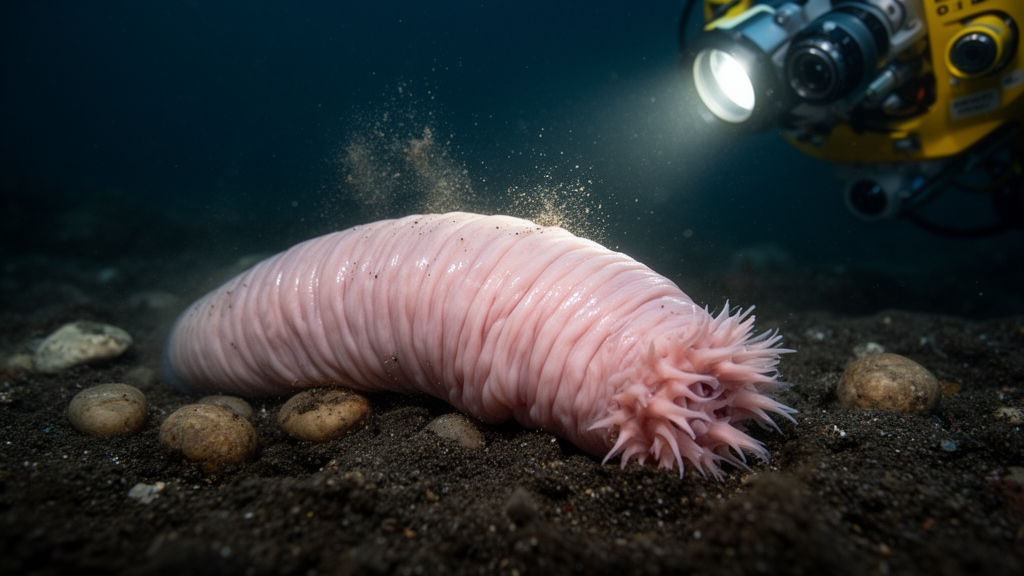
Nearly two decades after a German research expedition hauled box cores of sediment up from more than five kilometers beneath the tropical Atlantic, a team of taxonomists has formally confirmed what those samples quietly contained: six specimens of a deep-sea peanut worm, Nephasoma constricticervix, collected from the Guinea Basin at depths of 5,141 to 5,171 meters. The finding, published in the journal Evolutionary Systematics, transforms a vague, decades-old “unpublished record” into a documented occurrence and, in the process, offers one of the most detailed microscopic portraits ever produced for any member of this notoriously difficult genus of marine worms.
Peanut worms, or sipunculans, are unsegmented marine worms named for the way their retractable feeding organ, the introvert, can be drawn into their bulbous trunk like the nut inside a peanut shell. They are hardly household names, yet they are everywhere in the ocean floor. Roughly 150 species are known, and about a third of them live in deep water, where they burrow through soft sediments as deposit feeders, ingesting organic particles from the mud. At least some species excavate deep burrows, reworking the seafloor and acting as ecosystem engineers that shape the physical structure of abyssal sediments in ways scientists are only beginning to appreciate.
Despite their ecological role, the deep-water sipunculan fauna remains strikingly poorly known. The northern oceans, particularly the North Atlantic, have been surveyed far more thoroughly than the tropics or the southern hemisphere. Recent syntheses of distribution data have, however, flagged hotspots of deep-sea sipunculan diversity in several regions, including the eastern South Atlantic, the very area where the newly reported specimens were recovered. The formal record from the Guinea Basin helps fill one of the many blank spaces on the map of abyssal life and suggests that the region’s diversity may be underestimated simply because so few samples have ever been sorted with sipunculans in mind.
The specimens themselves have an unusual history. They were collected in March 2005 during the DIVA II expedition of the German research vessel Meteor, cruise ME 63-2, which targeted the abyssal plains of the South-East Atlantic. Sediment was brought up with a box corer and immediately bulk-fixed in 4 percent formalin. The expedition report noted the presence of roughly fifteen sipunculan and echiurid specimens in the samples, including one large Nephasoma individual measuring about ten centimeters. But the six small specimens that now form the basis of the new record were originally overlooked. They sat in bulk-fixed sediment until staff at the German Center for Marine Biodiversity Research sorted the material and transferred the animals to 70 percent ethanol, where they waited for years to be recognized.
Once examined, the specimens proved challenging in every sense. They range from about 2.3 to 16.3 millimeters in length, and most arrived in less than perfect condition, with trunks partly injured and fragments difficult to distinguish from complete animals. The worms are yellowish to light brownish and transparent, and their bodies show irregular thickenings, including a bulbous introvert in some individuals. A key diagnostic feature, a constriction at the transition between the introvert and the trunk, was visible in some but not all specimens. Through the transparent body wall, the researchers could make out a coiled intestine, a gut packed with sediment, and, in one specimen, oocytes, evidence that at least one individual was a mature female. No thickenings of the cuticle known as pseudoshields could be detected on the trunk surface, an absence that would later prove taxonomically decisive.
The real breakthrough came from the introvert hooks, the minute curved cuticular structures that stud the feeding organ of many sipunculans. Hook length decreases from front to back in all six specimens, and the anterior hooks are strikingly long for the genus: up to 123 micrometers in one individual, with other specimens measuring 93, 75, 68 and 40 micrometers, tapering to around 20 micrometers posteriorly. Because most Nephasoma species have quite short hooks and only a handful have longer ones, hook length alone narrows the field of candidate species considerably. To characterize the hooks properly, the team turned to scanning electron microscopy, dehydrating the specimens through an ethanol series, critical-point drying them, sputter coating them with platinum, and imaging them with a LEO SEM 1524, after first documenting them with a digital microscope using focus stacking.
The electron micrographs revealed fine structure never before documented for this species. Each hook sits on the frontal side of an elevated socket in the introvert epidermis, with a sharp border between the hook cuticle and the surrounding body cuticle. Most remarkably, the basal sockets carry one or two semispherical papillae with a round apical structure, which the authors suggest could be a receptive or secretive opening. Papillae are usually described from the trunk of sipunculans, and papillae associated with hooks have been figured for only two other Nephasoma species before now, N. columbaris and N. diaphanes diaphanes. Neither of those species has hooks resting on elevated sockets, making the socket-and-papilla combination of the Guinea Basin worms a distinctive and previously underappreciated character complex.
Identifying the species required a careful process of elimination. Among the few Nephasoma species with long hooks, N. abyssorum has broad-based, darkly staining hooks arranged in spirals and is most abundant in the Northeast Atlantic. N. vitjazi, which can reach hook lengths of 280 micrometers, possesses pseudoshields absent from the Guinea Basin specimens and is a Pacific species. N. cutleri, with hooks up to 150 micrometers, also hails from the Pacific and has a proportionally longer introvert. N. constrictum, another Northeast Atlantic species with a constriction between introvert and trunk, is flask-shaped and bears pigmented, raised papillae. That leaves N. constricticervix, originally described in 1969 from the Western North Atlantic near Bermuda, with hooks up to 250 micrometers and the same characteristic constriction. The Guinea Basin worms match it in body form, hook shape and, crucially, distribution.
The biogeographic argument is as important as the morphological one. N. constricticervix has been recorded near Bermuda at 1,500 to 4,815 meters, off Puerto Rico at 5,499 meters, in the Gulf of Gascogne at 1,985 to 2,360 meters, and off West Africa at 4,284 meters, with a single Antarctic record from the Weddell Sea and mentions of unpublished records from the southern Pacific and the Eastern South Atlantic down to 22 degrees south. The authors suggest those earlier southeastern records were published so vaguely because the specimens were inconspicuous, perhaps with incompletely extended introverts or poor preservation, exactly the problems that plagued the newly studied material. The Guinea Basin sits squarely within the species’ reported range, and the authors note that longer hooks may well be present in the still-inverted anterior portion of the introverts, which could not be fully examined.
Beyond settling a taxonomic question, the study raises intriguing biological possibilities. One specimen bore a region of the introvert entirely free of hooks, yet studded with semispherical elevations that look precisely like the empty basal sockets of shed hooks, and a detached hook was observed lying nearby, apparently held by a trace of tissue. The sharp boundary between hook and body cuticle may allow hooks to detach and break away, supporting an old hypothesis that hooks can be lost during development, though clear evidence remains to be shown. Hook arrangement, considered diagnostic in some species, appeared spiral in one specimen but unordered in others, leaving its taxonomic value uncertain here. As deep-sea sampling intensifies and imaging techniques reach ever finer scales, creatures like these transparent, five-kilometer-deep worms are a reminder that the abyssal seafloor still holds species we have barely met, and that some of the ocean’s most important stories are hidden in boxes of mud collected years ago.
Subject of Research: First formal record and scanning electron microscope study of the deep-sea sipunculan worm Nephasoma constricticervix from the Guinea Basin in the South-East Atlantic
Article Title: Record of deep-sea Nephasoma constricticervix ( Sipuncula , Golfingiidae ) from the Guinea Basin (South-East Atlantic)
Article References: Schmidt-Rhaesa, A. (2026). Record of deep-sea Nephasoma constricticervix (Sipuncula, Golfingiidae) from the Guinea Basin (South-East Atlantic). Evolutionary Systematics, 10(2), 375-381. https://doi.org/10.3897/evolsyst.10.210468
Image Credits: AI Generated
DOI: 10.3897/evolsyst.10.210468
Keywords: Nephasoma constricticervix, Sipuncula, peanut worms, deep-sea fauna, Guinea Basin, South Atlantic, DIVA II expedition, scanning electron microscopy, marine biodiversity, taxonomy, abyssal zone, Golfingiidae
Cite Scienmag News
Drew Townsend. (October 15, 2026). Deep-Sea Peanut Worm Resurfaces After Decades in the Abyss of the South Atlantic. Scienmag. https://scienmag.com/deep-sea-peanut-worm-resurfaces-after-decades-in-the-abyss-of-the-south-atlantic/
Drew Townsend. "Deep-Sea Peanut Worm Resurfaces After Decades in the Abyss of the South Atlantic." Scienmag, 15 October 2026, https://scienmag.com/deep-sea-peanut-worm-resurfaces-after-decades-in-the-abyss-of-the-south-atlantic/. Accessed 15 October 2026.
Drew Townsend. "Deep-Sea Peanut Worm Resurfaces After Decades in the Abyss of the South Atlantic." Scienmag. October 15, 2026. https://scienmag.com/deep-sea-peanut-worm-resurfaces-after-decades-in-the-abyss-of-the-south-atlantic/


