


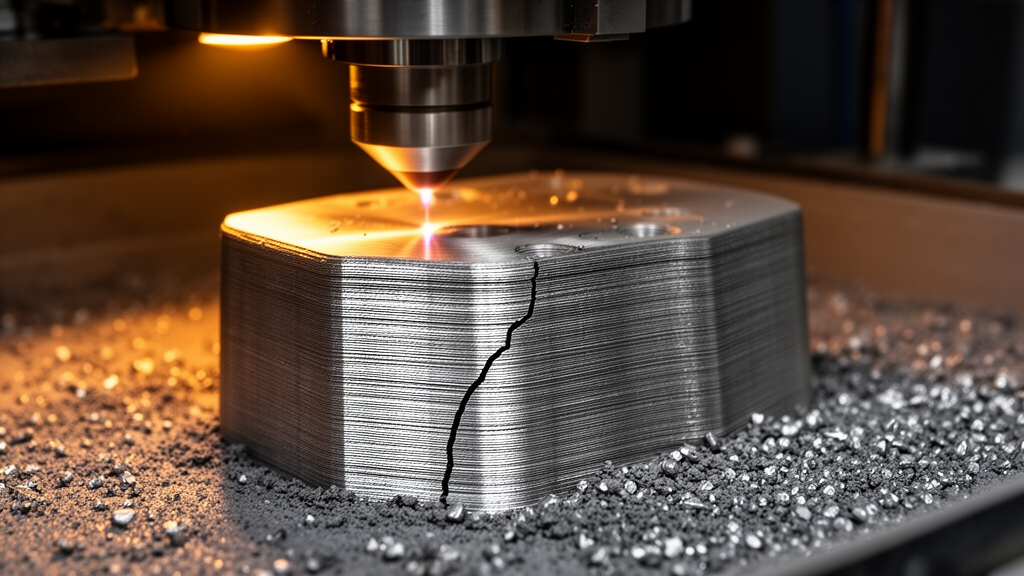
Maraging stainless steels have quietly become one of the most important material stories of the additive manufacturing era. These iron-based alloys, strengthened by the precipitation of intermetallic compounds inside a soft martensitic matrix, combine remarkable strength with good corrosion resistance, making them attractive for aerospace components, tooling, and demanding structural applications. When such steels are built layer by layer in a laser powder bed fusion (LPBF) machine, however, their final properties depend not only on chemistry and heat treatment but also on how efficiently the laser converts energy into melted material. A new study published in the Journal of Materials Science by Chao Wang, Lilin Wang, Xin Lin, Yajing Sun of Northwestern Polytechnical University in Xi’an, together with Geng Liu and Jie Su of the Central Iron and Steel Research Institute in Beijing, has now revealed that doubling the build efficiency of LPBF processing fundamentally reshapes the population of oxide inclusions inside maraging stainless steel, with dramatic consequences for its toughness.
The research team set out to answer a deceptively simple question: what happens to the microscopic oxides that inevitably form during laser melting when the processing efficiency is doubled? In LPBF, a focused laser beam scans across a thin bed of metallic powder, melting it into a small melt pool that solidifies within microseconds. Oxygen dissolved in the powder or picked up from the atmosphere reacts with alloying elements during this brief molten lifetime, generating oxide particles that become trapped in the solidifying metal. These inclusions range from nanometer-scale dispersoids to micron-sized particles, and they act as potential crack nucleation sites that can degrade impact toughness. Because manufacturers increasingly push LPBF machines toward higher productivity, understanding how efficiency changes oxide behavior is essential for qualifying printed parts.
The experimental comparison produced strikingly detailed data. Samples built with doubled processing efficiency contained coarser and more abundant micron-scale oxides, with an average size of 2.24 micrometers and a number density of 41.7 per square millimeter, compared with 2.17 micrometers and 27 per square millimeter in low-efficiency samples. At the nanometer scale, the trend reversed in an unexpected way: high-efficiency samples had fewer but larger nano-oxides, with a number density of 6.17 times ten to the nineteenth per cubic meter and an average diameter of 31 nanometers, whereas low-efficiency samples contained 1.35 times ten to the twentieth per cubic meter of nano-oxides averaging 27 nanometers. This dual-scale characterization demonstrates that build efficiency does not simply scale oxide content uniformly; it selectively alters different size populations through distinct physical mechanisms.
To explain these observations, the researchers turned to classical nucleation and growth theory, modeling how oxide particles form and evolve under the thermal conditions of each processing regime. Their analysis suggests that slower cooling rates in high-efficiency processing suppress the nucleation of new oxide particles while enhancing the growth of those that do form. Fewer nuclei, given more time in the molten state, grow into larger particles. Meanwhile, stronger convection within the melt pool drives oxides toward the pool surface, where they can be expelled during track overlaps. The consequence is that more micron-sized oxides remain trapped internally in the solidified metal after successive laser passes, while the nano-scale population becomes sparser but coarser. This mechanistic picture links macroscopic processing parameters directly to the microscopic inclusion architecture through well-established physical principles of deoxidation chemistry and melt pool hydrodynamics.
Heat treatment, a standard post-processing step for maraging steels, added another layer of nuance to the findings. The researchers found that heat treatment did not change the oxide inclusions themselves, confirming that these particles are stable remnants of the melting process rather than products of subsequent thermal cycles. What heat treatment did accomplish was the elimination of the cellular substructures characteristic of as-built LPBF material, the fine dislocation networks and solute-decorated cell walls that form during rapid solidification. After heat treatment, both sample groups produced similar amounts of retained austenite, the metastable face-centered cubic phase that can influence cryogenic toughness. This means that the microstructural differences responsible for property variations between the two build efficiencies were almost entirely attributable to the oxides rather than to matrix features.
The mechanical property data revealed the practical importance of these oxide differences. Despite comparable tensile strengths between the two sample groups, low-efficiency samples exhibited substantially higher impact toughness. At room temperature, low-efficiency samples absorbed 195 joules of impact energy compared with 160 joules for high-efficiency samples. The gap persisted at cryogenic temperature, with low-efficiency samples absorbing 106 joules at minus 196 degrees Celsius versus 88 joules for high-efficiency samples. Because heat treatment had equalized matrix microstructure and retained austenite content, the researchers could attribute the toughness differences primarily to the oxide inclusion populations. Larger and more abundant micron-scale oxides in high-efficiency samples provide more crack nucleation sites and easier crack propagation paths, degrading impact performance at both ambient and cryogenic temperatures.
These findings carry significant implications for the industrial deployment of additively manufactured maraging stainless steels. Manufacturers seeking to maximize productivity by increasing laser power, scan speed, or layer thickness may inadvertently create a tougher-to-qualify material with degraded impact resistance. The study demonstrates that build efficiency must be carefully balanced rather than simply maximized. A processing window that optimizes oxide behavior, suppressing the formation of large micron-scale inclusions while managing the nano-scale dispersoid population, is essential for achieving the combination of strength and toughness that these steels are designed to deliver. This is particularly relevant for cryogenic applications, where the toughness gap between processing regimes remained substantial even at minus 196 degrees Celsius.
The research also connects to a broader scientific conversation about oxygen inclusions in LPBF-processed stainless steels. Previous studies have documented the presence of oxide inclusions in laser additively manufactured austenitic stainless steels and their effects on impact toughness and stress corrosion cracking behavior. Other work has explored the origin and formation of oxygen inclusions during powder bed fusion, tracing them to powder surface chemistry and atmospheric exposure. The present study extends this understanding to maraging stainless steels, a class of materials where the interplay between oxide inclusions, retained austenite, and precipitation strengthening is especially intricate. By isolating the effect of build efficiency through careful experimental design, the researchers have provided a clean dataset that other investigators can use to validate and refine predictive models of inclusion evolution during additive manufacturing.
Looking ahead, the mechanistic framework developed in this study opens pathways for rational process optimization. If slower cooling suppresses nucleation while enhancing growth, and if stronger convection redistributes oxides toward the melt pool surface, then targeted modifications to scanning strategies, such as adjusting laser parameters, hatch spacing, or interlayer time, could be used to steer the inclusion population toward a more favorable architecture. Numerical modeling of oxide particle evolution during additive manufacturing, building on classical deoxidation theory from steelmaking, offers a route to predicting inclusion outcomes before parts are ever printed. As additive manufacturing matures from rapid prototyping into certified production of safety-critical components, the ability to control not just bulk chemistry but also the microscopic inclusion landscape will separate qualified, reliable parts from those that fail unexpectedly. This study demonstrates that the invisible oxides inside printed steel are not incidental artifacts but controllable features that demand the same engineering attention as any other aspect of the manufacturing process.
Subject of Research: Effect of LPBF build efficiency on oxide inclusions and toughness of maraging stainless steel
Article Title: Effect of LPBF build efficiency on oxide inclusions and toughness of maraging stainless steel
Article References: Wang, C., Wang, L., Lin, X., Sun, Y., Liu, G., & Su, J. (2026). Effect of LPBF build efficiency on oxide inclusions and toughness of maraging stainless steel. Journal of Materials Science, 61(43), 33956-33973. https://doi.org/10.1007/s10853-026-13698-5
Image Credits: AI Generated
DOI: 10.1007/s10853-026-13698-5
Keywords: LPBF, maraging stainless steel, oxide inclusions, toughness, additive manufacturing, build efficiency, nucleation and growth, cryogenic properties, heat treatment, retained austenite, melt pool convection, Journal of Materials Science
Cite Scienmag News
Denise Maddox. (October 15, 2026). Doubled build efficiency degrades toughness of laser-printed maraging stainless steel. Scienmag. https://scienmag.com/doubled-build-efficiency-degrades-toughness-of-laser-printed-maraging-stainless-steel/
Denise Maddox. "Doubled build efficiency degrades toughness of laser-printed maraging stainless steel." Scienmag, 15 October 2026, https://scienmag.com/doubled-build-efficiency-degrades-toughness-of-laser-printed-maraging-stainless-steel/. Accessed 15 October 2026.
Denise Maddox. "Doubled build efficiency degrades toughness of laser-printed maraging stainless steel." Scienmag. October 15, 2026. https://scienmag.com/doubled-build-efficiency-degrades-toughness-of-laser-printed-maraging-stainless-steel/


