


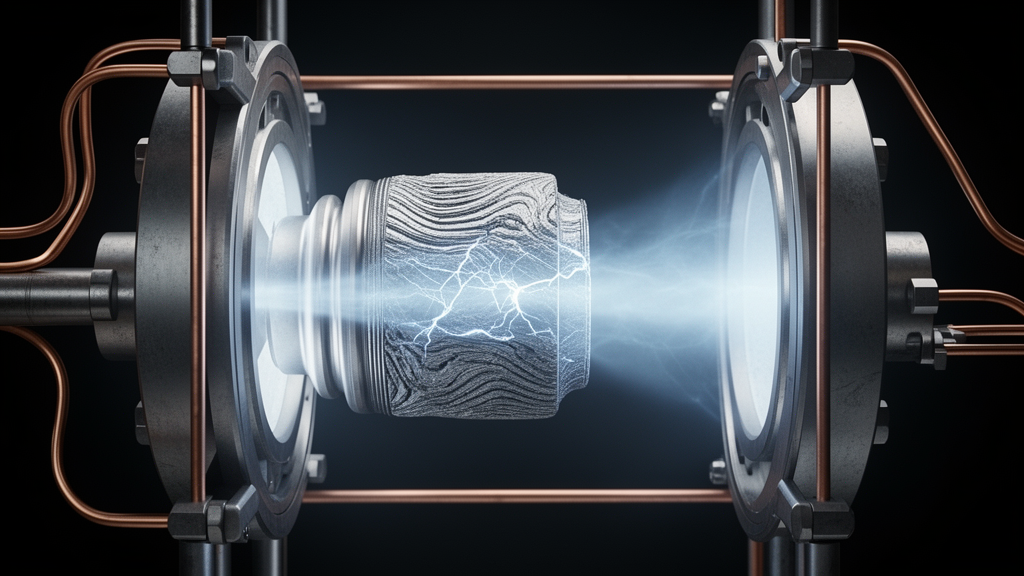
Additive manufacturing has already transformed aerospace and medicine, and it is now knocking on the door of the nuclear industry with an audacious promise: reactor components printed layer by layer, with geometries that casting and forging could never achieve, delivered in weeks rather than years. But a comprehensive new review published in Frontiers in Nuclear Engineering argues that the field stands at a critical crossroads. The same microscopic quirks that make 3D-printed metals so attractive may also make them vulnerable in ways scientists are only beginning to understand, and the qualification frameworks needed to certify these parts for safety-critical service simply do not yet exist.
The review, authored by Irfan Nazir Wani of Universidad Europea de Madrid, examines five mainstream additive manufacturing technologies for nuclear materials: laser powder bed fusion, directed energy deposition, electron beam powder bed fusion, wire arc additive manufacturing, and binder jetting. Each process leaves a distinct fingerprint on the material. Laser powder bed fusion, the most thoroughly studied technique, solidifies metal at staggering cooling rates of up to a million degrees per second, producing a hierarchical microstructure of columnar grains threaded with dislocation cells just 200 to 500 nanometers across. Wire arc systems, by contrast, deposit material up to a thousand times faster but yield coarse, weld-like grains. These process-structure-property-performance relationships, the review argues, are the key to understanding how printed parts will behave inside a reactor.
The stakes could hardly be higher. Fourth-generation fission reactors and fusion devices demand structural materials that survive temperatures up to 1,000 degrees Celsius, transient heat fluxes exceeding 10 megawatts per square meter, and neutron bombardment reaching 200 displacements per atom over decades of service. Traditional manufacturing already struggles to deliver such components, with lead times stretching to several years. Additive manufacturing offers near-net-shape fabrication, functionally graded compositions, and microstructures that could, in principle, enhance irradiation resistance. Yet the two dominant global nuclear qualification frameworks, ASME and RCC-M, apply only to conventional forged and cast materials.
One of the most striking findings concerns the thermal fragility of the very dislocation structures that give printed stainless steel its strength. In laser powder bed fusion 316L, the dense network of dislocation cells, enriched with chromium and molybdenum at their walls, begins to undergo irreversible changes at temperatures as low as 230 degrees Celsius. Above 600 degrees, the cell walls dissolve entirely, and short exposures of less than half an hour at 800 degrees can destroy the cellular structure altogether. That is an uncomfortable fact for a material intended for Generation IV reactors operating between 400 and 800 degrees. Long-term aging studies on printed 316H, however, offer a more nuanced picture: despite accelerated precipitation kinetics up to a hundred times faster than wrought material, the printed alloy retained yield strength better than its forged counterpart, and physics-informed models now extrapolate its behavior out to a century of service.
The review also exposes a genuine scientific controversy over irradiation swelling. Several studies report that printed 316L swells less than wrought material, crediting the dislocation cells with acting as sinks that annihilate the point defects radiation generates. Other work finds heterogeneous void distributions, with denuded zones near cell walls, suggesting the cell network may not be the ideal sink structure after all. The outcome hinges on a delicate interplay of grain boundary character, void bias, helium bubble nucleation from transmutation reactions, and defect recombination efficiency, all of which differ in printed microstructures. Whether cell walls act as recombination sites or as nucleation sites for damaging voids remains an open question that systematic experiments have yet to answer.
Oxide dispersion-strengthened alloys illustrate how contested the field remains. These steels, seeded with nanometer-scale oxide particles that block dislocations and trap helium, are traditionally made by costly mechanical alloying. Printing them directly from blended powders would be transformative, but studies reach opposite conclusions: some show that the extreme cooling rates kinetically trap Y2O3 and Y-Al-O phases intact, while others observe dissolution and coarsening driven by Ostwald ripening at high laser energy densities. Atom probe tomography adds a further twist, revealing that nanoclusters far more numerous than the visible oxide particles can multiply and change composition under irradiation, and that their stability depends strongly on temperature. Recent neutron irradiation data on 12Cr ODS steel at low dose showed the clusters barely changed, a reassuring but narrow data point.
Tungsten, the leading candidate for fusion divertors, presents its own drama. With a melting point of 3,422 degrees Celsius and notorious brittleness, printed tungsten cracks under the thermal stresses of fabrication. Mitigation strategies, from substrate preheating to nanoparticle doping with titanium carbide or lanthanum oxide, have produced crack-free small coupons, but scaling to divertor-relevant components larger than 100 millimeters remains unsolved. Printed tungsten also raises a fusion-specific concern: tritium retention. Studies of electron beam printed tungsten found deuterium retention comparable to conventional material but with altered desorption behavior, while laser powder bed fusion samples trapped argon from the shielding gas in nanopores, hinting that printed porosity could create additional trapping sites for scarce fusion fuel.
Perhaps the most consequential limitation is the near-total absence of neutron irradiation data for printed nuclear materials. Almost everything known comes from ion irradiation, which delivers damage up to ten thousand times faster than reactors, produces different cascade structures, penetrates only microns deep, and generates no transmutation helium or hydrogen. The few comparative studies suggest that properly heat-treated printed 316L can match wrought material’s radiation response, but as-built material may not, and extrapolation beyond 10 displacements per atom, far below the 50 to 200 that reactors will impose, is essentially unsupported. Compounding the problem, most mechanical tests run for hundreds to thousands of hours while reactor components must endure roughly half a million.
Qualification presents a regulatory labyrinth of its own. The 2025 RCC-MRx code case for laser powder bed fusion components marks real progress but covers only specific material-process combinations within the French framework, and ASME has yet to offer comparable guidance. Printed parts vary with build height and geometry in ways that conventional sampling plans may not capture, their keyhole porosity and lack-of-fusion voids behave differently from wrought defects, and traditional nondestructive inspection loses sensitivity on complex printed geometries. The European NUCOBAM project is working to draft additive-specific text for nuclear design codes, while digital twins and machine learning-enhanced inspection promise to compress qualification timelines that would otherwise stretch over decades.
The review’s roadmap is unambiguous about priorities: coordinated international neutron irradiation campaigns comparing printed and wrought materials across the full dose and temperature range, long-term thermal aging studies exceeding 10,000 hours, anisotropic property databases that respect the directional nature of printed microstructures, and validated models that embed additive-specific initial conditions. Near-term opportunities exist in less safety-critical niches, such as repairing non-structural components with directed energy deposition, or deploying printed heat exchangers in small modular and research reactors to accumulate operational experience. The central question, the review concludes, has shifted from whether additive manufacturing can serve nuclear energy to which components can be certified, under what conditions, and how quickly the evidence base can catch up with the technology’s ambition.
Subject of Research: Additive manufacturing of nuclear reactor materials under extreme irradiation and thermal conditions
Article Title: Additive manufacturing of nuclear materials under irradiation extremes: thermal-mechanical performance, qualification challenges, and future research directions
Article References: Wani, I. N. (2026). Additive manufacturing of nuclear materials under irradiation extremes: thermal-mechanical performance, qualification challenges, and future research directions. Frontiers in Nuclear Engineering, 5, Article 1894792. https://doi.org/10.3389/fnuen.2026.1894792
Image Credits: AI Generated
DOI: 10.3389/fnuen.2026.1894792
Keywords: additive manufacturing, nuclear materials, irradiation damage, laser powder bed fusion, void swelling, ODS alloys, tungsten, silicon carbide composites, reactor qualification, Generation IV reactors, fusion materials, thermal stability
Cite Scienmag News
Denise Maddox. (October 15, 2026). 3D-Printed Reactor Parts Face a Harsh Reckoning Under Nuclear Irradiation. Scienmag. https://scienmag.com/3d-printed-reactor-parts-face-a-harsh-reckoning-under-nuclear-irradiation/
Denise Maddox. "3D-Printed Reactor Parts Face a Harsh Reckoning Under Nuclear Irradiation." Scienmag, 15 October 2026, https://scienmag.com/3d-printed-reactor-parts-face-a-harsh-reckoning-under-nuclear-irradiation/. Accessed 15 October 2026.
Denise Maddox. "3D-Printed Reactor Parts Face a Harsh Reckoning Under Nuclear Irradiation." Scienmag. October 15, 2026. https://scienmag.com/3d-printed-reactor-parts-face-a-harsh-reckoning-under-nuclear-irradiation/


