


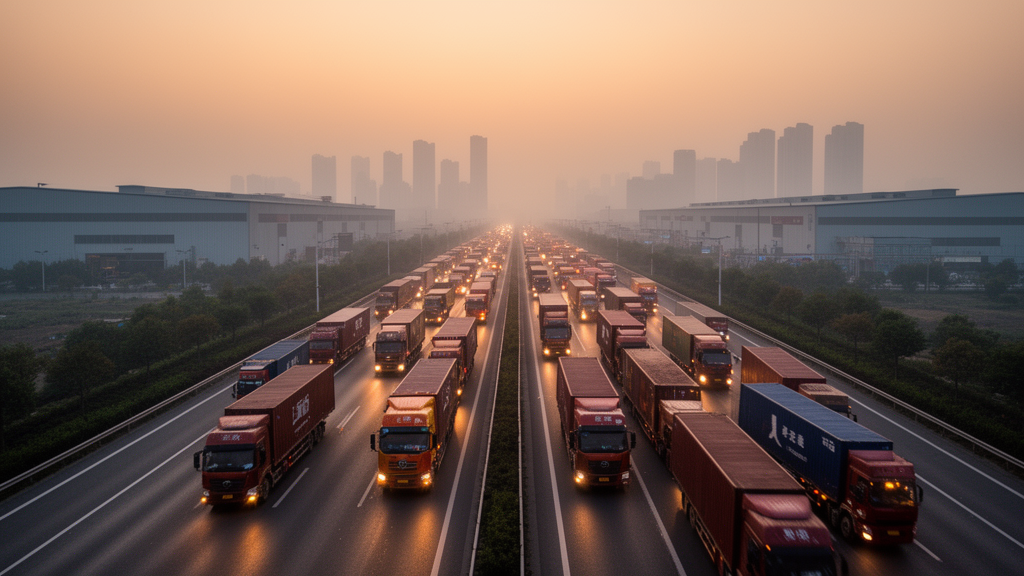
China’s freight industry consumed 665.45 million tons of standard coal equivalent and emitted 1466.38 million tons of carbon dioxide in 2024, according to a new study that provides the most recent multi-modal accounting of the sector’s energy and climate footprint. The analysis, published in Frontiers in Future Transportation, covers road, rail, waterway and air freight from 2022 to 2024 and finds that emissions climbed from 1308.44 million tons in 2022, a trajectory that sits uncomfortably against the country’s commitments to peak carbon emissions before 2030 and achieve carbon neutrality by 2060.
The study, led by Li-Qun Ji of the International Business School at Shanghai University of International Business and Economics, applied the IPCC’s “top-down” methodology to official freight turnover data drawn from the China Statistical Yearbook, the China Railway Yearbook and civil aviation statistics. Rather than measuring emissions from individual vehicles or companies, the top-down approach aggregates national-level activity data and multiplies it by standardized emission factors, offering a consistent macro-scale picture of the entire freight system. The researcher deliberately excluded pipeline transport, which mainly carries oil and gas, to focus on the four modes that dominate goods movement.
The technical backbone of the calculation is a two-step procedure. First, freight turnover for each mode, expressed in trillion ton-kilometers, is allocated across vehicle types using fleet shares from official yearbooks: roughly 70 percent of rail freight turnover is hauled by electric locomotives and 30 percent by diesel locomotives, while diesel trucks make up about 93 percent of the road freight fleet. These allocations are then multiplied by unit energy consumption rates, such as 0.0513 tons of diesel per 1,000 ton-kilometers for diesel trucks and 110 kilowatt-hours per 1,000 ton-kilometers for electric locomotives. All physical fuel and electricity consumption is converted to standard coal equivalent before aggregation, using national conversion factors like 1.45 tons of standard coal per ton of diesel and 0.1229 kilograms of standard coal per kilowatt-hour.
Second, the resulting energy consumption is translated into carbon emissions by applying fuel-specific CO2 emission factors: 3.1863 tons of CO2 per ton of diesel burned, 3.0900 tons per ton of gasoline, 3.157 tons per ton of aviation kerosene, and a national average grid factor of 6.205 × 10⁻⁴ tons of CO2 per kilowatt-hour for electric rail. Identical coefficients were held constant across 2022 to 2024, an assumption the author justified by noting that official yearbooks indicate no material change in average vehicle, ship or aircraft fuel efficiencies or in the national grid emission factor during the period.
The results reveal a striking structural imbalance. Road freight carried approximately 73.53 percent of China’s total freight volume by tonnage but consumed between 87.55 and 88.12 percent of the freight sector’s total energy. Road freight turnover grew from 6.896 trillion ton-kilometers in 2022 to 7.685 trillion in 2024, driving road emissions from 1144.32 to 1275.25 million tons of CO2. Because diesel trucks dominate the road fleet and have relatively high unit fuel consumption, changes in road freight activity translate almost directly into diesel demand and emissions, making road transport the single largest bottleneck in the sector’s decarbonization pathway.
By contrast, waterway freight demonstrated dramatically lower energy intensity. Ships and barges handled between 53.5 and 55.57 percent of total freight turnover, measured in ton-kilometers, yet consumed only 8.87 to 9.24 percent of the sector’s energy. Waterway turnover expanded from 12.100 trillion ton-kilometers in 2022 to 14.142 trillion in 2024, while the mode’s emissions rose from 115.67 to 135.19 million tons. Rail freight, benefiting from roughly 70 percent electrification, emitted only about 29 million tons of CO2 annually despite hauling more than 3.5 trillion ton-kilometers, though the climate benefit of railway electrification ultimately depends on the carbon intensity of the electricity grid.
Air freight, though tiny in volume share at between 0.01 and 0.02 percent of total tonnage, emerged as the fastest-growing emission source. Air freight turnover surged 39.3 percent from 25.410 billion ton-kilometers in 2022 to 35.389 billion in 2024, pushing the mode’s emissions from 19.25 to 26.81 million tons. The study attributes this growth to rising demand for high-value, time-sensitive goods such as electronics and pharmaceuticals, amplified by post-pandemic recovery. Because aviation kerosene carries a high energy intensity, the rapid expansion of air freight could become increasingly relevant to future emission trends even though its current contribution remains far smaller than that of road transport.
To test the robustness of these findings, the study included a quantitative sensitivity analysis with Monte Carlo error propagation. Unit energy consumption rates were varied by ±10 percent for road and air and ±5 percent for rail and waterway, fleet shares by ±5 percent, direct combustion emission factors by ±2 percent, and the grid electricity factor by ±10 percent. The analysis showed total sector emissions for 2024 remain within a range of 1340.27 to 1592.65 million tons of CO2, an uncertainty of roughly ±8.6 percent. Crucially, the calculations proved most sensitive to the road freight unit fuel consumption rate and the diesel emission factor, confirming that the severe energy imbalance of road freight is a statistically robust finding rather than an artifact of parameter choices.
Placed in national context, the freight sector’s 1.31 to 1.47 billion tons of annual CO2 emissions account for roughly 11 to 12 percent of China’s total emissions from fossil fuels and industry, which reached about 12.6 billion tons in 2024 according to Our World in Data. The study recommends a systemic transition built on four pillars: shifting suitable bulk and long-distance cargo to electrified rail and coastal waterways, accelerating the deployment of electric heavy-duty trucks alongside highway charging infrastructure, integrating sustainable aviation fuels and biodiesel into air and shipping, and bringing freight into an expanding carbon market. Digital logistics management to cut empty and partially loaded trips would further help decouple freight growth from fossil energy consumption.
The author acknowledges limitations: the top-down system boundary captures only end-use combustion, excluding upstream fuel extraction and electricity generation cycles as well as downstream logistics dynamics, and average unit consumption rates mask differences among specific vehicle, vessel and aircraft types. Still, the study argues that deep decarbonization of China’s freight sector requires precisely this kind of mode-specific, bottleneck-oriented strategy rather than uniform measures across all transport modes. With freight turnover continuing to expand alongside the world’s second-largest economy, the window for bending the sector’s emission curve before the 2030 peaking deadline is narrowing, and the trucks that dominate China’s highways remain the decisive front in that effort.
Subject of Research: Insights into energy consumption and carbon emissions from freight industry in China
Article Title: Insights into energy consumption and carbon emissions from freight industry in China
Article References: Ji, L.-Q. (2026). Insights into energy consumption and carbon emissions from freight industry in China. Frontiers in Future Transportation, 7, Article 1967052. https://doi.org/10.3389/ffutr.2026.1967052
Image Credits: AI Generated
DOI: 10.3389/ffutr.2026.1967052
Keywords: Insights, energy, consumption, carbon, emissions, freight, industry, China, scientific research
Cite Scienmag News
Sloane Callahan. (October 15, 2026). China’s Freight Sector Emits 1.47 Billion Tons of CO2 as Road Trucks Dominate Energy Use. Scienmag. https://scienmag.com/chinas-freight-sector-emits-1-47-billion-tons-of-co2-as-road-trucks-dominate-energy-use/
Sloane Callahan. "China’s Freight Sector Emits 1.47 Billion Tons of CO2 as Road Trucks Dominate Energy Use." Scienmag, 15 October 2026, https://scienmag.com/chinas-freight-sector-emits-1-47-billion-tons-of-co2-as-road-trucks-dominate-energy-use/. Accessed 15 October 2026.
Sloane Callahan. "China’s Freight Sector Emits 1.47 Billion Tons of CO2 as Road Trucks Dominate Energy Use." Scienmag. October 15, 2026. https://scienmag.com/chinas-freight-sector-emits-1-47-billion-tons-of-co2-as-road-trucks-dominate-energy-use/


