


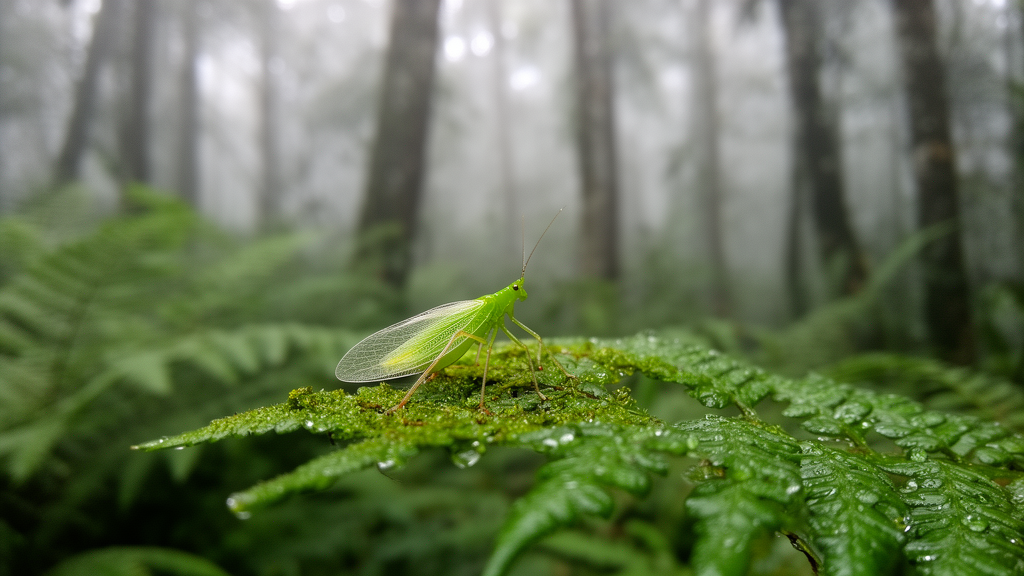
Deep in the mountain forests of Yunnan Province, China, a tiny wedge-shaped insect has been quietly living out its life on the undersides of leaves, almost certainly mistaken for one of its close relatives every time a collector’s net swept past. Now, a careful taxonomic study published in the Deutsche Entomologische Zeitschrift has revealed that this little hopper, along with a species previously placed in another genus entirely, belongs to a lineage so distinct that it deserves a genus of its own. The newly established genus, Dianagallia, described by Zhang and Webb, adds a fresh branch to the evolutionary tree of agalliine leafhoppers and underscores just how much undiscovered diversity still hides in the Oriental tropics.
Leafhoppers are among the most species-rich groups of plant-feeding insects on Earth, and the tribe Agalliini, to which the new genus belongs, comprises compact, wedge-shaped hoppers found on every continent. These insects feed by piercing plant tissues with needle-like mouthparts and sucking sap, and in the Oriental Region their host preferences are remarkably broad: documented records span monocotyledonous plants from a single plant family and dicotyledonous hosts spread across nineteen families and forty-one species. That ecological breadth makes agalliines important subjects for studying how plant-feeding insects diversify, and it also means that some species have the potential to become crop pests when their host plants overlap with agriculture.
The story of Dianagallia began with recently collected material from Yunnan. Specimens gathered in the field bore a striking resemblance to Igerna gladiota, a species described in 2021 from the Oriental Region, both in their general body form and in the architecture of their male genital structures, which serve as the primary yardstick for distinguishing leafhopper species. But when the researchers subjected the material to detailed morphological comparison against the defining characters of Igerna and its closest relatives, a different picture emerged. The Yunnan insects, it turned out, represented a separate generic lineage, warranting the formal establishment of a new genus to house both the new species and the previously described one.
The new genus is named Dianagallia, a combination that carries a small piece of Chinese geography in its syllables. Dian is the traditional single-character abbreviation for Yunnan Province, while the suffix -agallia nods to Agallia, the type genus of the tribe Agalliini, established all the way back in 1833. The name is feminine, as convention requires, and it anchors the new lineage firmly in both place and phylogeny. The type species, upon which the genus definition rests, is the newly described Dianagallia yunnanica, whose species epithet likewise honors the province where the type material was collected.
What makes Dianagallia diagnosable is a suite of anatomical characters that, taken together, separate it cleanly from its neighbors. The head bears two large, round black spots on the vertex, positioned closer to each other than to the compound eyes, and the ocelli, the simple eyes that many insects carry between their compound ones, sit closer to the eyes than to each other. The forewings lack accessory cross veins and display the standard complement of three ante-apical and four apical cells, with the inner ante-apical cell open at its posterior end. On the hind legs, the pattern of stout macrosetae follows a specific numerical formula, and the hind basitarsus carries a single platella in its distal transverse row, details that matter enormously to taxonomists working at this scale.
The male genitalia provide the most decisive evidence. The pygofer, a protective structure flanking the genital capsule, carries a single long, spine-like and heavily sclerotised process arising from its posterior margin and directed dorsally. The anal collar, a ring-like structure around the anus, is well developed, with each lateral branch bearing an elongate apical process. The aedeagus, the intromittent organ whose shape is often the single most important character in leafhopper classification, is symmetrical, with a tubular shaft that curves slightly upward and terminates in two pairs of elongate, lamellate processes. The connective, a skeletal element linking the aedeagus to the rest of the genital apparatus, is T-shaped with lateral arms shorter than its stem. Each of these features diverges from the corresponding condition in related genera.
Those divergences are precisely what justified the new genus. Dianagallia runs closest to Austroagallia in the existing identification key to Oriental Agalliini, but Austroagallia has ocelli distinctly closer to each other than to the eyes, a strongly asymmetrical aedeagus, and a different configuration of the dorsal apodeme and pre-atrium. Ianagallia, another superficially similar genus, possesses a robust, asymmetrically bifurcate pre-atrial process and a highly modified aedeagal architecture that Dianagallia lacks. And Igerna itself, the genus in which one of the new species had been housed, differs in subtle but consistent ways: in Igerna the ocelli are slightly closer to each other than to the eyes, the anal collar is simple or reduced rather than strongly sclerotised with an elongate process, the connective’s lateral arms are roughly equal in length to the stem, and the aedeagal shaft typically curves downward with its base sunk into the dorsal apodeme. In taxonomy, such consistent differences in hard anatomical structures are the currency of generic boundaries.
The new species itself, Dianagallia yunnanica, is a small insect, with males measuring between roughly 3.6 and 3.7 millimeters in body length and females slightly larger at up to about 4.1 millimeters. Its face is yellow-brown, marked with a reversed Y-shaped dark brown macula between the ocelli and scattered smaller markings around them, while the pronotum carries a broad median longitudinal band flanked by irregular maculae. The holotype, a single male specimen that permanently defines the species, was collected on 7 June 2021 in the Nangunhe National Natural Reserve in Cangyuan County, Lincang, by B. Zhang, and is deposited along with the paratypes at Inner Mongolia Normal University. Additional paratypes came from Mount Leigongshan in neighboring Guizhou Province, extending the known range of the species across provincial boundaries.
Distinguishing D. yunnanica from its congener D. gladiota required attention to fine structural detail. The male pygofer lobe of the new species bears a rectangular projection on its caudodorsal margin, where D. gladiota’s is rounded. The anal collar process carries a small sub-basal spur that is absent in D. gladiota. And the inner apical process of the aedeagal shaft is approximately two-thirds the length of the outer process, whereas in D. gladiota it measures no more than half. The female genitalia, described here in detail for the new species, show slightly dorsally curved first and second valvulae, with oblique rows of scale-like processes on the distal half of the first valvula’s shaft and small teeth along the apical half of the second valvula’s dorsal margin, structures that assist in egg-laying and offer further species-level characters.
The second resident of the new genus arrived by combination rather than description. Dianagallia gladiota, originally named Igerna gladiota by Meshram and Rai in 2021, has been formally transferred into Dianagallia on the strength of the morphological evidence, even though no physical material of that species could be examined for the present study. The original description and illustrations were deemed adequate to support the move, a reminder that in taxonomy, published figures and careful documentation can carry real weight long after a paper appears. Together, the two species give the new genus a distribution spanning the Oriental Region, and they highlight a broader truth about biodiversity science: even in well-studied insect groups, the frontier of discovery runs through museum drawers and mountain reserves alike, waiting for whoever looks closely enough at the fine print of an insect’s anatomy.
Subject of Research: Taxonomic description of a new genus and species of agalliine leafhoppers from the Oriental Region
Article Title: A new genus of agalliine leafhoppers ( Hemiptera , Cicadellidae , Megophthalminae ) from the Oriental Region, with description of a new species and proposal of a new combination
Article References: Zhang, B., Yu, Y., & Webb, M. D. (2026). A new genus of agalliine leafhoppers (Hemiptera, Cicadellidae, Megophthalminae) from the Oriental Region, with description of a new species and proposal of a new combination. Deutsche Entomologische Zeitschrift, 73(2), 525-529. https://doi.org/10.3897/dez.73.195086
Image Credits: AI Generated
Keywords: leafhoppers, Dianagallia, Hemiptera, Cicadellidae, Megophthalminae, Agalliini, new genus, new species, Yunnan, China, taxonomy, Oriental Region
Cite Scienmag News
Gavin Prescott. (October 15, 2026). Hidden in Yunnan’s forests: new leafhopper genus rewrites an insect family tree. Scienmag. https://scienmag.com/hidden-in-yunnans-forests-new-leafhopper-genus-rewrites-an-insect-family-tree/
Gavin Prescott. "Hidden in Yunnan’s forests: new leafhopper genus rewrites an insect family tree." Scienmag, 15 October 2026, https://scienmag.com/hidden-in-yunnans-forests-new-leafhopper-genus-rewrites-an-insect-family-tree/. Accessed 15 October 2026.
Gavin Prescott. "Hidden in Yunnan’s forests: new leafhopper genus rewrites an insect family tree." Scienmag. October 15, 2026. https://scienmag.com/hidden-in-yunnans-forests-new-leafhopper-genus-rewrites-an-insect-family-tree/


