


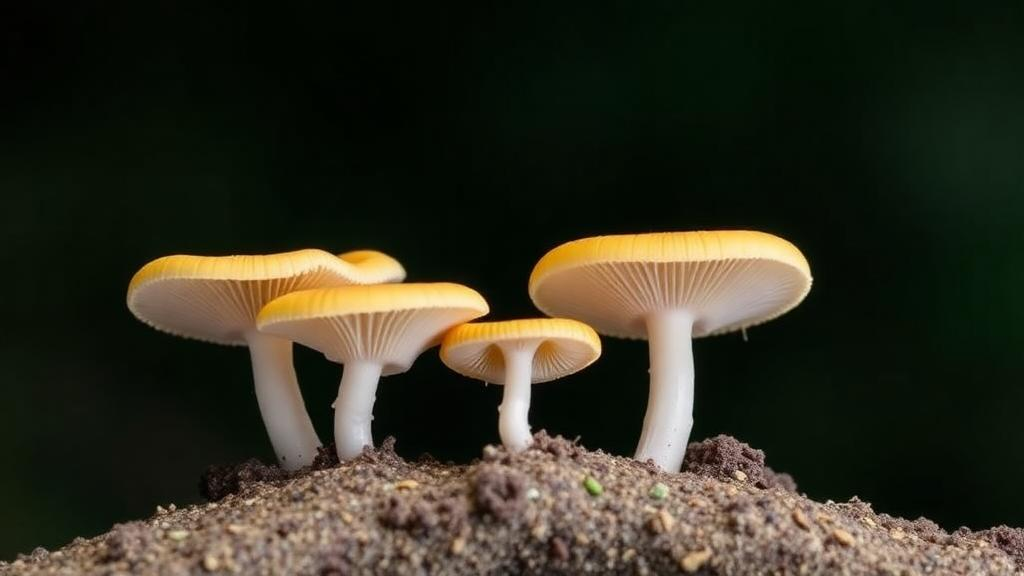
A mushroom-shaped mystery that has quietly troubled mycologists for more than half a century has finally been untangled, and the solution reads like a classic detective story: the suspect everyone thought they knew turned out to be several different characters wearing the same disguise. In a comprehensive taxonomic revision published in the journal MycoKeys, researchers led by Wanhao Chen, Yafeng Han and Jingde Liang report that the genus Tolypocladium, a group of soil-dwelling and insect-parasitizing fungi celebrated for producing the immunosuppressant drug cyclosporine, is not a single evolutionary lineage at all. Using a five-gene DNA analysis combined with meticulous microscopy, the team has proposed a new genus, described three brand-new species from the misty forests of Fanjing Mountain in Guizhou Province, China, and formally reassigned two species that had been sitting in the wrong family tree branch for decades.
The story of Tolypocladium begins in 1971, when the Dutch mycologist Walter Gams established the genus to house three soil fungi distinguished by a suite of distinctive microscopic features: sparingly branched spore-bearing stalks called conidiophores, swollen spore-producing cells known as phialides with conspicuously bent necks, and single-celled hyaline spores that gather together in slimy droplets at their tips. For decades, identifying members of this genus was largely a matter of matching these morphological traits and noting the host organism the fungus had killed or colonized. But as molecular phylogenetics swept through mycology in the 1990s and 2000s, cracks began to appear. Hodge and colleagues first connected the asexual Tolypocladium inflatum to its sexual stage, the fungus now known as Cordyceps subsessilis, revealing that this apparently simple mould was in fact part of a much larger lineage of entomopathogenic fungi.
The subsequent history of the genus is a case study in how the One Fungus-One Name principle, formally adopted by the International Code of Nomenclature for algae, fungi, and plants, has reshaped fungal classification. In 2007, Sung and Spatafora introduced the genus Elaphocordyceps for sexual species that parasitize Elaphomyces, the false truffles, along with certain arthropods, linking them to Tolypocladium anamorphs through multigene phylogeny. Seven years later, Quandt and colleagues synonymized Elaphocordyceps and another asexual genus, Chaunopycnis, under the older name Tolypocladium, consolidating the group within the family Ophiocordycipitaceae in the order Hypocreales. Recent surveys by Yu and colleagues in 2021 and Dong and colleagues in 2022 expanded the genus further, describing several new species and eventually bringing the count to 48 species worldwide, only nine of which had been reported from China.
Despite this growing census, one persistent problem loomed: molecular evidence kept hinting that Tolypocladium, as traditionally circumscribed, was polyphyletic, meaning its members did not all share a single recent common ancestor. The most conspicuous anomaly was Tolypocladium extinguens, a pathogen of the New Zealand glowworm Arachnocampa luminosa first described in 1984. Preliminary analyses by Dong and colleagues had already suggested it sat outside the core Tolypocladium lineage, but with limited sampling at the time, no formal move was made. This left mycologists with an uncomfortable question: how much of what they called Tolypocladium actually belonged together?
To answer it, the research team assembled one of the most taxonomically rich datasets ever built for this group, combining 202 fungal taxa and 3,424 DNA characters drawn from five loci: the internal transcribed spacer region and the large subunit ribosomal RNA gene, which are standard barcoding regions, plus three protein-coding genes, rpb1 and rpb2, which encode the two largest subunits of RNA polymerase II, and tef-1α, which encodes translation elongation factor 1-alpha. The specimens came from fieldwork on Fanjing Mountain in Jiangkou County, Tongren City, a UNESCO World Heritage site in southwestern China where dead insects infected with fungi were collected from the litter layer, transported in sterile bags, and cultured on potato dextrose agar under carefully controlled conditions of 25 degrees Celsius with alternating twelve-hour light and dark cycles.
The phylogenetic results were unambiguous. Using both Bayesian inference, run for ten million generations in MrBayes, and maximum likelihood analysis in IQ-TREE with 10,000 ultrafast bootstrap replicates, the team produced largely congruent trees showing that Tolypocladium species are scattered across three different families of Hypocreales: Ophiocordycipitaceae, Cordycipitaceae, and Clavicipitaceae. Two species in particular betrayed the genus. Tolypocladium extinguens, the glowworm pathogen, turned out to belong squarely within Cordycipitaceae, clustering near genera such as Dimorphspora, Flavocillium, Gamszarea and Parengyodontium. Meanwhile Tolypocladium lignicola, described in 1983 from rotting wood in Ontario, Canada, where it parasitizes bdelloid rotifers, landed firmly inside the genus Metapochonia in Clavicipitaceae.
The consequences were formal and deliberate. Because Tolypocladium extinguens could not remain in the genus that bears its name, the authors erected a new genus, Tolypocladiopsis, a name that acknowledges the morphological resemblance while signaling a fundamentally different evolutionary identity within Cordycipitaceae. The species is now Tolypocladiopsis extinguens. Similarly, Tolypocladium lignicola becomes Metapochonia lignicola, a new combination that mirrors the earlier transfer of another rotifer-associated species, Metapochonia parasitica, out of Tolypocladium. The team notes that the Bayesian support for Tolypocladiopsis was moderate, a limitation they attribute candidly to the fact that the ex-type strain of the species has only ITS and LSU sequences available, lacking the more informative protein-coding loci and represented by a single strain. Nevertheless, the lineage’s consistent recovery across analyses, its stable placement in Cordycipitaceae, and its unique paecilomyces-like reproductive structures and ellipsoidal to kidney-shaped spores justify its recognition.
The Fanjing Mountain expedition also delivered a bonanza of new species. The six newly collected strains formed three distinct, well-supported clades within Tolypocladium sensu stricto, each confirmed as a separate species using the Genealogical Concordance Phylogenetic Species Recognition approach, including a pairwise homoplasy index test that returned a value of 0.05942, just above the 0.05 threshold indicating the species are genuinely distinct rather than recombining populations. Tolypocladium guizhouense, with phialides averaging 17.6 by 1.9 micrometers, was found on a Cordyceps host. Tolypocladium tongrenense, bearing the shortest phialides at 11.9 by 1.1 micrometers and producing two distinct conidial types, infected a dead ant. Tolypocladium zongqii, named in honor of Professor Zongqi Liang for his contributions to arthropod-pathogenic fungus research, was isolated from a lepidopteran pupa and carries phialides measuring 13.1 by 1.6 micrometers with subglobose to ellipsoidal spores. Each species is anchored by holotype specimens deposited at the Institute of Fungus Resources at Guizhou University.
Beyond the formal nomenclature, the study delivers a broader lesson about the pitfalls of morphology-driven classification in fungi. The simple, reduced conidiogenous structures that characterize tolypocladium-like asexual forms have demonstrably evolved on multiple occasions across the Hypocreales, creating a case of convergent evolution so convincing that it fooled taxonomists for fifty years. The authors also report unexpected placements for other lineages, including Metarhiziopsis microspora, which forms a sister clade to Tolypocladium sensu stricto within Ophiocordycipitaceae despite its historically assumed position in Clavicipitaceae, and several other genera whose relationships remain stubbornly unresolved even with expanded sampling.
The discovery of three new Tolypocladium species from a single locality in Guizhou Province underscores how much fungal diversity remains undocumented in the biodiverse forests of southwestern China, where Fanjing Mountain may harbor further undescribed lineages. The research team has also provided a comprehensive taxonomic key covering all recognized Tolypocladium species, a practical tool for future surveys. As genomic-scale datasets and additional molecular markers become available, mycologists expect further realignments within Ophiocordycipitaceae, whose internal generic boundaries the authors describe as more complex than previously appreciated. For now, the revision stands as a vivid demonstration that in the fungal world, appearance can be profoundly deceptive, and that only by marrying classical microscopy with the molecular record can science begin to draw the true map of fungal life.
Subject of Research: Phylogenetic reassessment and taxonomic revision of the fungus genus Tolypocladium in the order Hypocreales
Article Title: Phylogeny and reassessment of the genus Tolypocladium s. lato.: Proposing a new genus, three new species and two combinations
Article References: Chen, W.-H., Xiong, C.-X., Shu, H.-L., Li, D., Zeng, Q., Liang, J.-D., Wijayawardene, N. N., Han, Y.-F., & Zhao, J.-H. (2026). Phylogeny and reassessment of the genus Tolypocladium s. lato.: Proposing a new genus, three new species and two combinations. MycoKeys, 141, 337-379. https://doi.org/10.3897/mycokeys.141.204222
Image Credits: AI Generated
DOI: 10.3897/mycokeys.141.204222
Keywords: Tolypocladium, mycology, phylogenetics, Ophiocordycipitaceae, Cordycipitaceae, Clavicipitaceae, new species, taxonomic revision, entomopathogenic fungi, Fanjing Mountain, Guizhou Province, Hypocreales
Cite Scienmag News
Roger Howard. (October 15, 2026). DNA reshuffles a famous fungus genus as scientists name a new genus and three new species. Scienmag. https://scienmag.com/dna-reshuffles-a-famous-fungus-genus-as-scientists-name-a-new-genus-and-three-new-species/
Roger Howard. "DNA reshuffles a famous fungus genus as scientists name a new genus and three new species." Scienmag, 15 October 2026, https://scienmag.com/dna-reshuffles-a-famous-fungus-genus-as-scientists-name-a-new-genus-and-three-new-species/. Accessed 15 October 2026.
Roger Howard. "DNA reshuffles a famous fungus genus as scientists name a new genus and three new species." Scienmag. October 15, 2026. https://scienmag.com/dna-reshuffles-a-famous-fungus-genus-as-scientists-name-a-new-genus-and-three-new-species/


