


…
The study region examined by van Broekhoven and colleagues occupies a distinctive position within the broader hydrogeology of the Indo-Gangetic Basin. The Upper Ganges-Yamuna interfluve, or doab, is one of several elongated landmasses bounded by the two great rivers of northern India, and its groundwater system is intimately connected to the alluvial sediments deposited over millions of years by the rivers themselves. These sediments, consisting of alternating layers of sand, silt, and clay, form a productive aquifer system capable of storing enormous volumes of water. That storage capacity is precisely what made the region so attractive for intensive agriculture, but it also means that changes in pumping behavior can propagate slowly through the system, with effects on water tables and river flows that unfold over decades rather than seasons.
The choice of 1830 as a starting point for the reconstruction is not arbitrary. The Eastern Yamuna canal, whose construction began in that year, represents the first large-scale engineered diversion of river water onto the interfluve in the modern era. Before that time, small-scale canal systems had existed since the Mughal period, but their reach was limited and their contribution to regional recharge modest. The nineteenth and early twentieth centuries saw a dramatic expansion of canal infrastructure across northern India, driven first by colonial revenue interests and later by food security concerns. Each new canal brought water to fields that had previously depended on rainfall or shallow wells, and in doing so, it quietly began to alter the subsurface water balance. Water that once flowed in rivers and evaporated from their surfaces now seeped through unlined canal beds and percolated downward from irrigated fields, adding substantial quantities of recharge to the aquifer beneath.
This phenomenon of unintended recharge from irrigation infrastructure has been documented elsewhere in the basin, but the analysis by MacAllister and colleagues of century-long observation well records in Punjab, Haryana, and central Pakistan provided some of the clearest evidence of its magnitude. Their work suggested that canal leakage may constitute the largest and longest-lasting anthropogenic recharge anywhere in the world. The new modeling study extends this insight eastward into the more humid conditions of Uttar Pradesh, where rainfall is higher and the relative contribution of canal leakage to total recharge differs from the drier northwest. In the Upper Ganges-Yamuna interfluve, monsoon precipitation remains a dominant recharge source, but canal seepage and irrigation return flow together add a substantial anthropogenic component that would not exist in an undeveloped landscape.
The modeling approach adopted by the researchers deserves some explanation for readers unfamiliar with groundwater simulation. MODFLOW 6, the code used in the study, is a widely applied finite-difference groundwater model developed by the United States Geological Survey. It divides the subsurface into a grid of cells and solves the equations governing groundwater flow between them, subject to boundary conditions such as rivers, recharge, and pumping wells. By running the model forward through time with reconstructed estimates of recharge and abstraction, the researchers could simulate how groundwater heads, storage, and the exchange of water between aquifers and rivers evolved across nearly two centuries. A key methodological feature is that the recharge and abstraction estimates were treated as uncertain external forcings, meaning the modelers acknowledged that historical water use figures, particularly for the nineteenth century, carry substantial imprecision. This uncertainty framing is important because it tempers the interpretation of specific simulated values while still allowing robust conclusions about the direction and broad timing of change.
The three-phase narrative that emerges from the simulations aligns well with the independent observational record. In the first phase, spanning roughly 1830 to the mid-twentieth century, canal construction dominated. Recharge exceeded abstraction, groundwater tables rose, and the hydraulic gradient between aquifers and rivers steepened in favor of the aquifer. Groundwater discharge to rivers, often called baseflow, increased. This is the component of river flow that sustains streams during dry periods, and it is ecologically critical because it delivers relatively cool, mineral-rich water that supports aquatic habitats. An increase in baseflow during this era would have made local rivers more perennial and more resilient to drought.
The second phase began around the 1970s, when tube well technology and rural electrification made groundwater pumping affordable and widespread across northern India. Farmers increasingly turned to wells because they offered control over timing and volume of irrigation that canal schedules could not match. The simulations indicate that abstraction grew rapidly, with irrigation accounting for roughly 85 percent of current withdrawals, municipal use about 15 percent, and industrial use less than 1 percent. These proportions underscore how thoroughly agriculture dominates the water economy of the region. As pumping intensified, it first consumed the surplus recharge created by the canals and then began drawing down the aquifer itself. Groundwater tables fell, and the hydraulic gradient between aquifer and river reversed in more and more locations.
The third phase, beginning around the year 2000, is the most consequential finding of the study. In the vicinity of local rivers, particularly the smaller tributaries such as the Hindon and its connections, the simulated exchange fluxes suggest a transition from gaining to losing conditions. A gaining river receives groundwater; a losing river leaks water into the aquifer beneath and beside it. This reversal is not merely a hydrological curiosity. It has direct implications for water quality, because rivers in this densely populated and industrially active region frequently carry high loads of untreated sewage and industrial effluent. When a polluted river loses water to the aquifer, contaminants travel with it into the groundwater body that many communities rely on for drinking water. The study’s authors point to this mechanism as a growing vulnerability, one that connects surface water pollution directly to the security of groundwater supplies.
The distinction between the large rivers and the small ones is worth emphasizing. Both the Ganges and the Yamuna show reduced groundwater exfiltration in the simulations, meaning their baseflow contributions have diminished, but neither has yet flipped to infiltrating conditions. Their large flows and regional extent buffer them against the local pumping effects that have overwhelmed smaller streams. The tributaries, by contrast, are smaller, shallower, and more sensitive to changes in the surrounding water table. When the water table drops below the riverbed elevation, the river begins to leak. This is why the finding that local rivers likely shifted around 2000 is both plausible and alarming: it marks the moment at which the cumulative effect of decades of pumping exceeded the recharge subsidy provided by the canals in the immediate vicinity of these streams.
The implications for environmental flows deserve careful consideration. Environmental flow refers to the quantity, timing, and quality of water flows required to sustain freshwater ecosystems and the livelihoods that depend on them. Reduced baseflow concentrates pollutants, raises water temperatures, and shrinks aquatic habitat during the long non-monsoon months. For a rainfed river like the Hindon, which depends heavily on groundwater discharge outside the monsoon season, the loss of baseflow can push the river toward episodic or seasonal flow regimes dominated by wastewater discharges rather than natural water. Such a transformation has cascading effects on fish, invertebrates, and the people who use the river for washing, irrigation, and religious purposes.
The study also fills an important geographical gap in the scientific record. Long-term groundwater monitoring data exist for the northwestern parts of the Indo-Gangetic Basin, in Punjab and Haryana, where observation wells extend back to the beginning of the twentieth century. The more humid eastern regions, including Uttar Pradesh, lack comparable records, and the behavior of their water systems under intensifying abstraction has been poorly constrained. By combining reconstructed historical forcings with physically based simulation, the researchers offer a way to extend understanding backward in time even where measurements are sparse. This approach cannot replace monitoring, but it provides a coherent framework for interpreting the changes that are now visible in satellite gravity data and in the lived experience of farmers who must dig ever deeper wells.
The GRACE satellite mission, launched in 2002, has been instrumental in revealing the scale of groundwater depletion across northern India, detecting a steady decline in total water storage over the past two decades. Those satellite observations, however, cover only a short slice of history and integrate signals over large areas. The value of the new study lies in resolving the two-century trajectory that led to the present state, and in separating the contributions of individual components: precipitation recharge, canal leakage, irrigation return flow, and sector-specific abstractions. This decomposition matters for management because different components respond to different policies. Canal leakage could, in principle, be reduced by lining canals or by capturing the seepage, while irrigation pumping responds to energy pricing, crop choice, and agricultural extension. Understanding which component dominates the water balance at a given time and place is a prerequisite for designing interventions that work.
There is also a restoration dimension to the findings. When water managers contemplate restoring a degraded river, they need realistic reference conditions against which to measure progress. The simulations suggest that the pre-canal baseline of the early nineteenth century featured lower water tables and different river-aquifer exchange patterns than anything seen since. A return to that state is neither feasible nor necessarily desirable given the region’s population and agricultural demands. But knowing how the system behaved before major human intervention, and how it responded to each successive wave of infrastructure and pumping, allows managers to set targets that are ambitious yet grounded in the actual dynamics of the aquifer and its rivers.
The connection between groundwater and surface water quality operates in both directions, and the study highlights this bidirectional coupling. Reduced baseflow means less dilution of pollutants entering rivers, so the same effluent load produces higher concentrations in the receiving water. Conversely, when rivers begin to infiltrate, they export their contamination into the aquifer, where it can persist for years or decades because groundwater moves slowly and natural attenuation processes are limited. Pollutants of concern in this region include pathogenic organisms from untreated sewage, nutrients from agricultural runoff, and industrial chemicals. Once these contaminants enter the aquifer, remediation is extraordinarily difficult and expensive, making prevention through protection of the exchange dynamics all the more valuable.
Looking forward, the trajectory described by the simulations raises questions about the future sustainability of water use in the interfluve. If pumping continues at current rates while recharge remains roughly constant, water tables will continue to decline, and more rivers will cross the threshold from gaining to losing. The monsoon provides a seasonal reset, recharging the aquifer each year, but the balance between annual recharge and annual abstraction determines the long-term trend. Management strategies that increase recharge, whether through enhanced canal seepage management, rainwater harvesting, or managed aquifer recharge structures, could help stabilize the system. Equally, demand-side measures that reduce irrigation withdrawals, such as crop diversification, improved irrigation efficiency, and solar pump regulation, would relieve pressure on the aquifer. The study does not prescribe specific policies, but by quantifying the historical roles of each water balance component, it provides the empirical foundation upon which such policies can be evaluated.
In the wider context of global groundwater science, this work contributes to a growing recognition that groundwater and surface water cannot be managed in isolation. The era in which rivers were treated as conveyance channels and aquifers as separate reservoirs is giving way to an integrated view in which the exchange between them is a central object of study and governance. The Upper Ganges-Yamuna interfluve, with its two-century history of engineered water use, offers a particularly instructive case. It demonstrates how infrastructure built for one purpose, canal irrigation, reshaped the subsurface water balance in ways that took decades to manifest, and how subsequent technological change, the spread of tube wells, reversed those gains. The lessons drawn here are relevant far beyond North India, wherever irrigated agriculture depends on the interplay between surface deliveries and groundwater pumping, and wherever the health of rivers depends on the invisible flows moving beneath their beds.
Subject of Research: Hydrology
Article Title: Changes in groundwater-surface water interactions following two centuries of irrigation practices and groundwater use in the Upper Ganges-Yamuna interfluve, North India
Article References: van Broekhoven, F. J. G., Dekker, S. C., Griffioen, J., Bhagwat, A., & Schot, P. P. (2026). Changes in groundwater-surface water interactions following two centuries of irrigation practices and groundwater use in the Upper Ganges-Yamuna interfluve, North India. Hydrology and Earth System Sciences, 30(20), 6315-6337. https://doi.org/10.5194/hess-30-6315-2026
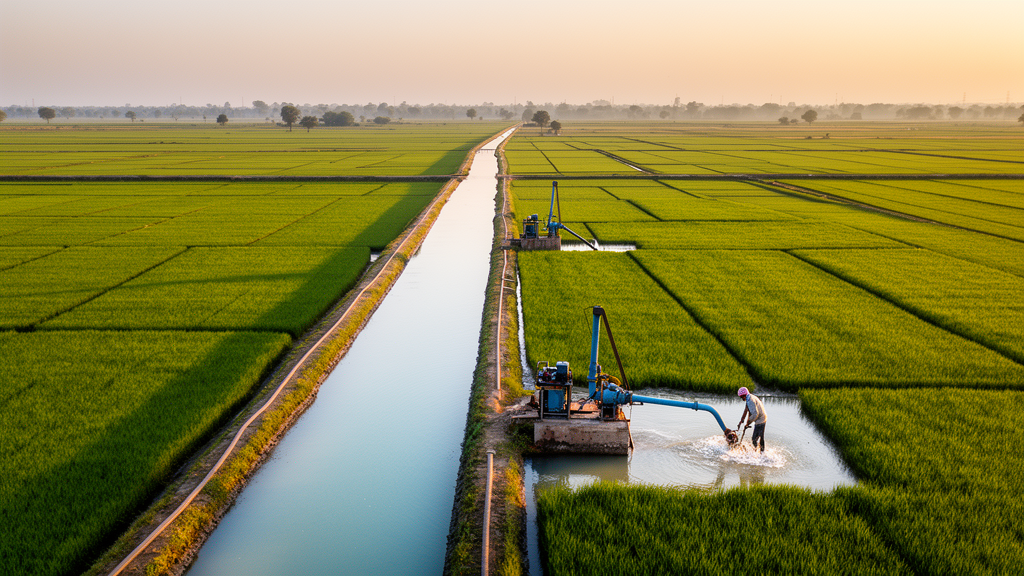
Image Credits: AI Generated
DOI: 10.5194/hess-30-6315-2026
Keywords: groundwater, Indo-Gangetic Basin, Hindon River, MODFLOW 6, irrigation, baseflow, water quality, Monte Carlo, Uttar Pradesh, environmental flows, Changes, groundwater-surface
Cite Scienmag News
Violet Maxwell. (October 15, 2026). Two Centuries of Canals and Pumps Have Reversed the Flow Beneath North India’s Rivers. Scienmag. https://scienmag.com/two-centuries-of-canals-and-pumps-have-reversed-the-flow-beneath-north-indias-rivers/
Violet Maxwell. "Two Centuries of Canals and Pumps Have Reversed the Flow Beneath North India’s Rivers." Scienmag, 15 October 2026, https://scienmag.com/two-centuries-of-canals-and-pumps-have-reversed-the-flow-beneath-north-indias-rivers/. Accessed 15 October 2026.
Violet Maxwell. "Two Centuries of Canals and Pumps Have Reversed the Flow Beneath North India’s Rivers." Scienmag. October 15, 2026. https://scienmag.com/two-centuries-of-canals-and-pumps-have-reversed-the-flow-beneath-north-indias-rivers/


