


When researchers at Rangsit University in Thailand surveyed 789 undergraduates about their mental health, they expected academic pressure, money worries, and social struggles to dominate the picture. What they found instead was a striking blind spot. Nearly half the students screened positive for clinically significant depressive symptoms, and the factor most strongly tied to symptom severity was not the coursework, the finances, or the relationships students readily named as stressful. It was the hours they spent on social media every day — a stressor they themselves ranked only fifth out of eight possible sources of strain.
The study, published in Frontiers in Child and Adolescent Psychiatry, used a mixed-methods design that combined a quantitative survey with in-depth interviews. All participants completed the 20-item Center for Epidemiologic Studies Depression Scale, or CES-D, a widely validated screening tool scored from 0 to 60. Scores of 16 or above indicate clinically significant symptoms, and 49.68 percent of the students — 392 of 789 — crossed that threshold. The researchers then sorted scores into three ordered categories: low symptoms (0–15), mild-to-moderate symptoms (16–26), and severe symptoms (27–60), and used ordinal logistic regression to identify which of thirteen variables independently predicted movement up that severity ladder.
The statistical results were unambiguous. Compared with students reporting more than three hours of daily social-media use, those using it less than one hour per day had dramatically lower odds of greater symptom severity, with an adjusted odds ratio of 0.125 (95 percent confidence interval: 0.040–0.391). Students in the one-to-three-hour band also fared better, with an odds ratio of 0.424 (95 percent CI: 0.278–0.647). In raw numbers, only 4.55 percent of light users fell into the severe category, versus 24.11 percent of heavy users. Daily social-media use showed the strongest adjusted association of any factor in the model — stronger than academic year, major of study, grade point average, or source of personal support.
Yet when students rated eight potential stress domains on a four-point agreement scale, internet and social-media use ranked only fifth, endorsed by just 37.01 percent of respondents. Relationship and social environment topped the list at 56.40 percent agreement, followed by financial and economic status (53.87 percent) and the educational system (50.19 percent). This perception–association mismatch — the gap between what students perceive as stressful and what the statistics reveal — is the study’s central contribution, and it may explain why digital wellbeing is so often overlooked in university mental-health programs.
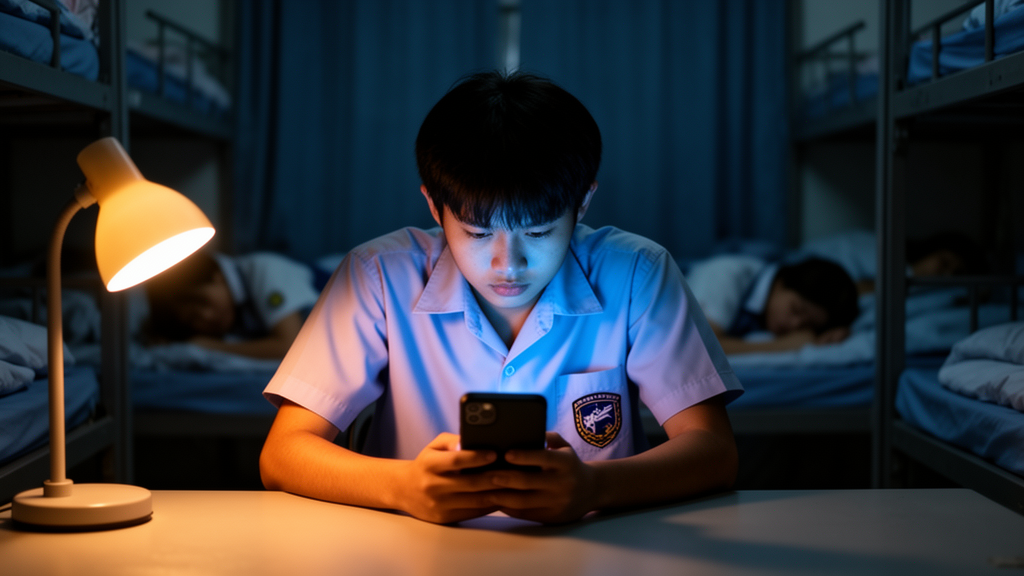
The qualitative strand of the study helps explain the blind spot. Twelve purposively selected students, six female and six male, aged 18 to 26, participated in semi-structured interviews covering social-media routines, online comparison, nighttime use and sleep, coping, and help-seeking. Thematic analysis revealed that social media was so deeply embedded in everyday student life — used after waking, during commutes, between classes, and before sleep for entertainment, news, communication, information seeking, academic tasks, and relief from boredom — that it was rarely identified as a source of stress. One participant captured the ambivalence: while using social media felt enjoyable, spending too long on it sometimes left a sense of having wasted time.
The interviews also revealed how the psychological impact of social media depends on patterns and interpretations of use rather than duration alone. Several students described upward social comparison when viewing posts about career success, travel, or desirable lifestyles, reporting feelings of pressure, inadequacy, or falling behind. One participant explained that seeing posts about good jobs or beautiful destinations sometimes triggered thoughts of not being good enough. But comparison was not universal. Another student consciously discounted online portrayals, noting that people usually post only the good things that happen to them, and therefore felt little pressure from others’ lives. Nighttime use emerged as a more consistent concern among heavier users, with late-night scrolling delaying sleep and producing fatigue, irritability, mental fog, and reduced concentration the next day — though some participants reported no sleep disturbance at all.
The third qualitative theme concerned how students manage emotional distress. Participants described a stepped pattern of coping: manageable distress was handled through self-directed strategies such as listening to music, drawing, watching videos, traveling, or eating enjoyable food, while social media itself could function as both a potential source of strain and a coping resource. When distress became harder to manage, close friends and family were approached first, and professional counseling was generally viewed as a later option. Reluctance to seek formal help was shaped by fear of judgment, privacy concerns, and kreng jai — the Thai cultural norm of not wanting to impose on others. This pattern aligns with the quantitative finding that students who confided in family (adjusted OR = 0.289, 95 percent CI: 0.161–0.519) or close friends (adjusted OR = 0.536, 95 percent CI: 0.309–0.929) had lower odds of greater symptom severity than those who consulted teachers or others.
Beyond social media, the regression model identified several other independent correlates of depressive-symptom severity. Students in the lowest grade point average band (2.00–2.49) had more than threefold higher odds of greater severity than those in the highest band (adjusted OR = 3.161, 95 percent CI: 1.933–5.165). Senior students showed higher odds than junior cohorts, and Health Sciences students had lower odds than the reference major (adjusted OR = 0.554, 95 percent CI: 0.384–0.801). Engineering and Technology students had the highest severe-symptom rate in bivariate comparisons at 35.66 percent, versus 11.59 percent for Health Sciences. No significant associations were found for sex, age, religion, hometown, smoking, alcohol use, or relationship status.
The authors are careful to note that these cross-sectional findings do not establish causality. Reverse or bidirectional relationships remain plausible: students experiencing more severe depressive symptoms may spend more time online for distraction, social connection, or coping, while prolonged or emotionally challenging online engagement may also worsen wellbeing. Unmeasured factors such as loneliness, sleep disturbance, academic stress, or pre-existing psychological distress could contribute to both greater social-media use and greater symptom severity. The study also measured social-media use only by daily duration, and the qualitative findings themselves demonstrate that similar duration can encompass very different psychological experiences. Convenience sampling at a single private Thai university further limits generalizability, and the CES-D is a screening instrument rather than a diagnostic interview.
Nevertheless, the perception–association mismatch carries practical weight for university counseling centers and digital-wellbeing programs. The findings support moving beyond the single question of how many hours students spend online to include timing, purpose, comparison processes, sleep-related effects, and emotional responses after engagement. Routine CES-D screening linked to clear referral pathways, digital-wellbeing workshops addressing self-awareness and healthy boundaries, peer and family gatekeeper training, and culturally responsive messaging that reduces stigma and normalizes help-seeking may all strengthen prevention. Because most participants were aged 18 to 20, spanning late adolescence and the transition to emerging adulthood, the evidence is also relevant to continuity in mental-health care as young people move from adolescent-oriented services to adult systems. Longitudinal, multi-institutional studies using richer measures of digital engagement — platform, activity type, timing, purpose, emotional response, and self-regulation — are needed to establish temporal ordering and test the proposed pathways. For now, the message is clear: the stressor students refuse to name may be the one most worth assessing.
Subject of Research: Mental Health
Article Title: A mixed-methods study of depressive-symptom severity among Thai university students and the underestimated role of social media
Article References: Boonkrong, P., Khunboonjun, K., Shakya, S., Yang, J., Vitoonmetha, N., & Chatchumni, M. (2026). A mixed-methods study of depressive-symptom severity among Thai university students and the underestimated role of social media. Frontiers in Child and Adolescent Psychiatry, 5, Article 1907727. https://doi.org/10.3389/frcha.2026.1907727
Image Credits: AI Generated
DOI: 10.3389/frcha.2026.1907727
Keywords: depression, social media, university students, Thailand, mental health, digital wellbeing, CES-D, mixed methods, mixed-methods, depressive-symptom, severity, Thai
Cite Scienmag News
Glenn Wilkins. (October 15, 2026). Social Media Is the Stressor Thai Students Refuse to Name. Scienmag. https://scienmag.com/social-media-is-the-stressor-thai-students-refuse-to-name/
Glenn Wilkins. "Social Media Is the Stressor Thai Students Refuse to Name." Scienmag, 15 October 2026, https://scienmag.com/social-media-is-the-stressor-thai-students-refuse-to-name/. Accessed 15 October 2026.
Glenn Wilkins. "Social Media Is the Stressor Thai Students Refuse to Name." Scienmag. October 15, 2026. https://scienmag.com/social-media-is-the-stressor-thai-students-refuse-to-name/


