


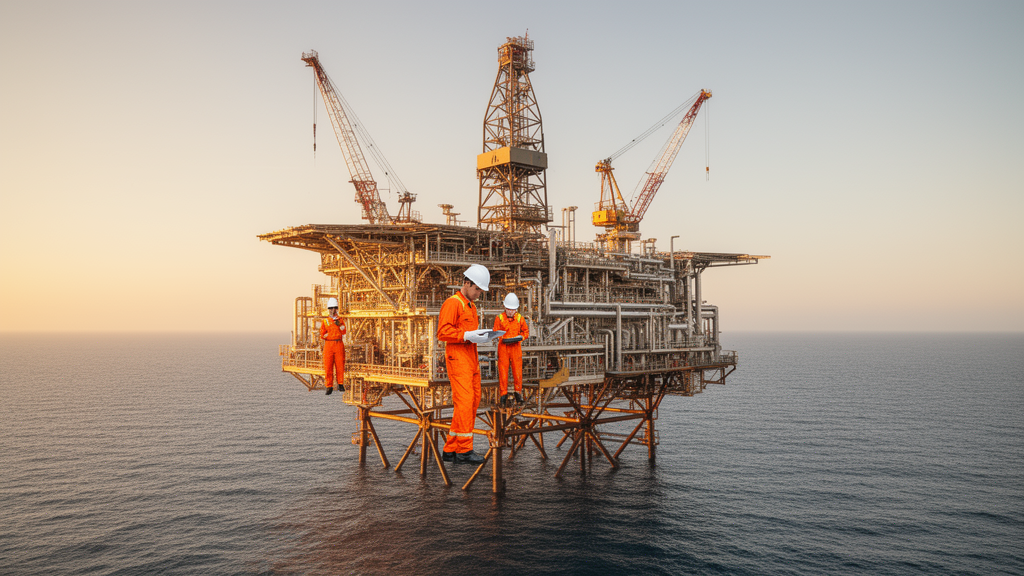
The steel skeleton that holds an offshore wind turbine or an oil and gas platform above the waves is deceptively simple in concept and staggeringly expensive in practice. Hundreds of tonnes of steel, formed into jackets, monopiles, spar buoys, semi-submersibles and tension leg platforms, must be procured, welded, transported out to sea and installed in some of the harshest working environments on Earth. All of this falls under capital expenditure, or CAPEX, which typically accounts for roughly 70 percent of the total lifecycle cost of these structures, with operations and maintenance taking 20 to 30 percent and decommissioning about 5 percent. Getting CAPEX right at the design stage, when a single line on a drawing can still move millions of dollars, is therefore one of the most consequential decisions in offshore engineering.
A new review published in Frontiers in Energy Research has now taken the most comprehensive look yet at how researchers actually model those costs. Engineers at the University of Wollongong in Australia systematically surveyed 99 peer-reviewed studies published mainly between 2000 and 2026, covering cost models for both fixed foundations such as jackets and monopiles and floating platforms including spar buoys, semi-submersibles and tension leg platforms. Their verdict is striking: the field’s favourite cost model, in two out of three cases, is also its crudest. Material costs appear in 98 percent of the studies reviewed, but 66.7 percent of studies rely on material cost alone, essentially equating the price of a platform with the price of its steel.
That weight-based approach has an obvious appeal. It requires nothing more than structural mass and a steel price, which makes it ideal for early-stage design studies and for comparing optimisation algorithms. The review documents how researchers have used it to pit genetic algorithms against particle swarm optimisation, colliding bodies optimisation, simulated annealing, ant colony methods and gradient-based sequential quadratic programming, all racing to shave tonnes off jacket legs and braces. It also underpins topology optimisation, where material is redistributed within a design space rather than resized member by member. But the simplicity comes at a price, because the mass of steel tells you almost nothing about what it actually costs to turn that steel into a finished structure bolted to the seabed.
Manufacturing is the most glaring omission. Processes such as blasting, cutting, welding and painting can account for more than 30 percent of the total production cost of welded steel structures, and for offshore wind turbines specifically, welding and bending make up 46 percent of manufacturing costs. Yet only 29 percent of the reviewed studies include manufacturing at all. The detailed models that do exist mostly descend from a time-based costing framework developed by Jármai and Farkas, which estimates the hours needed for preparation, assembly, tacking, welding, flattening, painting and cutting, and multiplies them by labour and equipment rates. Adaptations of this method have been applied to ring-stiffened cylindrical shells for platform columns, spar hulls and semi-submersibles, while other studies estimate weld volumes from the geometry of tubular joints or use activity-based costing borrowed from shipyards. Simpler studies multiply material cost by a manufacturing complexity factor, with values ranging from 1.1 for a spar buoy to 4.0 for a jacket relative to a monopile baseline.
Transport and installation fare even worse. These operations typically consume 10 to 16 percent of total CAPEX, yet they appear in only 16 and 20 percent of studies respectively. The review attributes this neglect to the sheer difficulty of modelling them: costs hinge on vessel day rates, weather windows, towing distances and mobilisation fees, all of which fluctuate with unsteady market conditions. The most rigorous approaches calculate vessel-based costs from day rates, travel time and weather downtime, distinguishing between floating platforms that can be towed to site by tugboats and fixed foundations that demand specialised barges and heavy-lift vessels. At the other extreme, some studies lump transport and installation into a single term pegged to structural mass or to turbine capacity, at rates such as 2.5 million euros per megawatt for spar platforms. Most strikingly, only 14.1 percent of the reviewed studies include all four CAPEX components together.
To make the comparison rigorous, the Australian team introduced a new quantitative framework combining cost model completeness, modelling detail and structural complexity, producing a composite score that ranges from zero to one. Plotted against the number of CAPEX components each study covers, the results reveal a field clustered in the bottom-left corner: most work considers material cost only, and even studies that cover more components rarely model them in full detail. The top-right corner, representing complete CAPEX coverage with fully detailed modelling of every component, is empty. Fewer than 5 percent of studies combine all four components with high detail scores, and none achieved a fully detailed treatment across the board.
The review also exposes asymmetries between fixed and floating technology. Offshore wind dominates the literature, appearing in 77 percent of the studies, and jackets and semi-submersibles attract the most attention because their complex welding and assembly make cost modelling more critical. Yet internal structures of floating platforms, such as stiffeners and bulkheads that are essential for structural integrity, show up in only 12 percent of CAPEX calculations, always alongside the hull, which itself appears in 96 percent of models. Mooring lines are considered in half of the floating platform studies and anchors in just 30 percent. On the fixed side, pile detail is included in only a small share of jacket cost models, and monopiles and tension leg platforms remain comparatively understudied despite their industrial importance.
Uncertainty adds another layer of neglect. Every CAPEX model, however detailed, ultimately depends on steel prices, labour rates and vessel day rates that swing with markets and geography, yet most studies treat these inputs as fixed constants. Only a handful of the reviewed works tested the consequences, using probabilistic distributions, bounded sensitivity ranges of around 10 percent, or one-at-a-time parameter sweeps. Across those that did, material and substructure costs emerged most often as the dominant driver of the final estimate. The review argues that robust optimisation, in which cost uncertainty is built directly into the design process rather than examined afterwards, remains largely unexplored for offshore support structures.
The recommendations that follow are straightforward. Future cost models should cover manufacturing, transportation and installation together rather than defaulting to steel mass, treat internal floating platform components as standard rather than optional, adopt detailed vessel-based transport and installation models especially for fixed foundations, model jacket piles explicitly, and extend established manufacturing costing methods beyond the dominant Jármai-Farkas lineage. The authors also call for cutting, assembly and coating to receive more consistent attention, since these operations shape real fabrication bills even if welding dominates.
Why does this matter beyond the journals? Steel jacket support structures alone can account for 19 percent of the total cost of an offshore wind farm, and as floating wind pushes into deeper waters with new platform concepts appearing every year, the economic penalty of optimising against an incomplete cost picture grows. A design that minimises tonnes of steel may unwittingly inflate welding hours, barge days or weather-exposed installation windows. By mapping exactly where the literature’s blind spots lie, this review gives designers and researchers a checklist for building cost models that reflect what an offshore project actually costs, a small change in method that could translate into large savings across a rapidly expanding global industry.
Subject of Research: CAPEX cost models for steel support structures of offshore energy platforms
Article Title: Cost-driven design and optimization of steel support structures for offshore energy platforms: a review of CAPEX cost models
Article References: Asgari Motlagh, A., McCarthy, T., & Ahmed, A. (2026). Cost-driven design and optimization of steel support structures for offshore energy platforms: a review of CAPEX cost models. Frontiers in Energy Research, 14, Article 1917780. https://doi.org/10.3389/fenrg.2026.1917780
Image Credits: AI Generated
DOI: 10.3389/fenrg.2026.1917780
Keywords: offshore wind, CAPEX, cost models, steel structures, jacket platforms, monopiles, semi-submersibles, floating wind, manufacturing costs, installation, structural optimisation, offshore energy
Cite Scienmag News
Denise Maddox. (October 15, 2026). Offshore platform cost models lean too heavily on steel weight, review finds. Scienmag. https://scienmag.com/offshore-platform-cost-models-lean-too-heavily-on-steel-weight-review-finds/
Denise Maddox. "Offshore platform cost models lean too heavily on steel weight, review finds." Scienmag, 15 October 2026, https://scienmag.com/offshore-platform-cost-models-lean-too-heavily-on-steel-weight-review-finds/. Accessed 15 October 2026.
Denise Maddox. "Offshore platform cost models lean too heavily on steel weight, review finds." Scienmag. October 15, 2026. https://scienmag.com/offshore-platform-cost-models-lean-too-heavily-on-steel-weight-review-finds/


