


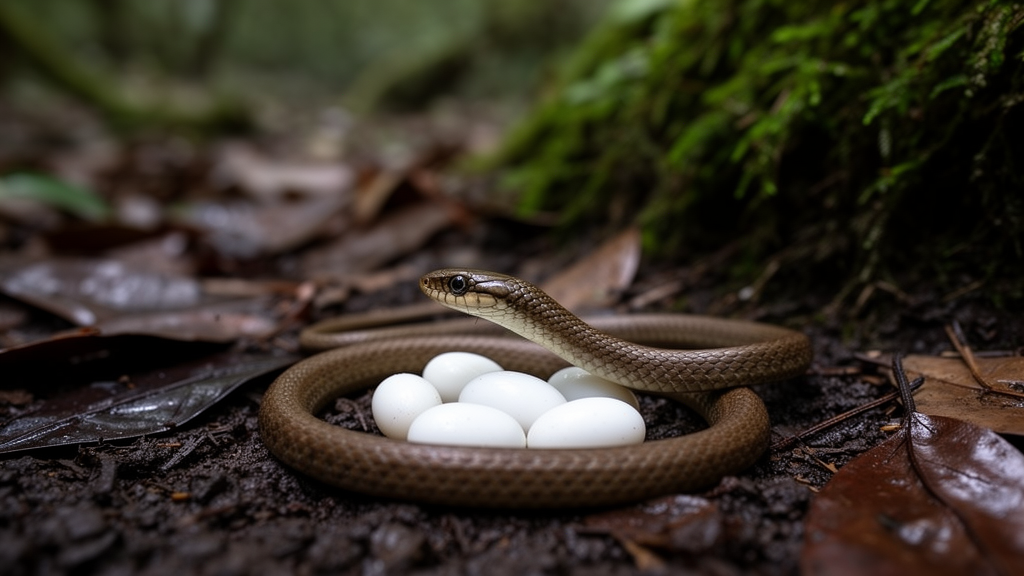
Deep in the subtropical montane forests of Zhangmu Town, on the southern slopes of China’s Xizang Autonomous Region near the Nepal border, one of the world’s most recently discovered snakes has finally begun to give up its secrets. Trachischium nyalamense, a small fossorial species described only in 2024 from a single adult male, was known for years from just one specimen. Now, field surveys in July 2025 and June 2026 have yielded three adult females and one additional male, along with a clutch of seven fertilised eggs found beside a gravid female under a rotten log. Three of those eggs hatched successfully under artificial incubation, giving researchers their first look at the juvenile stage of a snake whose biology had remained almost entirely unknown.
The new findings, published in the journal Zoosystematics and Evolution, provide a detailed re-description of the species, including the first data on its skull morphology, dentition, hemipenial anatomy and reproductive biology. Because Trachischium snakes are secretive, burrowing animals that feed on worms and other soft-bodied invertebrates, they are notoriously difficult to collect, and their taxonomy and natural history have long remained poorly studied. The new material therefore represents a significant expansion of scientific knowledge about a genus whose species diversity and evolutionary relationships are still incompletely resolved.
To confirm the identity of the newly collected specimens, the researchers turned to mitochondrial DNA. Fragments of the 16S ribosomal RNA and cytochrome b genes were amplified, sequenced and analysed alongside 43 previously published sequences from across the genus, using both Maximum Likelihood and Bayesian Inference methods. The results were unambiguous: all four new specimens clustered with the holotype of T. nyalamense with strong statistical support, and no genetic differentiation was detected between the new samples and the type specimen, with uncorrected p-distances of 0.0% for both mitochondrial markers. The closest relative in the phylogeny proved to be T. fuscum, from which T. nyalamense differs by 1.5% in 16S sequences, while distances to other congeners ranged up to 6.0% for 16S and 17.1% for cytochrome b.
Morphological examination of the four adults confirmed their assignment to the species, with differences from the original description attributable to normal sexual dimorphism. The females are larger than males, with snout-vent lengths of 375 to 395 millimetres compared with 324 to 330 millimetres in the two known males. Females also possess more ventral scales, 152 to 153 versus 150, fewer pairs of subcaudal scales, 33 to 34 versus 38 to 39, and proportionally shorter tails, with tail length to total length ratios of 0.134 to 0.143 versus 0.158 to 0.165. These patterns are consistent with sexual dimorphism documented in other species of the genus, though the authors caution that additional specimens are needed to determine whether these differences are stable across the species.
One particularly intriguing character emerged from the comparison of scale keeling. In the newly examined male, the lateral dorsal scales in the cloacal and basicaudal regions, near the vent and at the base of the tail, are weakly keeled, whereas the corresponding scales in all three females are completely smooth. Similar sex-related differences have been documented in T. fuscum, T. guentheri, T. tenuiceps and T. laeve, suggesting that this character may also be sex-related in T. nyalamense. Because the original description of the holotype did not separately document the condition of these scales, the authors recommend that the type specimen be re-examined, and they urge future studies of the genus to record scale keeling in these regions together with the sex of the specimen, since this character has played a role in species descriptions and comparisons throughout the taxonomic history of Trachischium.
The study also provides the first CT-based data on the skull of the species. Using micro-computed tomography on an adult female, the researchers reconstructed the cranial skeleton in three dimensions at a resolution of 11.0 micrometres, revealing an elongate, subcylindrical skull with a projecting, rounded premaxilla, flattened conchal processes of the septomaxillae, a large shield-like parietal, and a slender, lanceolate pterygoid whose posterior wing expands posterolaterally. The dentition consists of slender, sharply pointed, laterally compressed teeth that are posteriorly recurved at the tips, with continuous maxillary tooth rows lacking an obvious diastema. Tooth counts were 24 maxillary teeth on each side, 16 palatine teeth, 29 to 30 pterygoid teeth and 25 to 26 dentary teeth. The prefrontal bone bears an anterior projection similar to that of T. fuscum, a character whose taxonomic significance within the genus remains to be tested with additional cranial data.
The reproductive observations are equally novel. On 3 July 2025, a gravid female was discovered under a rotten log beside a clutch of seven milky-white, elongate-oval eggs adhering to one another. The eggs, with a mean length of 25.2 millimetres, a mean width of 8.0 millimetres and a mean mass of approximately 1.7 grams, were transported to Qinghai University in Xining and incubated at approximately 20 degrees Celsius on a moist mixture of coarse vermiculite and perlite. Between the night of 3 September and the early morning of 4 September 2025, hatchlings emerged from three eggs after roughly two months of incubation. The remaining four eggs failed to hatch: one fully developed hatchling died inside its egg, two became mouldy, and one shrivelled. The authors suggest that the transfer of the eggs from the humid southern Himalayan slope to the dry inland plateau environment, together with differences in substrate, temperature and humidity, may have contributed to mould development or desiccation.
The three captive-hatched juveniles, examined at 20 days old, measured 100 to 106 millimetres in snout-vent length and showed head scalation generally consistent with that of adult females, though minor abnormalities were observed in two specimens, including a horizontally divided supralabial and a fusion of paired subcaudal scales. Their colouration differed notably from that of adults. While both juveniles and adults display eight black longitudinal stripes over a greyish-brown dorsum with a distinct metallic iridescence, the juveniles possess a striking yellowish-white nuchal collar behind the head, a feature absent in adults. Nuchal collars have been reported in juveniles or smaller individuals of several other Trachischium species, including T. fuscum, T. guentheri, T. monticola, T. hmuifang and T. reticulata, suggesting that T. nyalamense undergoes ontogenetic colour change. However, newly hatched T. reticulata lack a nuchal collar, indicating that this character may not be consistently present throughout the juvenile stage across the genus.
The newly collected adults were all found in subtropical moist montane forest near Zhangmu Town, at elevations of approximately 2000 to 2320 metres. One female was discovered in a homestay courtyard in the early morning, another was found in roadside vegetation at night, and the gravid female was detected under a rotten log after rain had cleared in the afternoon. None showed obvious defensive behaviour; the gravid female attempted to escape by burrowing into the soil. The male specimen was found as a fresh roadkill in the early hours of 16 June 2026, a sobering reminder of the threats that roads pose to small, cryptic snakes. Other snake species observed in the same habitat included the montane pitviper Ovophis monticola, the Tibetan pitviper Trimeresurus tibetanus, the keelback Herpetoreas platyceps and the agamid lizard Japalura tricarinata.
Currently, T. nyalamense is known only from the vicinity of Zhangmu Town, though similar forest habitats occur across the nearby Nepal border, and the authors suggest the species may also be present in adjacent regions of Nepal. The species is not yet listed on the IUCN Red List, and available data remain insufficient to evaluate its population size, trend, full geographic range or habitat requirements. The researchers recommend that it be considered Data Deficient in future formal conservation assessments, and they emphasise that further field surveys in the central Himalayas are needed to clarify its actual distribution. For a species described from a single male just two years ago, the sudden availability of females, eggs, hatchlings and high-resolution cranial data marks a remarkable leap forward, and it offers a template for how integrative taxonomy, combining molecular phylogenetics, morphology and reproductive biology, can transform our understanding of the Himalaya’s most elusive burrowing snakes.
Subject of Research: Re-description of Trachischium nyalamense Guo, Liu, Jin, Shu, Wu & Che, 2024 ( Serpentes , Natricidae ), with notes on skull morphology and reproductive biology
Article Title: Re-description of Trachischium nyalamense Guo, Liu, Jin, Shu, Wu & Che, 2024 ( Serpentes , Natricidae ), with notes on skull morphology and reproductive biology
Article References: Sun, F., Chen, M., Weng, S., Wei, C., & Peng, L. (2026). Re-description of Trachischium nyalamense Guo, Liu, Jin, Shu, Wu & Che, 2024 (Serpentes, Natricidae), with notes on skull morphology and reproductive biology. Zoosystematics and Evolution, 102(5), 1247-1263. https://doi.org/10.3897/zse.102.207395
Image Credits: AI Generated
Keywords: Re-description, Trachischium, nyalamense, Serpentes, Natricidae, notes, skull, morphology, reproductive, biology, scientific research
Cite Scienmag News
Drew Townsend. (October 15, 2026). Himalayan worm-eating snake finally reveals its females, eggs and hidden skull secrets. Scienmag. https://scienmag.com/himalayan-worm-eating-snake-finally-reveals-its-females-eggs-and-hidden-skull-secrets/
Drew Townsend. "Himalayan worm-eating snake finally reveals its females, eggs and hidden skull secrets." Scienmag, 15 October 2026, https://scienmag.com/himalayan-worm-eating-snake-finally-reveals-its-females-eggs-and-hidden-skull-secrets/. Accessed 15 October 2026.
Drew Townsend. "Himalayan worm-eating snake finally reveals its females, eggs and hidden skull secrets." Scienmag. October 15, 2026. https://scienmag.com/himalayan-worm-eating-snake-finally-reveals-its-females-eggs-and-hidden-skull-secrets/


