


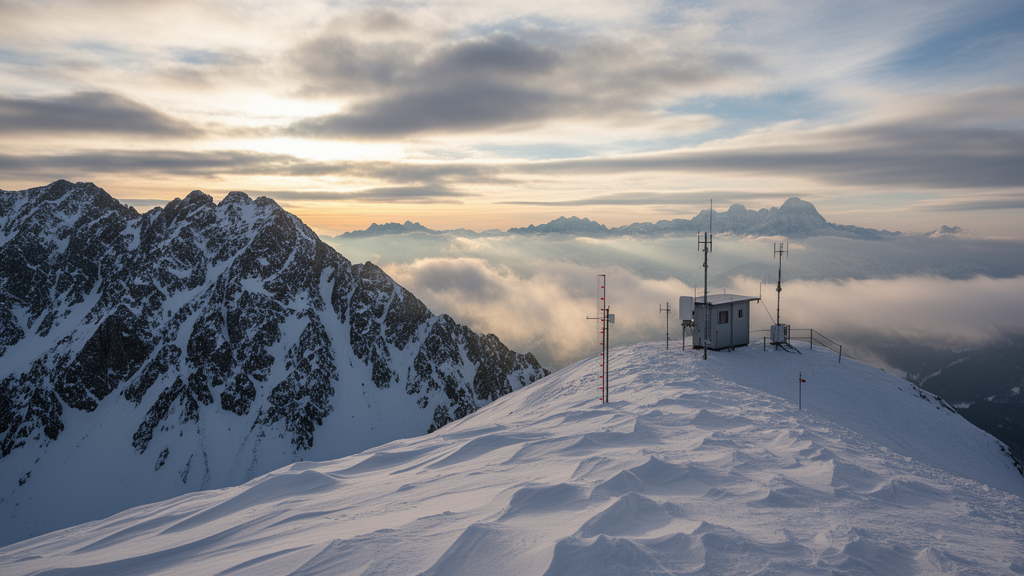
Snowmelt from the world’s mountains supplies water to billions of people, yet scientists still struggle to answer a deceptively simple question: how much snow is actually up there? A new study published in The Cryosphere by David R. Casson of the University of Calgary and colleagues tackles this problem head-on by building meteorological uncertainty directly into physically based mountain snow modeling. Rather than feeding a snow model a single, seemingly perfect weather dataset, the team generates dozens of plausible weather realities and lets them compete, producing probabilistic estimates of snow accumulation and melt that finally acknowledge how little we truly know about precipitation falling in complex terrain.
The core insight driving the research is that meteorological forcing is a dominant source of uncertainty in snow simulations. Mountain weather varies wildly with topography, observations are sparse and biased, and snow models themselves carry structural and scale limitations. Traditional approaches rely on deterministic gridded products that smooth spatial variability, underestimate extremes, and lack any explicit characterization of uncertainty. These biases propagate through snowpack simulations, making the weather inputs themselves a critical weak link. The new framework addresses this by generating meteorological ensembles specifically designed for mountainous terrain, accounting for topographic effects, wind-induced gauge undercatch, and large-scale atmospheric patterns.
The technical workflow begins with a crucial correction step. Precipitation gauges systematically underestimate snowfall, particularly in cold and windy environments where wind blows flakes past the instrument opening. The team applies standardized transfer functions derived from World Meteorological Organization Solid Precipitation Intercomparison studies, relating catch efficiency to wind speed and air temperature for specific gauge types and shielding configurations. In the Bow Basin in the Canadian Rockies, the WMO SPICE transfer function was applied for assumed unshielded Geonor and Pluvio gauges, while the Chena in Interior Alaska and the Tuolumne in the Sierra Nevada used the WMO standard rain gauge correction for assumed unshielded US standard 8-inch gauges. Because global station datasets lack consistent gauge metadata, the team assumed a single gauge configuration per basin, a pragmatic simplification that still captures the dominant effect of wind on snowfall measurement.
Wind observations at gauge height were used where available, while ERA5 reanalysis winds translated to gauge height supplemented gaps for stations lacking co-located measurement data. ERA5 temperatures, lapsed to station elevation, helped estimate precipitation phase and apply temperature-dependent correction factors. The results showed that reanalysis winds tended to underestimate high wind speeds relative to observations, resulting in conservative catch-efficiency estimates. Using daily maximum wind speeds rather than means better reflected the storm conditions during which snowfall occurs, reducing this bias. Even with these adjustments, the corrections improved the magnitude of cold-season precipitation estimates, an established and influential source of bias in mountainous snowfall measurement.
With corrected station data in hand, the team turned to geospatial probabilistic estimation to generate gridded meteorological fields. Station observations were combined with static topographic predictors derived from the MERIT Digital Elevation Model and dynamic atmospheric predictors from reanalyses. The researchers systematically screened topographic descriptors including elevation, latitude, longitude, directional derivatives, aspect, slope, and Topographic Position Index, applying two-dimensional Gaussian filters of varying radii to suppress small-scale noise while retaining large-scale orographic gradients. Predictor selection used cross-validation error in a sequential forward screening procedure, starting from an empty model and adding predictors one at a time, retaining only those that improved the augmented Kling-Gupta Efficiency by more than 0.01.
The team compared two estimation approaches: locally weighted regression, the traditional method that fits separate models at each grid cell using distance-based weights, and random forests, a machine learning technique that builds an ensemble of decision trees trained on all available data. The random forest approach systematically outperformed locally weighted regression once multiple predictors were available, particularly for precipitation. Adding dynamic predictors from reanalyses further shifted performance distributions toward higher skill, indicating that reanalysis fields add useful information about event occurrence beyond static topography and climatology alone. For temperature, elevation remained the dominant control, reflecting the adiabatic lapse rate, while precipitation benefited from interactions between orography and large-scale meteorology captured through reanalysis precipitation rate and surface pressure.
Ensembles were generated at approximately one kilometer resolution with a daily timestep using the open-source Geospatial Probabilistic Estimation Package. The framework combines deterministic mean estimates with uncertainty calculated from station error and a stochastic component represented by spatially correlated random fields. These random fields impose correlation among neighboring grid cells using an exponential correlation model, with correlation lengths estimated empirically from station data. For intermittent variables like precipitation, the distribution is decomposed into probability of occurrence and conditional distribution of nonzero values, with the latter transformed to normal space using Box-Cox transformations. Fifty-member ensembles of daily precipitation and temperature were generated over each study area, and verification using the Brier Skill Score against station observations yielded predominantly positive values, confirming that the ensembles are both skillful and reliable relative to climatology.
The resulting ensembles then drove the SUMMA energy-balance snow and hydrological modeling framework, which represents snow accumulation, interception, metamorphism, and ablation through explicit energy balance calculations. The snowpack is represented as a dynamic set of layers with specific physical properties, allowing detailed simulation of compaction, sublimation, meltwater, and refreezing. Calibration of eleven snow-related parameters used a Large Sample Emulator approach, which jointly leverages model simulations from a large sample of locations using machine learning to emulate a comprehensive model response surface. The emulator was trained on 162,000 SUMMA runs across 162 snow gauges drawn from the Northern Hemisphere Historical In Situ Snow Water Equivalent Dataset and quality-controlled SNOTEL stations, then used to search for locally appropriate parameter sets at each model unit based on climatic and physiographic attributes.
The framework was applied in three contrasting mountain basins chosen to represent a broad range of hydroclimatic and monitoring contexts: the Chena above Two Rivers in Interior Alaska, a subarctic watershed with discontinuous permafrost where snowmelt dominates hydrology; the Bow above Calgary in the Eastern Canadian Rockies, where snowmelt accounts for roughly 80 percent of river inflow; and the Tuolumne above Hetch Hetchy in the Sierra Nevada, where 80 to 90 percent of annual precipitation falls as snow. Ensemble-forced SUMMA simulations reproduced observed snow water equivalent with realistic magnitude, timing, and uncertainty. In the Chena and Tuolumne, the ensembles better captured the range of low- and high-accumulation years, including years when deterministic forcings substantially under- or overestimated peak snow water equivalent. Quantitative evaluation showed that random forest ensembles provided comparable or improved representation of peak snow water equivalent magnitude relative to ERA5 and CaSR reanalysis benchmarks.
The implications extend beyond academic interest. Probabilistic snow estimates with credible uncertainty bounds are directly usable in data assimilation, seasonal outlooks, and risk analyses, supporting water resource management, hydrological forecasting, and hazard mitigation. The approach advances mountain snow estimation by explicitly representing forcing uncertainty in complex terrain, bridging the gap between sparse observations and the complex terrain processes that govern snow distribution. As climate change increases the frequency of rain-on-snow events and alters snowpack dynamics across mountain ranges worldwide, quantifying uncertainty in snow estimates becomes ever more critical for managing water scarcity, predicting flood risk, and planning for the trillion-dollar question of how much water mountains hold in frozen storage.
Subject of Research: Propagating meteorological uncertainty in physically based mountain snow modeling
Article Title: Propagating meteorological uncertainty in physically based mountain snow modeling
Article References: Casson, D. R., Tang, G., Vásquez, N., Wood, A. W., & Clark, M. P. (2026). Propagating meteorological uncertainty in physically based mountain snow modeling. The Cryosphere, 20(10), 5895-5940. https://doi.org/10.5194/tc-20-5895-2026
Image Credits: AI Generated
Keywords: Propagating, meteorological, uncertainty, physically, based, mountain, snow, modeling, scientific research
Cite Scienmag News
Violet Maxwell. (October 15, 2026). Propagating meteorological uncertainty in physically based mountain snow modeling. Scienmag. https://scienmag.com/propagating-meteorological-uncertainty-in-physically-based-mountain-snow-modeling/
Violet Maxwell. "Propagating meteorological uncertainty in physically based mountain snow modeling." Scienmag, 15 October 2026, https://scienmag.com/propagating-meteorological-uncertainty-in-physically-based-mountain-snow-modeling/. Accessed 15 October 2026.
Violet Maxwell. "Propagating meteorological uncertainty in physically based mountain snow modeling." Scienmag. October 15, 2026. https://scienmag.com/propagating-meteorological-uncertainty-in-physically-based-mountain-snow-modeling/


